Madeira Flag: Blue and Yellow Stripes, Cross of Christ & History
Madeira’s regional flag has three vertical bands and a distinctive Cross of Christ. Explore the official 1978 law, the colours’ meanings and Portuguese island identity.
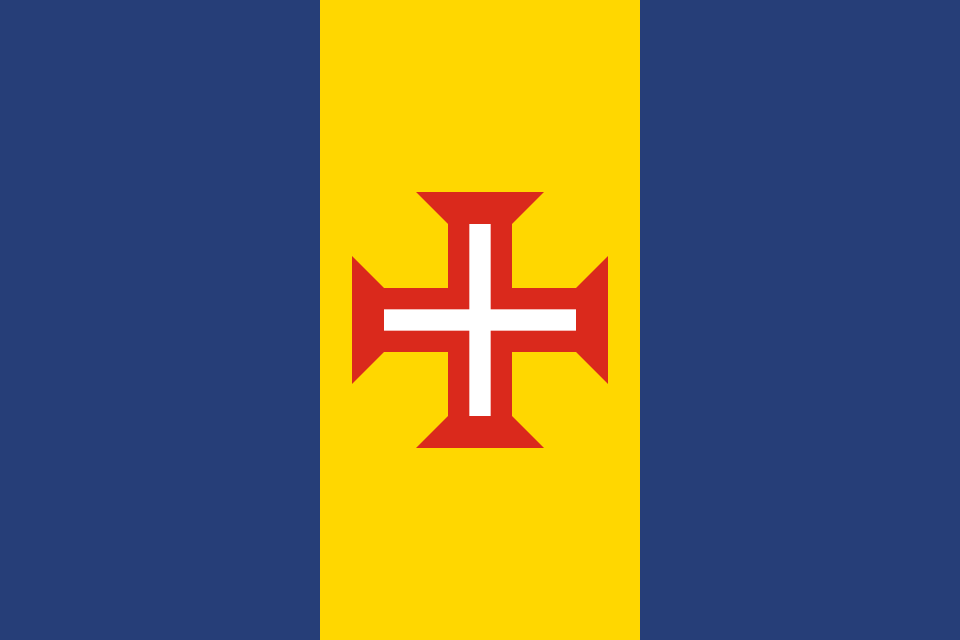
Madeira is an autonomous region of Portugal in the Atlantic Ocean. Its own flag is flown alongside the Portuguese national flag and is recognizable by the two blue side panels framing a gold middle section.
Unlike many informal explanations, Madeira’s 1978 regional law explicitly sets out both the flag’s construction and its symbolic rationale. The official text is available in Portugal’s Diário da República.
Madeira flag at a glance
| Feature | Details |
|---|---|
| Region | Madeira (Região Autónoma da Madeira) |
| Status | Autonomous Region of Portugal |
| Capital | Funchal |
| Design | Blue-gold-blue vertical tricolour |
| Band widths | Three equal sections |
| Centre emblem | Cross of the Order of Christ |
| Legal establishment | Regional Decree 30/78/M |
| Published | 12 September 1978 |
The quick facts distinguish the flag’s design from separate heraldic history and constitutional status. Official sources and artwork credits are included below for readers who need to check a legal description or specific emblem detail.
What does the Madeira flag look like?
The flag’s base is divided into three equal vertical bands. The outer bands are blue, and the centre is gold or golden yellow. The distinctive red-and-white Cross of Christ sits in the middle of the gold area.
The regional law specifies a flag height equal to two-thirds of its width, giving a 2:3 height-to-length relationship. A drawing with horizontal stripes, a separate Portuguese shield or a plain red cross without the correct Order of Christ pattern does not accurately reproduce the official emblem.
What is the cross on Madeira’s flag?
The symbol is the Cross of the Order of Christ, a historic Portuguese religious and military order. In standard renderings it appears as a broad red cross with flared ends and white internal cross form.
The flag law deliberately chose this specific emblem, not the everyday St George cross or a Scandinavian cross. The symbol’s association with Portuguese maritime history helps distinguish Madeira from other Atlantic island groups and from ordinary striped flags.
Why is the Order of Christ important to Madeira?
The 1978 decree explains that Madeira was historically linked to the Order of Christ from the time of its Portuguese discovery and settlement, with population and administration developing under that order’s direction.
Only later did the Crown assume direct possession under Manuel I. That history explains why the order’s cross appears prominently on a modern flag adopted centuries after the initial Portuguese settlement of the archipelago.
What does the blue represent on the Madeira flag?
The regional decree identifies blue with the island environment and the condition of insularity. In heraldic symbolism, the same colour also represents nobility, beauty and serenity according to the official explanatory text.
It is common to shorten the symbolism to ‘the surrounding Atlantic sea’. That fits the geography, but the official explanation is richer and not restricted to a single stretch of water. The blue is used in two symmetrical side bands.
Why is the middle band gold or yellow?
The law identifies gold with Madeira’s mild, favourable climate and its role in the regional economy. It also cites traditional heraldic associations such as wealth, strength, faith, purity and constancy.
The yellow band is not officially described as a named beach or a single flower. It represents an important natural and economic quality of Madeira while providing a high-contrast background for the red-and-white cross.
When was Madeira’s flag adopted?
The regional decree was approved by the Madeira Regional Assembly in July 1978, signed in August and published on 12 September 1978. The law states that it entered into force the day after publication.
For precise historical writing, those are different stages of the same process. A general article can say the flag was established in 1978 while giving 12 September as the publication date. The region’s autonomy did not make Madeira a new sovereign nation.
Does Madeira use its own flag instead of Portugal’s?
Madeira has its own autonomous symbols, but the national Portuguese flag remains the sovereign-state flag. The 1978 regional law calls for Madeira’s flag to be flown at regional public institutions together with the national flag.
The two are visually easy to tell apart: Portugal uses red and green with its national armillary-sphere arms; Madeira uses a blue-gold-blue tricolour and the Order of Christ. Both may appear together at official ceremonies.
Madeira vs the Azores and Canary Islands flags
The Azores uses blue and white with a golden bird and nine stars. The Spanish Canary Islands flag has white-blue-yellow vertical stripes, sometimes with a regional shield.
Madeira has blue–gold–blue bands and the red Cross of Christ. The three Atlantic archipelagos have separate constitutional histories and symbols. A quick flag quiz can use the centre emblem as the primary clue rather than assuming every Atlantic island flag is blue and white.
How to draw the Madeira flag
Draw a rectangle and divide it into three vertical bands of equal width. Colour the two outer bands blue and the central band golden yellow. In the centre draw the traditional red Cross of the Order of Christ with its white internal cross.
For an accurate educational sheet, use the official or licensed vector art for the cross’s shape. A simple thin red plus sign does not capture the distinctive form of the Order of Christ symbol.
Frequently asked questions
What does the Madeira flag look like?
Three equal vertical blue, gold and blue bands with the Cross of Christ in the centre.
What is the red and white cross?
The Cross of the Order of Christ, associated with Madeira’s Portuguese settlement history.
What does the blue mean?
The region’s island environment and heraldic qualities such as nobility and serenity, according to the 1978 law.
What does the gold mean?
Madeira’s mild climate and heraldic qualities including wealth, strength and constancy.
When was the flag established?
In 1978, under Regional Decree 30/78/M, published on 12 September.
Is Madeira an independent country?
No. It is an autonomous region of Portugal.
What ratio does the law specify?
A height of two-thirds of its width, corresponding to a 3:2 length-to-height format.
How can you tell Madeira from the Azores?
Madeira has a Cross of Christ and blue-gold-blue stripes; the Azores has nine stars and a golden bird.
Official references and illustration credits
Diário da República — Madeira Regional Decree 30/78/M, full text
Diário da República — Madeira symbols legislation 1991
Flag drawing derived from Wikimedia Commons — Madeira flag vector. Artwork by Nuno Tavares (vector), derived from Brian Boru’s original, Wikimedia Commons, CC BY-SA 1.0. PNG rasterization for display; image adaptation distributed under CC BY-SA 1.0: https://creativecommons.org/licenses/by-sa/1.0/.
All flags are shown for educational identification. This article is independent of the government or institution represented. Information and source descriptions reviewed November 2026.