Russia vs Slovakia Flag: White, Blue and Red Tricolors and the Shield
Compare two identical stripe sequences, the Slovak shield, official proportions and historical variants.
White-blue-red with double cross and hills on a shield.
Official flag reference →| Feature | Russia | Slovakia |
|---|---|---|
| Stripe order | White, blue, red | White, blue, red |
| Height:length | 2:3 | 2:3 |
| Emblem | None | Double cross and hills on red shield |
| Shield height | Not applicable | Half the flag height |
Look at the hoist half of the flag
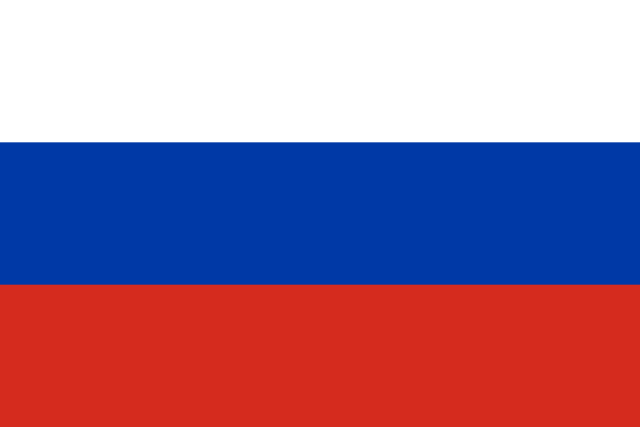
Russia and Slovakia share the same arrangement of three horizontal color bands. Both use white at the top, blue in the middle and red at the bottom. Both standard national flags also have the same overall shape, a rectangle with a height-to-length ratio of two to three. The important distinction is that the modern Slovak flag bears a coat of arms near the hoist, whereas the ordinary Russian national flag is an uninterrupted tricolor.
The coat of arms on Slovakia’s flag is a red shield containing a white double-barred cross above three blue rounded hills. It occupies the half of the flag nearest the pole and extends across portions of all three bands. If you are looking at a small reference image, search for the shield’s outline and the white cross. Russia’s national design has no corresponding central or corner device.
The position of the Slovak emblem matters. It is not centered horizontally on the entire rectangle. A reference showing a similar shield at the exact midpoint should be checked against the official specifications rather than treated automatically as an accurate rendering. When photographed from behind, the emblem may appear on the viewer’s right because that is the hoist in the photograph. Its relationship to the pole is more important than its apparent position on a screen.
If the shield is hidden, the remaining portion of the Slovak flag can look exactly like the Russian stripe arrangement. Therefore, do not use the absence of an emblem in a cropped picture as proof that the flag is Russian. Look for the full rectangle and reliable context. This distinction is especially helpful in sports quizzes, where several flags can share the same background colors.
The plain Russian tricolor
The Russian embassy’s national-symbol reference describes three horizontal fields of equal height. The governing federal constitutional law, No. 1-FKZ of December 25, 2000, gives the same arrangement in Article 1. The law’s opening article describes the national flag separately from other state symbols. A viewer should not expect to find Russia’s double-headed eagle on the ordinary flag.
This separation explains why a government coat of arms, a presidential standard and an ordinary national flag should not be used interchangeably in a geography chart. A photograph of an official document may show a double-headed eagle; that does not mean that a correct illustration of the national tricolor requires the eagle to be added. If a Russian-colored banner bears an additional image or lettering, identify the specific banner before labeling it.
For a simple drawing exercise, start with a rectangular outline and divide its vertical dimension into three equal parts. In the Russian design, the colored fields extend all the way across the width. There is no hoist-side gap, extra stripe or overlay. On white paper, a fine neutral presentation border can help distinguish the upper white area from the page itself. Such an outline should not be mistaken for a black edge belonging to the flag.
The basic national description names white, blue and red. It does not give every color interpretation or require that a particular popular explanation of the colors be accepted as official. Many national flags attract symbolic readings that differ from source to source. When preparing a report, distinguish the legal design from historical interpretations rather than assigning a single definitive meaning to each stripe without an authoritative reference.
The Russian flag is recognizable because of its overall color order and lack of additional symbols. In a larger set of flags, those features must still be compared with the specific alternatives. The same white-blue-red palette can occur in different arrangements elsewhere in Europe.
The double cross, hills and red shield
The Slovak president’s official state-symbol page describes the coat of arms as a double silver cross standing above the middle of a group of three rounded mountain peaks on a red shield of Early Gothic form. In flag illustrations the silver is rendered as white. The horizontal arms of the cross have distinctive ends, and the hills form a blue base beneath it. These features distinguish the Slovak emblem from other national symbols that also use a cross or a mountain silhouette.
Begin with the outer shield when studying a full reference. Next locate the cross and identify its two horizontal bars. Finally examine the group of three hills. This order is useful for learners because a tiny rendering may reveal the red shape and cross before it reveals the separate blue peaks.
The shield occupies more than just the middle blue stripe. It spans part of the upper white band and lower red band as well. The official design includes narrow white separation where the shield meets nonwhite background areas. This makes the red shield discernible against the lower red stripe. A newly added black outline would not be an appropriate substitute for the specified treatment.
The national flag is distinct from the state seal. The seal adds a circular identifying inscription around the arms and uses a particular heraldic treatment. Do not paste an image of the entire circular seal onto a white-blue-red tricolor. A state-symbol resource can contain both images, so be sure to select the one identified as the flag.
The official Slovak reference is linked directly in this article rather than reproducing a newly drawn shield. Act 63/1993 governs the design and use of state symbols. Students can study the official image and calculate its layout, while those needing to reproduce national imagery should consult the relevant rules. A copyright statement about a digital file is not a determination of every permitted use of the state emblem.
Measure the two flags at the same scale
Both countries use a two-to-three ratio for the standard national flag. Choose a height of eighteen centimeters and a length of twenty-seven centimeters. Divide the height by three to obtain six centimeters for each background band. Mark the stripe boundaries six and twelve centimeters down from the top. These same dimensions provide the starting point for either flag.
The Russian drawing needs only the three full-width stripes. The Slovak drawing requires an accurately positioned shield as well. According to Slovakia’s official design description, the height of the shield is one half of the full flag height. In this example the shield is nine centimeters high. The distance from its upper edge to the top of the flag is equal to the distance from its lower edge to the bottom. Each is 4.5 centimeters.
The front edge of the shield is also the same distance from the hoist as those vertical margins. For the eighteen-centimeter example, the relevant margin is 4.5 centimeters. The exact width and curved boundary of the shield should be taken from the official model rather than assumed to be equal to its height. The law describes a heraldic shape, not a square placed over the stripes.
The official reference gives the white edging a width equal to one hundredth of the flag length where the shield meets colored bands. At a length of twenty-seven centimeters, that corresponds to 0.27 centimeters, or 2.7 millimeters. This is a proportional calculation. It is not a recommendation to replace the official contour with a uniformly thick decorative border. The edging applies where the source specifies it.
For a reduced worksheet nine centimeters high and 13.5 centimeters long, each stripe is three centimeters high, the shield is 4.5 centimeters high, the corresponding margins are 2.25 centimeters and the edging relationship gives 1.35 millimeters. The proportional relationships remain the same at the smaller scale. If your measuring tools cannot represent all the decimals accurately, record the rounding rather than invent new specifications.
A digital reference may be resized to fit a common display box. Make sure the complete artwork retains its original aspect ratio. A horizontal stretch can make the shield appear broader or move its apparent position relative to the field. Since the two flags have the same official rectangle, comparing them at the same visible height is particularly useful.
How the similar tricolors developed
The white-blue-red Russian tricolor has a history that predates the modern Russian Federation. Historical flag references associate it with maritime use and with Peter the Great’s period. Its status and official uses developed over subsequent centuries. During the Soviet era, red flags representing Soviet institutions replaced the tricolor as the principal state design.
The tricolor returned to official use in 1991. Flags of the World documents an earlier one-to-two format used in the period from 1991 to 1993, followed by the modern two-to-three format. The federal constitutional flag law of 2000 codified the familiar three-band design. The distinction between the date of restoration and the date of a later legal definition explains why several dates appear in descriptions of the same national symbol.
Slovakia’s use of the three colors also has roots in nineteenth-century national history. Specialist flag histories describe a plain tricolor used in earlier periods, and the Slovak law of 1990 provided for a plain design within the then Czechoslovak state. The 1992 constitution incorporated the state arms into the flag. The modern independent Slovak Republic came into being on January 1, 1993, and Act 63/1993 specified the state symbols in more detail.
The addition of the arms is historically significant because the plain Slovak tricolor could be confused with Russia’s and other flags using closely related palettes. The shield supplied a distinct identifying device that retained the familiar horizontal bands. This is a useful example of how an emblem can distinguish national flags without changing their entire background.
A historical photo from Slovakia showing a plain white-blue-red flag may therefore be valid evidence of an earlier Slovak design. It should not automatically be relabeled as Russian. Similarly, a long Russian tricolor from the early 1990s should not be dismissed merely because its rectangle differs from the current 2:3 format. Identify the date, source and intended use before judging historical flags by current specifications.
These histories explain a visual resemblance without establishing any present political position. A shared flag palette or an earlier design relationship does not imply that modern governments or the people represented by those flags hold the same views.
When a photograph hides the shield
A flag hanging from a pole may conceal the hoist half behind folded fabric. Because the Slovak emblem sits in that region, a visible fly end may contain only white, blue and red. The same three uninterrupted bands occur on the Russian flag. It is therefore essential to distinguish an observed plain area from proof that the entire flag is plain.
Begin with the visible edges. Can you see the portion of the flag that would normally contain the Slovak shield? If not, the image may not contain enough information for a definite identification. If the complete field is unobstructed and there is no emblem, the current ordinary Russian design is indicated in a two-choice comparison. If the shield and double cross are visible, Slovakia is indicated.
A reverse view can cause another common mistake. An observer on the back side of the flag sees the hoist on the opposite side of the photograph. The white-blue-red vertical order remains unchanged, but the shield’s apparent horizontal position is reversed. Do not insist that every authentic photo must show the emblem on the viewer’s left.
In a monochrome picture, the silhouette of the Slovak emblem may be more helpful than the shades of the stripes. In a small color icon, the white cross can be difficult to distinguish from the surrounding white areas. Enlarging an already compressed picture may not recover that missing detail. Ask for a clearer source or use the official country label.
If a sports event displays the labels RUS and SVK, those labels may resolve uncertainty when the flag itself is partially hidden. Different events use different codes, especially in exceptional participation arrangements. Consult the organizer’s legend and avoid treating a sporting label as part of the national flag design.
A practical rule for accessible image descriptions is to name both the stripe order and the presence or absence of the coat of arms. Describing both flags merely as white, blue and red fails to communicate the distinction that matters most.
Distinguish Slovakia, Slovenia and other related flags
Slovenia’s flag has the same white-blue-red stripe order and also carries a shield toward the hoist. That creates a more demanding recognition task than the two-country comparison with Russia. Slovenia’s shield depicts a white mountain shape, blue wavy lines and three stars. Slovakia’s depicts a white double cross above blue hills. The two shields should not be treated as interchangeable because both contain mountainous imagery.
Serbia uses the related colors in another horizontal order, with red at the top, blue in the middle and white at the bottom. Its state flag includes a different coat of arms. The color order supplies a first clue before the reader studies the heraldic details.
The Netherlands uses red, white and blue, with a different order from Russia’s. Luxembourg’s design also uses red, white and blue horizontal bands, with a lighter usual blue reference. These examples illustrate why a list of three colors alone is rarely a sufficient flag description. Direction, order, emblems and proportions all provide independent information.
The existing FlagExplorers comparison of Slovenia and Slovakia offers a more detailed examination of their shields. Readers who already recognize Russia’s plain tricolor can use that guide as the next step. A learning activity can move from plain-versus-emblem comparisons to comparisons between two emblem-bearing designs, where the actual content of the shield becomes essential.
Build a reference chart with one row for each flag. Write the top, middle and bottom colors in separate columns. Add a column for the emblem and a column for its placement. This makes similarities and differences clear without relying on the subtle shade of blue used in a particular image. For historic flags, include a date column so that earlier variants remain distinguishable from the current designs.
A classroom recognition and geometry exercise
Prepare two blank rectangles measuring eighteen by twenty-seven centimeters. Divide each into three equal stripes. Mark one as the plain tricolor study and the other as the coat-of-arms placement study. Calculate the Slovak shield height, margins and white edging relationship from the geometry section. Write the answers outside the rectangle.
Open the full official Slovak reference and compare its shield with the layout notes. Keep the official artwork intact and do not use the worksheet to create an improvised state emblem. A blank placement diagram is an educational study, not the complete Slovak national flag. The Russian tricolor needs no analogous shield location.
Next, use two complete flag references and cover the country names. Ask a learner to explain which country has the double cross and which has a plain field. Then hide the hoist region of both images. The correct response may be that the available portions are insufficient to distinguish the pair. This tests the ability to recognize incomplete evidence rather than simply reward memorization.
For a further numerical exercise, select a flag height of thirty centimeters. The length becomes forty-five centimeters and each stripe ten centimeters high. The Slovak shield height is fifteen centimeters, the specified equal margins are 7.5 centimeters and the white edging relationship gives 4.5 millimeters. Verify each result by scaling the earlier example by five thirds.
Finally introduce a Slovenian reference. Ask whether identifying the presence of a shield is now enough. It is not, because both Slovenia and Slovakia have heraldic devices. The learner needs to identify the double cross or the mountain-and-stars composition. This expanded exercise shows how a recognition rule depends on the set of possible answers.
Use properly captioned national references and cite their sources in any submitted schoolwork. Keep design annotations outside the images and respect the use rules for the national symbols.
Frequently asked questions
Are Russia and Slovakia’s flags the same? No. Their stripe arrangements and proportions match, but Slovakia adds its coat of arms toward the hoist.
Which flag has the double cross? Slovakia. The cross is depicted above three blue hills inside a red shield.
What is the ratio of the two current national flags? Both use two units of height for three units of length.
Is the Slovak coat of arms in the exact center of the rectangle? No. It is vertically centered and placed toward the hoist.
Why might an old Slovak flag lack the shield? Earlier Slovak tricolor designs did not include the modern arms. A historical picture should be identified by its date.
Can the flags be identified by their blue shades alone? No. Image reproduction varies. The presence and identity of the shield are stronger clues.
How is Slovakia different from Slovenia? Slovenia’s shield has a mountain, wavy lines and stars. Slovakia’s has a double cross and three hills.
What if the flag is partly hidden? If the hoist region is concealed, a Slovak flag may resemble Russia’s. Look for a full view or reliable label.
Sources and artwork
- Russian Embassy — national flag description
- Federal Constitutional Law 1-FKZ of December 25, 2000, Article 1 (unofficial translation)
- President of Slovakia — flag dimensions and heraldic design
- Slovak Act 63/1993 on state symbols and their use
- Flags of the World — Russian flag history
- Flags of the World — Russian tricolor, 1991–1993
- Flags of the World — Slovak flag history
- President of Slovakia — historical overview
- Flagpedia — flag artwork terms
Russian reference artwork supplied by Flagpedia / FlagCDN under its stated public-domain terms. The Slovak flag reference is linked directly to the official source. Separate national-symbol and use rules may apply. The Russian legal translation is unofficial; its design description is corroborated by the embassy reference.