Palestine vs Sudan Flag: Triangle Colors and Stripe Order
The same four colors and geometric structure, with different triangle colors and stripe sequences.
| Feature | Palestine | Sudan |
|---|---|---|
| Triangle | Red | Green |
| Stripe order | Black, white, green | Red, white, black |
| Height:length | 1:2 | 1:2 (published law translation) |
| Triangle depth | One-third length | One-third length (published law translation) |
Compare the triangle before looking at the stripes
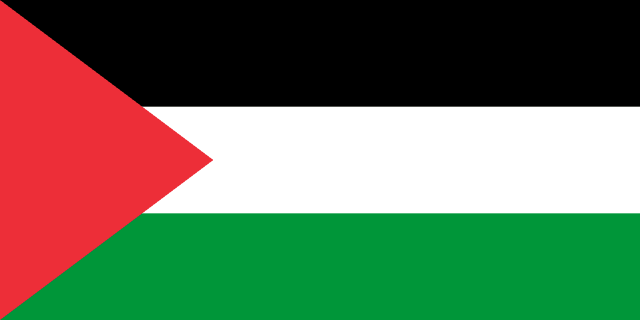
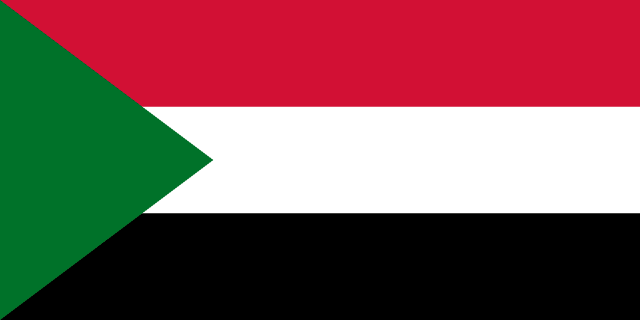
Palestine and Sudan use the same four broad colors in their national flags: red, green, white and black. Both have three horizontal stripes and a triangular field extending from the hoist toward the middle of the rectangle. Their geometry is remarkably similar, but the colors occupy different positions. Palestine has a red triangle and bands of black, white and green. Sudan has a green triangle and bands of red, white and black. In both examples the central horizontal band is white.
A simple recognition method starts with the triangular device. If the triangle is red, look for black at the top and green at the bottom to confirm Palestine. If the triangle is green, look for red above white and black below it to confirm Sudan. The second observation is important because a red or green triangle also occurs in other national designs. Using the triangle alone might work in a two-choice exercise, but the combination of the triangle and stripe order is a more reliable description.
Neither of these ordinary designs has a star in its triangle or a separate emblem in the white band. A star would require further investigation of the particular flag type or country shown. Jordan, for example, adds a white star to its red triangular field. South Sudan uses a different arrangement that includes a blue triangle and a yellow star. The distinction between Sudan and South Sudan is especially important when interpreting country names in an online quiz.
This comparison focuses on the national designs rather than on historical banners, protest symbols or institutional flags. The appearance of a national flag is not sufficient evidence to determine a person’s political position, and historical context should be established separately from visual identification.
A shared geometry with different colors
The amended Palestinian flag law of February 17, 2006 specifies a rectangular field twice as long as it is high. Its three stripes divide the height equally. The red triangular field has a base equal to the flag height and a perpendicular altitude equal to one third of its length. The official gazette provides the Arabic text of this amendment, making it possible to calculate its proportions without relying on an illustration.
The English reproduction of Sudan’s 1970 national flag amendment published by Flags of the World describes the same general geometry. It gives the field a length twice its height and describes a full-height isosceles triangle reaching one third of the length. The Sudanese embassy confirms the current colors and general design. The complete original Sudanese legal instrument has not been independently inspected here; the detailed numerical relationships are therefore attributed to the published English reproduction rather than presented as a newly certified legal specification.
Choose a common field height of twelve centimeters for a paper comparison. Each rectangle is twenty-four centimeters long. Each horizontal band is four centimeters high, with boundaries at four and eight centimeters from the top. The triangle begins at the entire twelve-centimeter hoist edge, and its point is eight centimeters along the rectangle and six centimeters down from the top.
The two outlines can therefore be prepared using the same measurements. A student does not need a different ruler template to explain the two arrangements. The important change is which colors belong in the regions defined by those lines. This makes the pair a useful example of how color placement can distinguish flags that share a construction pattern.
Repeat the calculation at a height of eighteen centimeters. Each rectangle is thirty-six centimeters long, the stripes measure six centimeters high, and the apex is twelve centimeters from the hoist and nine centimeters below the top. The numerical relationships remain constant even though the physical drawing is larger. Do not confuse the perpendicular altitude of the triangle with either of its sloping sides. Measuring along a sloping side would give a different value.
Calculate the colored areas in a flat reference
The shared construction allows a useful mathematics exercise. Take the twelve-by-twenty-four-centimeter rectangle used above. Its total area is 288 square centimeters. The triangle has a base of twelve centimeters and a perpendicular altitude of eight centimeters. Its area is half the product of those measurements, which gives forty-eight square centimeters. The triangle therefore occupies one sixth of the whole flag.
The remaining area is 240 square centimeters. It is not enough simply to divide this number into three equal parts, because the triangle overlaps each background stripe by a different amount. The center stripe intersects the broad middle portion of the triangle, while the upper and lower stripes intersect the narrowing regions nearer its sloping edges.
Before the triangular field is added, each horizontal stripe has an area of ninety-six square centimeters. The part of the triangle in the central four-centimeter band can be divided into two trapezoids. At either boundary of that band, the triangle reaches sixteen thirds of a centimeter from the hoist. At the midpoint it reaches eight centimeters. You can calculate its area by splitting it at the horizontal midline into two trapezoids, each two centimeters high. The combined area is eighty thirds of a square centimeter.
The upper and lower triangle portions have equal areas by symmetry. Subtract the central portion from forty-eight, and divide the remainder by two. Each outer portion measures thirty-two thirds of a square centimeter. The visible parts of the original colored stripes therefore measure approximately 85.33 square centimeters each for the outer bands and 69.33 square centimeters for the middle band.
This explains a visually interesting feature of the two flags. The central white region has less exposed area than either of the other bands, even though all three nominal stripes have the same height. The triangle itself has a separate color. In Palestine it is red; in Sudan it is green. Reassigning the colors leaves the geometric area calculations unchanged.
These results follow from the specified ideal flat construction. They are calculated teaching examples, not measurements taken from fabric, and should not be used to claim that all commercial reproductions follow the same tolerances. A graph-paper approximation can also demonstrate the area relationship without requiring students to work with fractions.
Palestine’s design and the 2006 amendment
The Palestinian official gazette is particularly useful because it records the change to the flag description through an amending law. An earlier description is not automatically the current specification simply because it appears in an old flag book. The 2006 provision replaces the earlier article defining the flag and describes the length, height, colors and triangular field.
The ordinary design is identified by the black upper band, white middle band, green lower band and red triangle. The triangle has no seven-pointed star. Readers who already know the Jordanian flag may initially find the two designs similar because they share the same order of background stripes. The star on Jordan’s flag supplies an obvious difference, while the respective construction specifications provide another distinction in the triangle’s reach.
Palestine’s flag belongs to the wider historical family of flags associated with the Arab Revolt and the development of Palestinian national institutions. A historical reference might show a triangular field with proportions different from the amended specification. This is not necessarily evidence of an erroneous image if it represents an earlier period. Check the date and intended context before assessing its geometry.
A contemporary reference should preserve the distinction between national identification and questions about diplomatic status. This page uses the flag identified in the cited Palestinian legislation and describes its design. It does not infer conclusions about borders, political allegiances or the views of individuals from the presence of the flag.
For a school activity, ask a learner to identify the upper and lower stripes and calculate the triangle’s depth from the rectangle length. Then compare the result with the documented law. A correct answer should distinguish the red triangle from the red top stripe of Sudan and avoid adding a white star that is not part of the ordinary Palestinian design.
Sudan’s current flag and earlier tricolor
Sudan’s embassy in Berlin identifies its national flag as a red, white and black horizontal arrangement with green at the hoist. The embassy dates this design to May 20, 1970. That date distinguishes it from the earlier independence-era flag, which used three different horizontal colors: blue, yellow and green. A historic photo showing that earlier arrangement should not be relabeled as the present design.
The green triangle is the most useful part of the Sudanese flag when comparing it with Palestine. The upper red band provides a second clue. The black band lies at the bottom rather than at the top. The central white stripe is a shared feature, so it is not a reliable distinguishing cue by itself.
The embassy discusses the colors in relation to Sudan’s history and identity. Such interpretations answer a different question from the legal geometry. A description of why a color is significant does not determine how many centimeters of a particular field must appear on a flag. Similarly, a construction chart does not by itself establish the full historical meaning of the design.
Sudan should be distinguished from South Sudan, which became independent in 2011. Their flags are separate national symbols. South Sudan’s design features additional white dividing bands, a blue hoist triangle and a yellow star. It does not share the simple three-equal-band and green-triangle arrangement of Sudan’s current flag.
When making a historical timeline, place the independence-era Sudanese design and the 1970 replacement on separate lines. If you include South Sudan, add its own national history rather than treating it as a later version of Sudan’s flag. Clear captions make this kind of flag study more useful for geography lessons and help avoid ambiguity when articles mention different periods.
Recognize the pair in partial photographs
A full flat picture makes the difference straightforward, but a flag flying from a pole may conceal its triangular area. If the hoist is hidden, look at the visible horizontal bands. Unlike some pairs with identical background stripes, Palestine and Sudan have different colors at both the top and bottom. The remaining three bands may therefore supply enough evidence for a two-choice identification exercise.
If only the middle white area is visible, there is no dependable distinction. If only a portion of the triangle appears, the color may suggest the right answer but should be confirmed from the rest of the field. A learner should be comfortable recording an uncertain identification rather than guessing which country an incomplete image represents.
A reverse view moves the hoist to the other side of the picture, so the triangular device may point left rather than right. The normal vertical order of the horizontal stripes remains the same. When comparing a photo with a standard illustration, identify the edge attached to the pole instead of assuming that the triangle always starts at the viewer’s left.
A grayscale photograph may reduce the distinction between red and green. Because the two flags have very similar geometry, shape alone may not solve this particular comparison. Read the caption, investigate the location or consult another image. This is an example where two different designs can have identical construction lines, and the colors are essential information.
Digital flags may be displayed within rounded icons, square masks or equal-width containers. Do not measure the masked portion and treat it as the original field. A country label or the two-letter identifiers PS and SD can provide independent evidence when an icon is too small to inspect. Verify the coding system if the flags are used in a sporting or institutional setting.
Practice with a measurable two-flag worksheet
Prepare two rectangular outlines of eighteen by thirty-six centimeters, using the construction relationships discussed above. Mark three horizontal stripes six centimeters high in each. Locate the point of the triangular field twelve centimeters from the hoist and nine centimeters from the top. Connect it with the top and bottom hoist corners. At this stage the outlines are geometrically identical.
Fill the first diagram with the Palestinian color order and the second with the Sudanese order if the proposed educational use is appropriate. Keep any measurement guides and explanatory labels outside the completed fields. Compare the diagrams with the complete reference images or source links. The same outline should support two different recognition answers depending on the assignment of colors.
For a second activity, make a verbal description of one flag without naming it. Include the top stripe, the middle stripe, the bottom stripe and the triangular device. Ask a partner to identify the country and explain why the alternative is incorrect. Exchange roles and repeat.
For an additional mathematics challenge, reduce the field to a height of nine centimeters. Its length is eighteen centimeters and the triangle reaches six centimeters into it. The total field area is 162 square centimeters, of which the triangle occupies twenty-seven. Verify that this is still one sixth of the rectangle, as it was in the larger example.
Finally, compare a complete reference and an incomplete fragment by covering part of the image with a removable piece of paper. Discuss which observations remain available. Record the source and the date for each historical image. This exercise is useful for building reliable recognition habits, not just memorizing a fixed set of answers.
Frequently asked questions
Which flag has a red triangle? Palestine’s flag has a red triangle with black, white and green stripes.
Which flag has a green triangle? Sudan’s flag has a green triangle with red, white and black stripes.
Do the flags have identical construction? The Palestinian amendment and the published English reproduction of Sudan’s flag law describe the same 1:2 field relationship, equal bands and a triangular field reaching one third of the length. Their colors are arranged differently.
Does either design have a star? Neither ordinary flag discussed here includes a star. Jordan and South Sudan provide useful contrasting examples.
When was Sudan’s current flag adopted? The Sudanese embassy identifies May 20, 1970.
Does the Palestinian flag have the same triangle proportions in every historical image? No. The 2006 amendment changed the written description. Use a dated reference when evaluating older images.
Can they be distinguished in black and white? Not always from their geometry alone. A reliable caption or additional context may be necessary.
Where should I check formal specifications? Consult the Palestinian official gazette and the Sudanese legal reference linked below. The original Sudanese legal text was not independently available for this comparison.
Sources and artwork
- Palestinian Official Gazette — Law 5 of 2006, Article 1
- Flags of the World — Palestine flag and historical specifications
- Embassy of Sudan in Berlin — flag and history
- Flags of the World — translated Sudanese flag law and construction reference
- Flags of the World — Sudan flag history
- IGAD regional reference — Sudan flag and historical context
- Flagpedia — artwork copyright terms
Flag artwork supplied by Flagpedia / FlagCDN under its stated public-domain terms. Separate national-symbol and display requirements may apply. The original Sudanese legal instrument was not independently inspected; construction details are attributed to the published English reproduction.