Australia vs United Kingdom Flag: Union Jack, Stars and Proportions
Compare the Union Jack, Australia’s six stars, official proportions and the history behind their shared design.
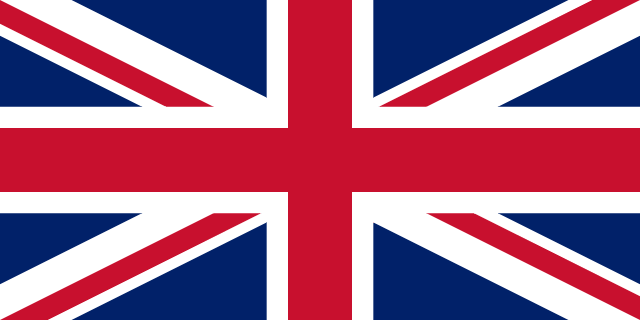
| Feature | Australia | United Kingdom |
|---|---|---|
| Union Jack | Upper hoist quarter | Entire field |
| Stars | Six white stars | None |
| Height:length | 1:2 | 3:5 land format; 1:2 also used |
| Main distinguishing device | Commonwealth Star and Southern Cross | Combined crosses |
The quickest way to distinguish the two flags
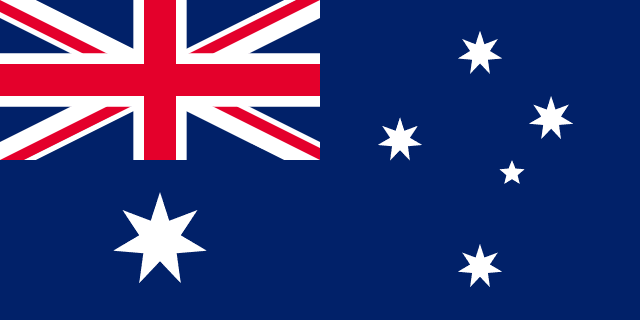
The United Kingdom’s national flag, commonly called the Union Jack or Union Flag, uses an arrangement of red and white crosses over a blue background. The crosses occupy the entire rectangle. Australia’s national flag also contains the Union Jack, but it appears only in the upper quarter nearest the flagpole. The rest of Australia’s flag is predominantly dark blue, with six separate white stars.
This difference provides an easy first identification rule. If the diagonal and upright crosses extend across the whole field, the flag is the Union Flag. If the crossed design occupies the upper hoist quarter and white stars occupy other parts of a blue rectangle, the flag is the Australian National Flag. A complete picture is important because a crop of Australia’s upper hoist quarter could look like a separate British flag.
The two designs are related historically, not simply coincidentally similar in color. Australia’s official account explains the British flag in the canton by reference to the country’s history of British settlement. The Commonwealth Star and Southern Cross distinguish the Australian national design and identify features of Australia’s federation and geographical setting.
A photograph of the flags flying together makes the difference easy to see when the entire flags are visible. On small mobile icons, the Australian stars may appear as white dots, while the Union Jack’s thinner diagonal stripes may be difficult to resolve. In that situation, look for the distribution of white elements across the entire rectangle instead of trying to count individual star points immediately.
This guide compares the ordinary national flags of Australia and the United Kingdom. Both countries also have naval, governmental and other official flags. Some contain similar cross or star elements but represent different institutions or functions. Those flags need to be identified by their own specifications.
Understanding the United Kingdom’s three crosses
The Union Flag combines elements associated with three patron saints: the upright red cross of Saint George, the diagonal white cross of Saint Andrew and the diagonal red cross of Saint Patrick. Their arrangement creates the distinctive pattern across the whole flag. The white areas around the red elements are part of its construction, rather than separate stars or additional emblems.
The red upright cross is the easiest element for a new learner to locate. It runs through the middle of the rectangle, horizontally and vertically. The diagonal elements form an X-shaped arrangement, with blue areas between them. The diagonal red stripes are offset within the white diagonals, which means the design is not simply a symmetrical red X placed centrally over a white X.
This matters when checking the orientation of a flag. In a conventional illustration with the hoist on the left, the broad white diagonal band lies above the red diagonal near the upper hoist. Turning the flag upside down changes that relationship. A viewer who checks only the central upright cross may miss the incorrect orientation.
Wales is part of the United Kingdom but its red dragon does not appear as a separate element of the Union Flag. The historical development of the design explains this absence. It should not be interpreted as evidence that Wales is outside the United Kingdom or that the national flag is incomplete. The Welsh flag is a distinct national symbol with its own design and history.
The term Union Jack is widely used for the flag, including in ordinary contexts away from ships. Union Flag is also an established name. The House of Commons Library uses both terms when describing the national flag. A geography learner should recognize either name rather than assume that they refer to two visually different national designs.
The three components of Australia’s national flag
The Australian flag can be understood by dividing it into three principal elements. The Union Jack occupies its canton, the large Commonwealth Star sits beneath that canton, and five stars representing the Southern Cross appear in the half farthest from the flagpole.
A canton is an area at the upper hoist of a flag. In this case it occupies one quarter of the overall rectangular field. The British cross design therefore has a smaller role within the Australian composition than it has in the independent Union Flag. This distinction is central to the visual comparison.
The large star beneath the canton has seven points. Australia’s government explains that six points represent the original states and the seventh represents the territories. The star is consequently associated with the Commonwealth’s federal structure. It is not part of the Southern Cross group. When asked how many stars are on the flag, count this large star as well as the five on the fly.
The Southern Cross consists of four larger seven-pointed stars and one smaller five-pointed star. These five stars represent a constellation visible in the southern sky. Their positions are deliberately unequal, and they should not be reorganized into a regular pentagon or substituted with a set of identical stars. The smaller five-pointed star is especially useful when examining a full-resolution reference.
At a distance the exact point counts may be hard to see. A useful method is to identify the isolated large star beneath the canton, then count the five separate stars in the other half. That gives six stars in total. A mistaken answer of five often results from counting only the constellation and overlooking the Commonwealth Star.
The flag should also be distinguished from Australia’s other official flags. The Australian Aboriginal Flag and the Torres Strait Islander Flag are important national symbols with entirely different compositions. They are not alternative arrangements of the six white stars. Australia’s blue national flag is the design compared with the United Kingdom’s flag in this article.
Compare flag proportions and canton measurements
Australia’s national flag uses a height-to-length proportion of one to two. A flat reference with a height of eighteen centimeters therefore has a length of thirty-six centimeters. The Union Jack in its upper hoist quarter occupies a rectangle nine centimeters high and eighteen centimeters long. Its proportions match the one-to-two form of the Union Flag.
The United Kingdom’s flag is commonly encountered in more than one proportion. The Flag Institute describes a three-to-five form for land use and the customary one-to-two form for ensigns at sea. The one-to-two Union Flag is also widely encountered in general use. It is therefore misleading to claim that the two countries can always be distinguished by their outer rectangle alone.
At a shared height of eighteen centimeters, the three-to-five British reference is thirty centimeters long. The one-to-two British reference is thirty-six centimeters long, matching Australia’s rectangle. Despite that match, the internal compositions differ completely. The British cross design covers its full rectangle, while the Australian version is confined to the nine-by-eighteen-centimeter canton.
To understand the arrangement geometrically, draw a thirty-six-centimeter horizontal baseline and construct vertical sides eighteen centimeters high. Mark the midpoint of the horizontal sides at eighteen centimeters from either end. Mark the vertical midpoint at nine centimeters from the top. Light construction lines through these positions divide the rectangle into four equal areas. The upper area nearest the hoist is the canton.
The center of the lower hoist quarter lies nine centimeters from the hoist and 13.5 centimeters from the top. This identifies the location of the Commonwealth Star in the statutory arrangement. The constellation occupies the fly half, rather than sharing the lower hoist quarter. The exact star diameters, points and positions should be checked against the official Australian flag schedule before making a detailed reproduction.
For a smaller exercise, use a height of twelve centimeters. The Australian rectangle becomes twenty-four centimeters long and its canton measures six by twelve centimeters. A British land-format example of the same height would be twenty centimeters long. These calculations provide a repeatable way to compare proportions without forcing both flags into an identical website thumbnail.
Keep the construction lines separate from the final artwork. Neither the invisible quarter divisions nor the rectangles used to organize the stars form visible parts of the completed national flag.
Why the Union Jack appears on Australia’s flag
The Union Flag’s history predates Australia’s current national design by centuries. The House of Commons Library traces an early Union Flag to 1606, when the crowns of England and Scotland were already held by the same monarch. The present arrangement incorporates the red diagonal cross associated with Saint Patrick following the union with Ireland in 1801.
In the Australian colonies, British flags were used before the federation of the Australian Commonwealth in 1901. Following federation, a public competition sought a national flag design. Australia’s Department of the Prime Minister and Cabinet records that the winning design was first flown on September 3, 1901. The inclusion of the Union Jack acknowledged historical links with Britain, while the star devices differentiated the new design.
The early competition design was not identical in every detail to today’s flag. The original Commonwealth Star had six points, corresponding to the six states. The current seven-point arrangement developed subsequently. The Southern Cross star shapes were also standardized. Consequently, an early Australian flag illustration may have differences that are historically authentic rather than errors.
The Flags Act 1953 formally declared the Australian blue ensign to be the national flag. The Act received royal assent in 1954. These dates refer to legal recognition and should not be confused with the first public display of the competition design in 1901.
Australia and the United Kingdom are separate countries with their own national flags. The presence of the Union Jack on Australia’s flag does not mean that the two are interchangeable, or that an Australian flag represents the United Kingdom in an international sporting event. The designs reflect historical relationships as well as distinct national identities.
A useful school timeline separates the development of the Union Flag, Australian federation, the competition and the later legislation. That allows students to understand why a component from an older flag appears inside a later national design without treating the later flag as merely a smaller version of the earlier one.
Recognizing both flags in photographs and sports icons
When comparing flags on a sports scoreboard, look at the fly half first. The Australian design has a group of white stars there, while the Union Flag has red and white cross elements reaching toward the outer edges. Even if the upper hoist area is difficult to see, this part of the field often provides enough information to distinguish them.
Photographs of flags in the wind require more care. A folded Australian flag might display only its canton, making the visible fragment resemble the British flag. A photograph taken from behind can place the canton on the opposite side of the image. The relevant question is which area is closest to the actual flagpole, not whether the Union Jack is always on the viewer’s left.
A cropped icon may also hide parts of the Australian Southern Cross or remove the edges of a British cross. If the complete field is not available, check the caption or country code before drawing a conclusion. A visual observation that the fragment contains the Union Jack is not sufficient by itself to establish which full flag it belongs to.
In sporting contexts, Australia is frequently identified by AUS and the United Kingdom may be represented by different labels depending on the competition and participating team. England, Scotland, Wales and Northern Ireland can have separate sporting teams and symbols. Do not automatically substitute the Union Flag for every team representing one of the UK’s constituent countries.
For accessible text descriptions, distinguish the full-field cross arrangement from the cross canton and six stars. Simply describing both flags as red, white and blue fails to communicate their most important visual differences. A useful alternative text identifies the country and gives the distinctive layout in a short phrase.
These principles also apply to flag quizzes. A high-quality quiz should present the full image or make clear that it intentionally tests partial-image recognition. It should not require learners to identify a country from a fragment that could reasonably belong to more than one flag.
Other flags containing the Union Jack
Australia is not the only national flag with the Union Jack in its canton. New Zealand has a dark blue field, a Union Jack in the upper hoist and four red stars edged in white. It lacks Australia’s large Commonwealth Star beneath the canton. This makes the star arrangement and color a better distinction than the shared blue background.
Fiji also features a Union Jack in the canton, but its field is light blue and it carries a shield rather than Australia’s arrangement of six white stars. Several flags of British overseas territories have a similar ensign structure, differentiated by their own badges. The presence of a Union Jack therefore identifies a historical design family, not a single country.
Australia’s Red Ensign uses a red field instead of blue and has a specific maritime function. It should not be substituted for the blue national flag in an ordinary country comparison without explaining the different context. UK maritime ensigns similarly use a Union Flag canton with other field arrangements.
For a classroom activity, assemble a chart of the United Kingdom, Australia, New Zealand and Fiji. First identify which design uses the Union Jack across the full field. Next compare the remaining flags by their background colors and fly devices. Count the stars where stars occur, and note whether a Commonwealth Star is present beneath the canton.
The exercise demonstrates a general method for flags with related construction. Start with the shared element, then find the features that distinguish individual examples. This is more effective than memorizing the broad colors of each flag in isolation. The separate Australia versus Fiji guide in the comparison directory provides a useful follow-up for readers studying this family of designs.
A practical recognition and measurement exercise
Draw two rectangular outlines on paper. Give both a height of fifteen centimeters. Use a length of thirty centimeters for the Australian model and twenty-five centimeters for the British land-format model. Add temporary half-height and half-length guides to the Australian outline. Ask a partner to locate the canton, the Commonwealth Star’s quarter and the constellation’s half without consulting the labels.
Then use complete official references to identify the three cross elements of the Union Jack. Compare the diagonal offsets and explain why the orientation of the flag matters. Do not trace the diagonal red stripes as if they were centered symmetrically inside the white diagonals. Consult the construction reference for the correct proportion-specific arrangement.
For an additional challenge, calculate the canton area in the fifteen-by-thirty-centimeter Australian outline. The canton measures 7.5 by fifteen centimeters and occupies 112.5 square centimeters. The full rectangle occupies 450 square centimeters. The canton therefore accounts for one quarter of the total area, as the layout suggests.
Ask the learner to identify which of the Australian stars has five points, which group represents the Southern Cross and why the large star is not included in that group. Follow the exercise with a comparison against New Zealand to test whether the learner can use the same features when the alternatives change.
Finally, examine a photograph in which part of the flag is hidden. Discuss what can and cannot be inferred from the visible portion. A correct identification depends on having enough evidence, not merely on making a confident guess. Record the source of each reference and keep explanatory labels separate from the flag artwork.
Frequently asked questions
Why does Australia’s flag contain the Union Jack? It reflects historical links with Britain, as explained in the Australian government’s flag resources.
How many stars are on Australia’s flag? Six: the Commonwealth Star and five representing the Southern Cross.
Does the United Kingdom’s flag have stars? No. Its ordinary national flag is a combination of crosses.
Are Australia and the United Kingdom’s flags the same proportions? They can have the same outer shape when the one-to-two Union Flag is used. The Flag Institute also describes a three-to-five land format for the Union Flag.
What is the difference between the Union Flag and Union Jack? Both names are used for the same UK national design.
Why is Australia’s large star separate from the Southern Cross? It represents the federal structure of the Commonwealth rather than a star in the constellation.
Does every flag with a Union Jack canton represent Australia? No. New Zealand, Fiji and other flags use a related arrangement. Identify the remaining devices.
Can an Australian flag be mistaken for a British flag in a cropped photo? Yes. If only the canton is visible, the shared cross design may not be enough to establish the identity of the full flag.
Sources and artwork
- Australian Flags Act 1953 — legislation and schedules
- Australian government — design and symbolism
- Australian government — design competition and history
- National Archives of Australia — Australian flag
- UK House of Commons Library — Union Flag and other UK flags
- Flag Institute — Union Flag construction and proportions
- Flag Institute — history of the Union Flag
- Australian government — flag protocols
- Flagpedia — image terms
Flag illustrations supplied by Flagpedia / FlagCDN under its stated public-domain terms. The UK illustration uses the 1:2 format. Separate flag-use and display requirements may apply. The dimensional examples are calculated from the stated proportions.