Russia Flag: White, Blue and Red Meaning, History and Facts
The Russian tricolour explained: stripe colours, legal dimensions, naval origins, imperial and Soviet periods, 1991 restoration, National Flag Day and similar European flags.
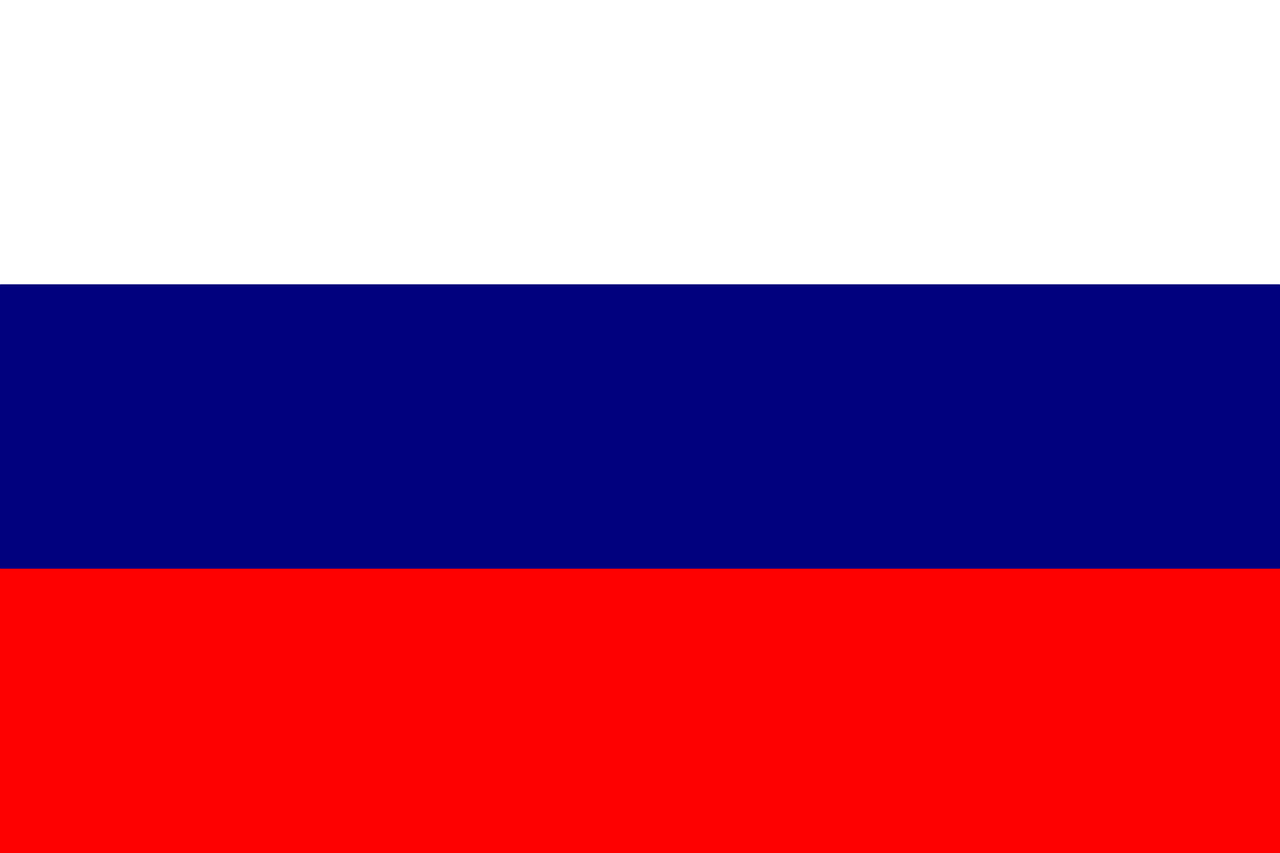
The Russian national flag is a white-blue-red horizontal tricolour with three equal stripes and a 2:3 height-to-length ratio. The design developed through Russian maritime history in the late seventeenth century, gained wider use during the imperial period, was replaced by Soviet-era flags and was restored as the modern state’s emblem in 1991.
The present flag is defined by a federal constitutional law dated 25 December 2000. Its simple appearance is easy to memorise, but its history includes merchant shipping, competing imperial banners, Soviet state symbols and a modern legal restoration. This guide distinguishes documented events from popular colour interpretations and explains how to recognise the Russian tricolour among similar European national flags.
What does the Russian flag look like?
Russia’s national flag consists of three equal horizontal stripes: white at the top, blue in the middle and red below. It has no separate cross, star, crown, shield, seal or coat of arms. The design is often called the Russian tricolour, a reference to the three-colour format used by many national flags around the world.
When describing a flag, the order of the stripes is essential. A white-blue-red design is Russian, whereas red-blue-white may be Serbian and white-blue-red with a shield may be Slovak or Slovenian. Each design reflects a different national and legal history. The Russian state flag’s ordinary form has no centre emblem, despite the existence of a separate official coat of arms with a golden double-headed eagle.
The Federal Constitutional Law on the State Flag describes this arrangement. A basic classroom diagram should show the three evenly sized colour bands without unnecessary outlines. The flag remains recognisable when flown, but photographs of folded fabric sometimes hide the upper or lower bands.
What are the official Russian flag proportions?
The legal proportions are 2:3 in height to length. Thus a flag measuring 20 centimetres high should be 30 centimetres long. The stripes have equal height, so a 600-pixel-high digital flag can have three bands each 200 pixels tall. The design does not have a narrow blue separator line: blue occupies exactly one-third of the flag.
Older Russian flags sometimes had other dimensions, particularly those used on ships or in historical ceremonial settings. Those differences should not be transferred automatically to the modern state specimen. If a historical painting shows a stretched tricolour, that does not change the dimensions established by modern law.
For formal printing, obtain an authorised reproduction and check current technical rules. On a webpage, preserve the original aspect ratio instead of forcing the image into a square thumbnail. Users learning to identify flags benefit from clean, undistorted examples, especially when comparing several countries with very similar colour palettes.
What do Russia’s white, blue and red colours mean?
Popular explanations connect white with honesty, peace, independence or nobility, blue with loyalty, faith or devotion, and red with courage, strength or sacrifice. There are several variations, and these associations have changed over time. They are part of the tricolour’s cultural symbolism rather than a universal dictionary of colour meanings.
The important legal distinction is that the federal constitutional law names the three colours but does not prescribe one exclusive official symbolic meaning for each stripe. A guide should not claim that a particular patriotic explanation is legally binding unless a cited statute actually says so. More dependable historical information concerns the flag’s maritime origins, changes in official use and eventual restoration.
That context makes the design easier to understand. The white-blue-red combination spread through maritime practice long before the modern federation existed. Later generations associated the stripes with different political periods and national ideas, so a single sentence about bravery or peace cannot represent the whole history.
How did Russia’s white-blue-red tricolour originate?
The flag emerged in connection with Russian shipbuilding and maritime activity in the late seventeenth century. As Russian rulers developed merchant shipping and contact with Western European ports, they needed recognisable banners for vessels. Early tricolour examples are associated with this environment rather than with the notion of a modern national flag flown by all citizens.
Different historical sources discuss flags used on vessels during the reigns of Tsar Alexei and Peter I. Their surviving evidence does not always establish a single first flag with perfect clarity, so claims about one exact invention date require caution. The most reliable summary is that the white-blue-red design developed in the final decades of the 1600s and was subsequently standardised for shipping.
Maritime flags could function differently from royal standards or military flags. A merchant ensign identified a vessel’s nationality in foreign ports, while state banners had ceremonial uses. Understanding these distinctions prevents readers from treating the first recorded maritime example as if it had already been the flag of a modern constitutional state.
What role did Peter the Great play in the flag’s history?
Peter I, commonly called Peter the Great, is closely associated with Russia’s expansion of shipbuilding, maritime commerce and naval organisation. He travelled in Western Europe and studied foreign maritime practices. In 1705, his government issued a decree directing Russian merchant vessels to use the white-blue-red tricolour, making this a major documented step in the design’s history.
The flag therefore belongs to the country’s seafaring story before its later use as a general national symbol. Ships needed identifiable colours, and standardisation made that possible. Russian naval vessels also developed other ensigns, notably the blue St Andrew’s cross on white, which should not be confused with the ordinary national tricolour.
Popular accounts sometimes say Peter simply copied a Dutch flag. The Netherlands was indeed an important maritime reference, but the history is more complex than one visit or instant adoption. The flags share three colours but use different stripe orders, and their public roles developed in separate legal traditions.
Why does the Russian flag resemble the Netherlands flag?
The Netherlands uses horizontal red, white and blue stripes, while the Russian national flag uses white, blue and red. The similarity has long attracted historical attention because Dutch expertise was influential during Peter the Great’s maritime reforms. The Dutch tricolour was a familiar model in an international world of shipping, trade and naval competition.
However, resemblance alone cannot prove the precise intentions of every early flag maker. Other European national and maritime flags also used blue, white and red, and Russian designs changed during their early development. It is better to describe the Dutch maritime tradition as a notable influence than to invent an exact undocumented instruction to reverse one particular Dutch flag.
To identify the two modern flags, inspect the top stripe: Russia begins with white and the Netherlands with red. Also remember that a photograph taken on a windy day may conceal a stripe. A clean flag chart should show both fully extended, with their proportions intact.
When did the tricolour represent Imperial Russia?
Throughout the nineteenth century, Russia used different banners for royalty, government, maritime services and public celebrations. The white-blue-red tricolour gradually gained a wider civilian role. Meanwhile, black-yellow-white also appeared in official imperial contexts, illustrating that there was no single unchanging flag form for every institution throughout the imperial period.
In 1883, the tricolour became more prominent in public decoration. In 1896, it received official recognition as the national flag under Nicholas II. The sequence shows a gradual transition from ship flag to broader state and national use rather than a sudden invention in the late nineteenth century.
When preparing historical illustrations, specify whether the flag represents an imperial royal standard, a merchant ship, a military unit or the general national banner. Treating them as interchangeable obscures the reasons different designs coexisted. The modern flag preserves the colour combination, but not every historical procedure or ceremonial variant.
Why did the Russian flag change after 1917?
The revolutions of 1917 brought an end to the Russian Empire and transformed the country’s political system. Red banners associated with the socialist and communist movements became central state symbols, and the older white-blue-red national tricolour ceased to be the principal official flag.
The Soviet Union, founded in 1922, became internationally identified with a red flag carrying a hammer, sickle and star. The Russian Soviet Federative Socialist Republic, one component of the union, had its own Soviet-era designs. These flags belonged to different governments and institutions from the modern Russian Federation.
The old tricolour did not disappear from all memory: it continued to appear in exile and historical contexts. Its absence from state offices during Soviet rule should therefore be understood as a change in government symbolism, not as evidence that its earlier maritime and imperial history had never existed.
How was the Russian tricolour restored in 1991?
The white-blue-red tricolour returned to public prominence during the political transformation of 1991, as Soviet authority weakened and the Russian republic pursued a new state identity. The events of 22 August 1991 are especially significant in later official commemorations of the flag’s restoration.
During the following months, the historic colour combination became the flag of the Russian republic and then the Russian Federation after the collapse of the Soviet Union. Early post-Soviet flag rules were followed by later legal clarification. The restoration did not erase the design’s earlier history or mean that its stripes first appeared that year.
It is useful to distinguish three separate stages: historic maritime use in the late seventeenth century, public national use in imperial times, and re-establishment as a contemporary state flag in 1991. A date without its event can otherwise mislead a reader into thinking there is a contradiction between centuries-old origins and modern adoption.
What does Russia’s 2000 state flag law specify?
Federal Constitutional Law No. 1-FKZ, dated 25 December 2000, establishes the national flag of the Russian Federation as an official state symbol. Its first article describes a rectangle of three equal horizontal bands in the order white, blue, red, with a width-to-length ratio of 2:3.
Other provisions address official display at federal institutions and the circumstances of government flag use. Such details may be amended, so an official event organiser should consult the current law rather than an old infographic. The legal text is available through Russian legal publications; English translations should be checked for accuracy when precise legal terminology matters.
This law is the core technical reference for modern flag identification. It does not impose popular symbolic meanings on the individual stripes, and it does not place the coat of arms within the standard tricolour. Understanding those boundaries helps avoid passing along unsupported claims as official regulations.
When is Russia’s National Flag Day?
National Flag Day is observed on 22 August. The date refers to the tricolour’s restoration during the events of 1991. The annual observance was established through a presidential decree in 1994, separating the commemorative calendar from the later 2000 constitutional flag law.
Flag Day events may include public displays, educational programmes and ceremonies focused on the history of the national symbol. The flag is also flown at state buildings in routine official use. An important distinction is that flag history can be taught factually even when public interpretations and political contexts vary.
Do not confuse 22 August with the date of Peter the Great’s merchant shipping decree or with the formal adoption of the 2000 law. These milestones belong to different centuries. A simple timeline can show late-seventeenth-century origins, 1705 maritime standardisation, imperial public use, the Soviet interruption and the modern restoration.
Does Russia’s national flag show the double-headed eagle?
The ordinary national flag is a plain tricolour with no eagle. Russia’s separate state coat of arms displays a golden double-headed eagle on a red field with additional heraldic symbols. Because the eagle is widely recognised, commercial graphics sometimes superimpose it on the tricolour, but that does not make the resulting image the basic official national flag.
Similarly, the Soviet hammer-and-sickle design belongs to a historical state formation and should be identified by its own dates. For schoolwork or a country directory, use the plain white-blue-red banner and show the coat of arms separately when discussing state symbols.
This distinction is not unusual. Many countries have both flags and coats of arms whose designs differ. Clear image captions—“national flag” versus “state coat of arms”—make the relationship understandable without inventing an extra emblem-bearing national design.
What flags are commonly confused with Russia’s?
Russia shares its white-blue-red stripe sequence with Slovakia and Slovenia, but those countries add distinctive shields. Slovakia has a white double cross above three hills; Slovenia has Mount Triglav, waves and gold stars. The Russian standard flag is plain, without a shield.
Serbia has a red-blue-white tricolour, which puts the red at the top and the white at the bottom. Croatia uses red-white-blue with a central checkerboard coat of arms. The Netherlands uses red-white-blue without that emblem. These flags are often grouped because they share colours, yet the exact order and devices identify different states.
In a worksheet, provide both a flat colour diagram and a short written description. People often misidentify flags from photographs where the pole or hoist end is obscured, but stripe order and the presence of a coat of arms give reliable clues.
What is the connection with pan-Slavic flag colours?
White, blue and red became prominent in nineteenth-century pan-Slavic symbolism. Several national movements adopted combinations of these colours as expressions of cultural affinities, though individual countries developed distinct stripe orders, proportions and emblems.
The Russian tricolour was an important historical reference in this process, but it is inaccurate to treat every related flag as a copy with no national history of its own. Serbia, Slovakia, Slovenia and Croatia, for example, differ in legal specifications and heraldic motifs. Shared colours do not imply that they represent one modern nation or government.
For a flag researcher, comparisons are most useful when they separate visual influence from political identity. The flags may form a recognisable colour family while still reflecting independent historical choices. The Pan-Slavic connection is a helpful context, not a replacement for each country’s specific sources.
How can you draw Russia’s flag accurately?
Start with a rectangle 30 centimetres wide and 20 centimetres high, giving the correct 2:3 height-to-length ratio. Divide the height into three equal parts, each approximately 6.67 centimetres. Leave the upper part white, colour the middle blue and the lower red. No additional symbol is required.
For a digital design, a 900 × 600-pixel canvas produces three bands each 200 pixels high. Use sharp horizontal boundaries and preserve the original aspect ratio when resizing. A white top stripe can appear to disappear on a white page, so place a border around the illustration if necessary, without depicting that border as part of the national flag.
Online images may use slightly different blue or red shades. The federal law names the colours without giving a universal hexadecimal code, so do not claim that one randomly sampled RGB value is uniquely mandated. Use authoritative state artwork for formal or ceremonial production.
How should historical Russian flags be labelled?
A useful flag-history chart should separate at least four contexts: early maritime tricolours, imperial national and royal banners, Soviet red flags and the modern Russian Federation tricolour. Their periods overlap in some contexts, and different branches of the state could use different ensigns at the same time.
A historical photograph showing a red Soviet banner is not a photograph of the Russian Federation’s present national flag. Likewise, a drawing of a naval St Andrew’s cross is not evidence that Russia’s ordinary tricolour must have a diagonal cross. Identifying the institution and year is essential for accurate captions.
Modern public uses of national symbols can carry different political interpretations. A reference article should accurately describe the legal flag and documented changes without assuming that every person displaying it intends one particular political message.
Russia flag quick facts
| Country | Russian Federation |
|---|---|
| Colours | White, blue, red |
| Stripes | Three equal horizontal bands |
| Ratio | 2:3 height to length |
| Historic roots | Late seventeenth-century shipping |
| Merchant vessel decree | 1705 |
| State tricolour restored | 1991 |
| Current flag law | 25 December 2000 |
| National Flag Day | 22 August |
| Coat of arms in standard flag | No |
Russia flag FAQs
What are Russia’s flag colours in order?
White at the top, blue in the middle and red at the bottom.
What are the official flag proportions?
2:3 height to length.
When did Russia restore its current flag?
During the political transition of 1991; 22 August is commemorated as National Flag Day.
What do the three colours officially represent?
The flag law specifies their order, but does not assign one exclusive legal symbolic meaning to each.
Does the flag include Russia’s double-headed eagle?
No. The golden double-headed eagle is on the separate state coat of arms.
How is Russia’s flag different from Serbia’s?
Russia is white-blue-red; Serbia is red-blue-white.