Portugal Flag: Meaning, Armillary Sphere, History, Ratio & Facts
Explore Portugal’s green-and-red republican flag, the armillary sphere and national shield, exact 2:3 proportions, 1910–1911 adoption and documented origins of the colors.
What does the Portugal flag look like?
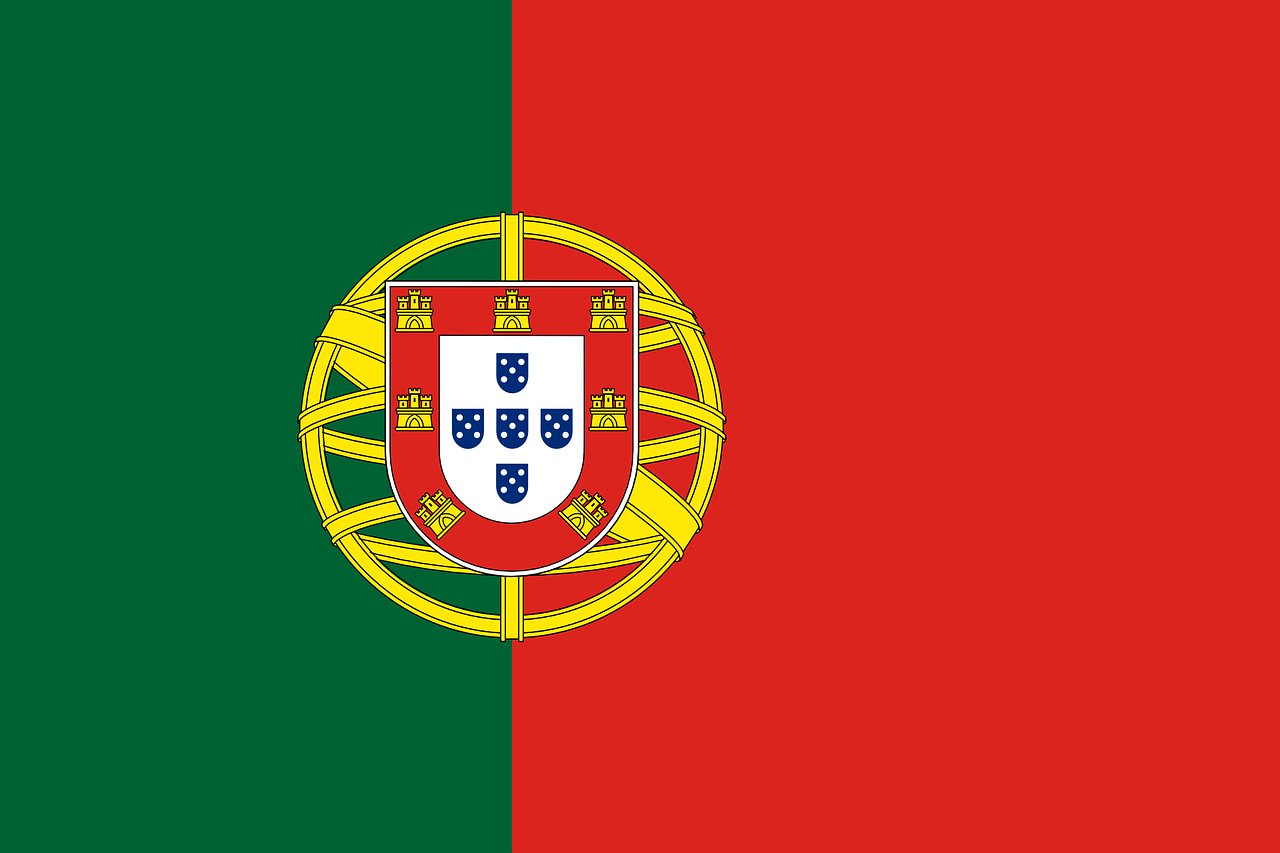
The Portuguese flag is split vertically into a smaller dark-green field next to the hoist and a larger scarlet-red field at the fly. The dividing line is not centered: green occupies two-fifths of the total length and red three-fifths.
The flag’s length is one and a half times its height, giving a 2:3 height-to-length ratio.
What is the symbol in the center?
At the border between green and red sits Portugal’s national shield on a golden armillary sphere. The Presidency describes the armillary sphere as an enduring symbol of Portugal’s adventurous and maritime tradition.
The white shield with five blue escutcheons refers to the deep medieval foundations of Portuguese statehood. Around it are seven castles on a red border.
Why is there an armillary sphere on the flag?
The armillary sphere was a navigation and astronomical instrument strongly associated with Portugal’s maritime expansion and with King Manuel I. The republican flag commission deliberately retained it as a historic symbol that could connect the new republic with Portugal’s seafaring past.
How did the current Portuguese flag originate?
After the monarchy was overthrown on 5 October 1910, the provisional republican government quickly turned to the creation of new national symbols. A commission including figures such as Columbano Bordalo Pinheiro, Abel Botelho and João Chagas was appointed on October 15.
The government approved the green-and-red project on November 29, 1910. The National Constituent Assembly formally established the national flag by decree on June 19, 1911, and detailed proportions followed later that month.
What do green and red mean?
The Presidency traces the republican use of red and green to the movement of 31 January 1891 and to the republican revolution of 1910. These documented political origins are more reliable than later simplified color legends that assign one fixed abstract meaning to each field.
Portugal flag dimensions
| Ratio | 2:3 |
|---|---|
| Green field | 2/5 of total length |
| Red field | 3/5 of total length |
| Hoist color | Dark green |
| Fly color | Scarlet red |
| Central emblem | National shield over armillary sphere |
Portugal flag quick facts
| Republic established | October 5, 1910 |
|---|---|
| Design approved | November 29, 1910 |
| Flag established by Constituent Assembly | June 19, 1911 |
| Ratio | 2:3 |
| Main colors | Green and red |
| Historic instrument | Armillary sphere |
Portugal flag FAQ
Why is the Portugal flag not split 50/50?
Its official construction gives two-fifths of the length to green and three-fifths to red.
What is the gold circle on the Portugal flag?
An armillary sphere, a historic navigation and astronomical instrument closely associated with Portuguese maritime history.
What is the Portugal flag ratio?
2:3.
When was the current flag adopted?
The republican design was approved in 1910 and legally established in 1911.
Why did Portugal change its flag in 1910?
The monarchy had been replaced by a republic, and the new government introduced national symbols reflecting the republican regime.