Bangladesh vs Japan Flag: Red Disc Position, Size and Background Compared
Side-by-side national flag identification, visual differences, historical context and practical examples.
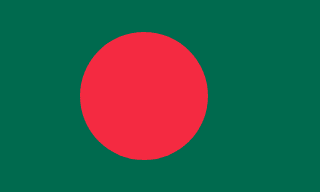
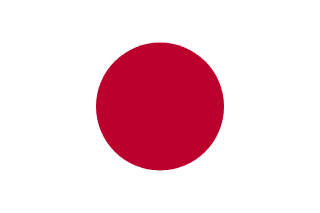
Bangladesh and Japan both have a red disc on a plain field. Bangladesh uses a dark green background with the disc slightly toward the hoist; Japan uses a white background and a disc centered geometrically. Bangladesh’s standard flag has a 3:5 height-to-length ratio, while Japan’s is 2:3. The discs also differ in size relative to their respective rectangles.
Comparison at a glance
| Feature | Bangladesh | Japan |
|---|---|---|
| Background | Bottle green | White |
| Disc color | Red | Deep red |
| Height:length | 3:5 | 2:3 |
| Horizontal disc center | 45% of length from hoist | 50% of length |
| Vertical disc center | Half height | Half height |
| Disc diameter | 40% of length (2/3 height) | 3/5 of height |
How to identify the two red-disc flags
The fastest way to tell the flags apart is to look at the background. Bangladesh uses green across the entire field, apart from the red disc. Japan uses white. This is a stronger identification feature than attempting to compare the precise shade of red.
Both flags contain a solid circular shape rather than a ring, a crescent or a star. Neither ordinary national design has text, an outline around the disc, a second symbol or stripes across the background.
The disc in Japan sits at the exact geometric center of the flag. Its distance from the left edge equals its distance from the right edge, and its distance from the top equals its distance from the bottom. The circle is surrounded by a balanced white area.
Bangladesh’s disc is slightly displaced toward the hoist. In the normal front-facing illustration with the pole on the left, its center sits to the left of the rectangle’s midpoint. The disc remains vertically centered.
This offset is subtle enough that it may not be obvious in a small thumbnail. When comparing flat illustrations at a larger size, notice the different spaces to the left and right of the disc in Bangladesh. Japan’s side spaces are equal.
A flag with a red circle on a dark background might initially suggest Bangladesh. If the background is unclear because of shadows, establish the original image source or obtain a clearer view. The circle’s horizontal position provides another clue when the entire rectangle is visible.
The two flags are straightforward to distinguish under ordinary viewing conditions, despite their shared central shape. Their historical meanings, legal dimensions and national origins are distinct, and neither is simply a differently colored version of the other.
Bangladesh’s construction: a 10-by-6 rectangle
The People’s Republic of Bangladesh Flag Rules specify a rectangle ten parts long and six parts high. The background is bottle green, and the red circle has a radius of one-fifth of the flag length. The center is positioned nine-twentieths of the length from the hoist and halfway down the height.
Take one construction part to be five centimeters. The resulting rectangle is fifty centimeters long and thirty centimeters high. The disc radius is ten centimeters, giving a diameter of twenty centimeters.
Find the vertical midpoint fifteen centimeters from the top. The horizontal center coordinate is forty-five percent of fifty centimeters, or twenty-two and a half centimeters from the left hoist. Mark the intersection with a pencil.
Draw the circle with a compass set to ten centimeters. Its left edge is twelve and a half centimeters from the hoist, and its right edge is thirty-two and a half centimeters from the hoist. The remaining distance from that right edge to the fly is seventeen and a half centimeters.
The difference between the two horizontal margins is five centimeters. The disc itself is displaced two and a half centimeters from the geometric center of the rectangle. This is exactly five percent of the flag’s total length, not an arbitrary adjustment.
Vertically, the circle extends from five centimeters down to twenty-five centimeters down. Both upper and lower green margins are five centimeters. The offset is only along the horizontal direction; moving the circle upward or downward would create an incorrect arrangement.
Color the disc red and fill the remaining rectangle green. Keep the circle as a continuous solid shape. Do not add the golden outline of a map, even though that element is relevant to the history of an earlier independence-era flag.
For a digital construction, a one-thousand-by-six-hundred-pixel canvas preserves the rule’s proportions. The circle center is at x equals 450 and y equals 300, with a radius of 200 pixels. These values follow directly from the specified geometry.
Japan’s construction: a centered Hinomaru
The Japanese government’s description of the national flag, known as Nisshoki or Hinomaru, specifies a height-to-length ratio of two to three. The disc is centered, and its diameter equals three-fifths of the flag height.
Use a thirty-centimeter height for comparison with the Bangladesh drawing. Japan’s flag length is then forty-five centimeters. Its red disc measures eighteen centimeters in diameter, giving a compass radius of nine centimeters.
The center is located twenty-two and a half centimeters from the left edge and fifteen centimeters from the top. Although this absolute horizontal coordinate happens to equal the center coordinate of the fifty-centimeter-long Bangladesh example, the relative positions are different. Japan’s rectangle is shorter.
Draw the circle around that point. Its left edge is thirteen and a half centimeters from the hoist and its right edge thirty-one and a half centimeters from the hoist. The white margins at both sides are thirteen and a half centimeters.
The upper and lower margins each measure six centimeters because the circle’s eighteen-centimeter diameter leaves twelve centimeters of the thirty-centimeter height outside it. Divide that remaining distance equally.
The white field should extend all the way to the edge of the rectangle. The disc is deep red and has no additional border or rays. A thin gray frame used by a website to show the edge of the white flag is not part of the national design.
For a nine-hundred-by-six-hundred-pixel artboard, the circle is centered at x equals 450 and y equals 300. Its diameter is three hundred sixty pixels and its radius is one hundred eighty pixels. These are exact scaled measurements based on the official Japanese proportions.
A historical Japanese flag specification or reproduction may use different proportions or a displaced disc. For a current national flag drawing, use the modern government definition rather than combining older specifications with the present design.
Compare the two discs at the same height
At a shared height of thirty centimeters, Bangladesh’s flag is fifty centimeters long and Japan’s is forty-five centimeters long. The disc diameters are twenty centimeters and eighteen centimeters respectively.
Bangladesh’s disc therefore occupies two-thirds of the flag’s height, whereas Japan’s occupies three-fifths. In percentage terms, the respective diameters are about 66.7 percent and 60 percent of the height. The Bangladeshi disc is proportionally larger when measured this way.
The horizontal center difference is also measurable. Bangladesh places its center at forty-five percent of the length; Japan uses fifty percent. A digital designer should not copy Japan’s circle and merely change the background to green, because the circle’s size and relative position would still be wrong.
It is possible to compare the total colored circle areas mathematically. Bangladesh uses a radius equal to one-fifth of the length and a height equal to three-fifths of the length. The red disc occupies approximately 20.9 percent of the entire rectangle’s area.
Japan uses a radius equal to three-tenths of its height and a length equal to one and a half times the height. Its disc occupies approximately 18.8 percent of the entire flag area. These are calculated geometric results, not separate legal percentages.
The difference in area is modest but visible in a carefully scaled drawing. It explains why Japan’s white margins can appear somewhat larger around its disc, especially above and below it.
For a classroom exercise, provide the dimensions of both rectangles but ask students to calculate the circle diameter and center themselves. This reinforces the distinction between a measurement based on horizontal length and one based on vertical height.
When displaying flag references side by side, align their heights and preserve their respective aspect ratios. Stretching both images into identical frames can hide the difference in length and distort the circles into ellipses.
Bangladesh’s red disc and independence-era history
The modern flag of Bangladesh developed during the movement for independence in 1971. An earlier design placed a map of the territory inside the red disc on a green background. The map was removed for the modern national design established after independence.
The flag’s green field and red disc form a recognizable national symbol connected with Bangladesh’s history and landscape. Common interpretations associate the green with the land and the red with the rising sun and the sacrifices of the independence struggle. The constitutional definition, however, describes the visual design without requiring those interpretations to be treated as additional legal specifications.
Article 4 of the Constitution identifies the national flag as a red circle on a green background. The flag rules provide the more precise measurements, color description and requirements governing display.
The offset circle is a documented design feature. It is often explained as allowing the circle to look more visually balanced when the flag flies, but that explanation should not replace the actual numerical rule. The circle’s horizontal center is fixed at nine-twentieths of the length from the hoist in the prescribed construction.
A historical image containing the map within the disc can be a legitimate representation of the earlier independence-era design. It should be labeled with its historical context rather than presented as the current national flag. A modern classroom drawing should omit the map.
The modern flag’s simplicity also makes it easy to reproduce at different sizes, provided the ratio and the circle placement remain correct. This is an example of how a design can retain a powerful historical association while using only two main colors and one geometric shape.
For more detail on the earlier map-bearing design and its development, consult the individual Bangladesh flag history guide. The purpose here is to compare the current flag’s geometry with Japan’s and explain the historical distinction between the two red discs.
Japan’s sun-disc tradition and the 1999 law
Japan’s national flag is commonly known as the Hinomaru, a name referring to the sun disc. The association with the sun has a long history in Japanese culture and national identity, predating the modern statutory definition of the flag.
Sun imagery appeared in Japanese banners and maritime contexts before the present national flag law. The exact origins of the design are sometimes explained through traditional stories or historical accounts, and it is important not to treat every such account as proof of a single invention date.
The modern government account states that the national flag and anthem were formalized by legislation in 1999. This law gives the current flag a clear geometric specification, including the centered deep-red disc and its size relative to the white rectangle.
The flag’s legal recognition in 1999 does not mean that Japan first began using the sun-disc design in that year. The design’s earlier historical use and its later legislative codification are distinct events.
The ordinary national flag should also be distinguished from designs using radiating red rays. The Rising Sun flag commonly described in discussions of military or maritime imagery has a different graphic arrangement. The Hinomaru compared here is a plain white field with a single red disc and no rays.
A reader looking at a historical photograph should therefore identify which sun design is actually present and consider the relevant period. A flag with rays should not be reproduced as though it were the ordinary current national flag.
Japan’s use of a sun symbol and Bangladesh’s use of a red disc arise from their separate national histories. Similar shapes can acquire different cultural meanings in different places. The shared geometric form is useful for visual comparison, not evidence that the two national flags represent the same historical tradition.
Classroom and digital drawing checks
For a small classroom exercise, prepare Bangladesh as a twenty-five-by-fifteen-centimeter rectangle and Japan as a twenty-two-and-a-half-by-fifteen-centimeter rectangle. Each follows its official height-to-length proportions.
For Bangladesh, measure eleven and a quarter centimeters from the hoist and seven and a half centimeters down from the top. Draw a circle with a five-centimeter radius. The center should be visibly closer to the hoist than to the fly.
For Japan, measure eleven and a quarter centimeters from the left and seven and a half centimeters down. Draw a circle with a four-and-a-half-centimeter radius. This center is halfway along the full length of the Japanese rectangle.
The center coordinates in centimeters coincide because the drawings have been constructed with the same height and the prescribed proportions. Do not mistake that numerical coincidence for identical relative placement. Bangladesh’s longer rectangle makes the center position offset.
After coloring, check that the circle remains circular rather than becoming oval. A digital flag image stretched without preserving aspect ratio can distort both the outer rectangle and the disc. Use a locked aspect ratio when scaling the complete artwork.
Check the Bangladeshi horizontal margins and the Japanese equal margins. If the green flag has its red disc exactly centered, move the disc toward the hoist by the correct proportion. If the white flag’s disc is offset, center it according to the modern Japanese rule.
For a geometry challenge, ask learners to calculate the diameter of each disc from a specified height, then explain which legal measurements were used. A second exercise can remove the labels and ask for identification based on field color, relative circle size and placement.
For an accessible flag collection, include a text label alongside each illustration. Some readers may have difficulty separating green and red visually, and a clear description of the background and circle position improves usability. The flag names should be part of the surrounding caption rather than inserted into the national artwork.
Frequently asked questions
Which flag has a green background?
Bangladesh.
Which flag has the circle exactly in the middle?
Japan’s modern national flag.
How far toward the hoist is Bangladesh’s disc?
Its center is 45% of the length from the hoist, five percentage points left of the midpoint.
Which disc is larger relative to height?
Bangladesh: 2/3 of height versus Japan’s 3/5.
Sources and artwork
Bangladesh Constitution: Article 4
Banglapedia: National Flag and Flag Rules
Bangladesh Ministry of Textiles and Jute: revised flag rules
Government of Japan: national flag and anthem
Flag artwork: Flagpedia / FlagCDN, public-domain reference artwork. Colors on screen are illustrative. Independent educational comparison; no official endorsement implied. Reviewed November 2026.