Austria vs Latvia Flag: Red-White-Red Stripes Compared
Side-by-side national flag identification, visual differences, historical context and practical examples.
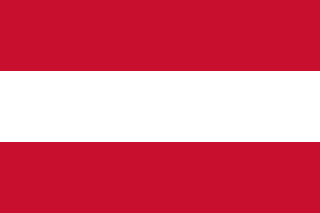
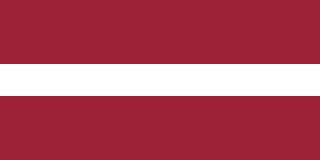
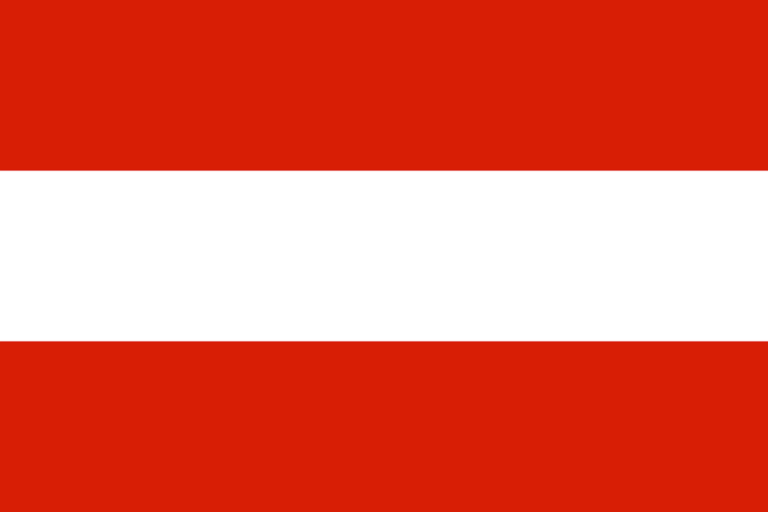
Austria and Latvia have red-white-red horizontal flags, but Austria’s three stripes are equal in height, while Latvia’s stripe heights follow 2:1:2. Latvia also uses a distinctive dark carmine red. The white stripe occupies one-third of Austria’s flag height and only one-fifth of Latvia’s. Measure that stripe first when the precise shade of red is uncertain.
Comparison at a glance
| Feature | Austria | Latvia |
|---|---|---|
| Color order | Red, white, red | Carmine, white, carmine |
| Stripe heights | 1:1:1 | 2:1:2 |
| White share of height | 1/3 | 1/5 |
| Common height:length | 2:3 reference | 1:2 statutory |
| Plain flag emblem | None | None |
The dependable difference is the white stripe
Both flags have a red band at the top, a white band through the middle, and another red band at the bottom. No additional emblem appears in either plain national design. If you reduce the flags to a simple list of colors, the lists are identical. What distinguishes the two is the relative size of the three bands.
Austria’s law describes three equal horizontal stripes. Consequently, the white stripe occupies the same amount of vertical space as either red stripe. Latvia has a much narrower white stripe. Each red stripe is twice the height of the white one, creating a darker-looking flag overall.
This geometric distinction is useful in a photograph where the exact red shade may have changed because of lighting or camera settings. Look at the central stripe in relation to the red areas above and below it. If the bands are all equal, the arrangement matches Austria. If the two outer bands are twice as high as the white one, the arrangement matches Latvia.
A photograph of a folded flag may conceal part of one red stripe. In that case, compare another region of the flag where the full height is visible. The stripe ratios can only be measured accurately if the original colored rectangle is sufficiently visible.
The color of the red regions offers useful supporting evidence. Latvia’s official carmine is typically noticeably darker than the bright red found in standard Austrian reference artwork. However, the stripe dimensions are much less dependent on a particular monitor or printing process.
Neither flag can be transformed into the other simply by turning it upside down. Both designs are symmetrical from top to bottom. The difference lies in proportions and color, not in the order of the bands.
Calculate the stripe heights at several sizes
Suppose both flags are thirty centimeters high. Austria’s three bands must each measure ten centimeters. The top red occupies the first ten centimeters, the white occupies the area from ten to twenty centimeters, and the bottom red occupies the last ten centimeters.
Latvia’s height is divided into five equal construction units. Each unit is six centimeters in this example. The upper carmine band is twelve centimeters high, the white band is six centimeters high, and the lower carmine band is twelve centimeters high.
The central white region is four centimeters narrower in the Latvian drawing even though both flags are the same height. At this scale, the Latvian white band measures sixty percent of the height of the Austrian white band.
For a smaller ten-centimeter-high drawing, Austria’s stripe heights are three and one-third centimeters each. Latvia’s are four, two and four centimeters. On a fifteen-centimeter-high drawing, Austria has five-centimeter stripes and Latvia has six, three and six centimeters.
On a digital canvas six hundred pixels high, Austria’s horizontal boundaries are at two hundred and four hundred pixels from the top. Latvia’s are at two hundred forty and three hundred sixty pixels. Both flags can be rendered with precise rectangular shapes rather than approximating the stripes by eye.
An area comparison yields the same fractions because each stripe spans the entire length. Austria devotes one-third of its area to white and two-thirds to red. Latvia devotes one-fifth to white and four-fifths to carmine. The larger red area contributes to the visual impression of a different design even before the shades are compared.
These calculations follow from the official stripe definitions. They are not separate legislative requirements for a particular physical size. They explain how to scale the designs consistently in classrooms, graphics and other educational materials.
The difference in overall flag proportions
The commonly reproduced Austrian national flag has a height-to-length ratio of two to three. Latvia’s standard national flag has a statutory ratio of one to two. The Latvian flag therefore looks longer when both designs are displayed at the same height and preserve their reference dimensions.
For a height of twenty centimeters, the usual Austrian reference measures thirty centimeters long, while Latvia’s standard flag measures forty centimeters long. Both remain simple rectangles, but the relative shape of the whole image differs.
The Austrian law’s basic definition of the plain flag emphasizes its three equal horizontal bands. Avoid treating the common two-to-three reference rectangle as an assertion about every possible Austrian flag used in practice. Particular official or service designs can have additional specifications.
Latvia’s national flag law expressly specifies the one-to-two ratio and the two-to-one-to-two stripe arrangement. It also allows certain decorative uses with different overall proportions, provided the prescribed color tones and stripe ratios remain intact. This is an important exception when identifying a Latvian decorative banner.
If a website places all flags in a standard rectangular container, it may normalize their visible lengths. A Latvian image shown in a shorter box might have been stretched, cropped or placed within a fixed-size design. Overall length is therefore best treated as corroborating evidence.
When creating a visual comparison, align the images by height and preserve their natural aspect ratios. This displays the stripe differences and relative lengths together. Do not stretch one flag until both have the same width simply to produce a visually symmetrical chart.
The ratio of the stripes remains the primary recognition feature. Even a decorative Latvian banner with a different length should retain its characteristic narrow white stripe if it conforms to the statutory decorative-use conditions.
Why Latvia uses a darker carmine red
The Office of the President of Latvia explains that the distinctive carmine red was formally described in government documentation in 1922 to help distinguish the Latvian flag from the similarly colored Austrian flag. This makes the color distinction more than a casual observation about modern web graphics.
Carmine is a deep red, often rendered in a darker, more burgundy-like shade than the red of the Austrian reference design. Latvia’s law calls the national flag carmine with a white horizontal stripe, and further regulations address technical color requirements for different materials and depictions.
A color displayed on a screen should not be treated as a certified match for a government textile standard. The same digital color can appear different on two monitors. A photographed flag may look lighter in direct sunlight or darker under indoor illumination.
Printed colors also depend on paper, ink and the production process. The exact appearance of a printed red swatch can differ from its RGB representation. This is why formal color matching should use the applicable official technical specifications rather than an arbitrary hexadecimal code.
In an ordinary flag quiz using consistently sourced illustrations, darker red is a useful clue for Latvia. It should be paired with the narrower white band. In an uncontrolled photograph, the geometry provides a more dependable basis for recognition.
For an educational drawing, choose a darker carmine for Latvia and a clearer bright red for Austria. Keep the white stripe genuinely white in both. This demonstrates the documented difference without suggesting that a student’s pencil shade is an official production standard.
Avoid describing the two flags as exactly the same design with different red shades. The stripe proportions are independently different and remain distinguishable even if both are colored with the same red pencil.
Austria’s flag and the Babenberg tradition
Austria’s red-white-red colors have a long association with the country’s heraldic history, particularly the arms of the Babenberg dynasty. The modern national flag is a simple expression of that older color tradition, rather than a picture of an entire medieval coat of arms.
A well-known legend associates the colors with a white garment that became stained red during a battle, leaving a white area beneath a belt. The story is commonly linked with Duke Leopold V. It is best understood as a traditional origin story rather than treated as verified proof of the first creation of the flag.
The red-white-red arrangement appears in historical Austrian heraldry, while the political institutions and official uses of Austrian flags changed over time. A medieval banner, an imperial ensign and a modern republican flag do not necessarily represent the same political entity.
The Austrian Republic’s current legal framework describes the colors and national flag through the federal coat-of-arms and symbols law. Section 3 provides the clear three-equal-band rule that is central to the comparison with Latvia.
The Austrian service flag includes the federal coat of arms. This is a separate official-use design from the plain red-white-red national flag. A central eagle on an Austrian flag may therefore indicate a governmental variant rather than a completely different color arrangement.
For a historical collection, identify the relevant period and kind of flag. Do not label every flag associated with the former Habsburg monarchy as the modern Austrian national flag. The relationship between historic color traditions and modern legal symbols is important, but the individual designs have their own contexts.
The key historical difference from Latvia is that Austria’s colors are tied to its own longstanding heraldic tradition. The fact that the Latvian flag also uses red and white does not establish an identical national origin.
Latvia’s flag and the restoration of national symbols
The Latvian flag also has a historical tradition associated with medieval accounts of red and white banners. The modern national design was developed through the Latvian national movement and the establishment of the independent republic in the twentieth century.
The Latvian president’s official account describes the modern flag tradition and the distinctive carmine color. The 1922 documentation helps explain why the flag’s color was intentionally differentiated from Austria’s. This is especially relevant because the two national flags share the same basic three-band sequence.
Latvia’s national symbols were suppressed during Soviet rule. The movement to restore the historic flag in the late 1980s became associated with the renewed struggle for national independence. The restored flag therefore carries a particular connection with the modern history of Latvian statehood.
The current law defines the flag’s carmine color, narrow white stripe and overall proportions. It also specifies conditions for display, respectful use and decorative depictions. The flag’s visual form is therefore supported by contemporary law as well as historical tradition.
A popular story about the origin of Latvia’s red-and-white colors may resemble legends associated with other European flags. Such stories should be clearly identified as legends or traditional accounts. Their similarity does not establish that the Austrian and Latvian national designs developed from the same event.
A comparative historical timeline should separate medieval references, twentieth-century standardization and modern legal definitions. These are different kinds of evidence. A medieval description may demonstrate an older color association without providing an exact construction drawing for the present flag.
The Latvian flag’s distinctive narrow white band and carmine color represent its own national identity. In a comparative flag collection, it should be labeled as Latvia’s national flag, not described merely as a darkened or stretched version of Austria’s.
Draw both flags without confusing the geometry
Prepare two pieces of graph paper with a common vertical height of thirty grid squares. For Austria, use a rectangle forty-five squares long. For Latvia, use one sixty squares long. These lengths follow the common Austrian reference ratio and the Latvian standard ratio.
On the Austrian rectangle, draw horizontal lines after the tenth and twentieth rows. Color the top and bottom ten-square bands red, leaving the middle ten-square band white.
On the Latvian rectangle, draw horizontal lines after the twelfth and eighteenth rows. Color the top twelve and bottom twelve rows carmine. The six middle rows remain white. Check that the two red bands have the same height.
Compare the two drawings from a distance before adding labels. Even if the same red pencil has been used on both, the central white bands differ. Use separate color samples afterward to demonstrate the additional carmine distinction.
A second exercise can be carried out using only black and white outlines. Ask learners to match the equally divided rectangle to Austria and the rectangle with a narrow center to Latvia. This makes the recognition activity independent of color perception.
For a cut-paper project, prepare rectangular bands separately. The Austrian three strips should have equal dimensions. The Latvian outer strips should each be twice the height of its middle strip. Assemble the pieces without overlaps or gaps that would change the measured proportions.
If building a digital illustration, use exact fractional coordinates instead of rounded visual positions. Scale the completed group as a single object. A resize that changes the overall aspect ratio may preserve the stripe fractions but still produce an inaccurate standard reference rectangle.
Finish by placing the country names outside the flags. A written label is especially useful when a reference is printed in grayscale or viewed as a small thumbnail.
Other flags with red and white bands
Several national flags contain red and white, but different structures separate them from Austria and Latvia. Poland uses two horizontal bands, white over red. Indonesia and Monaco use two bands, red over white. The presence of a second red band distinguishes the Austrian and Latvian designs.
Lebanon also has red bands above and below a white central field, but the white region is wider and contains a green cedar. Its distinctive tree and band proportions provide strong identification clues.
Canada places red regions at the sides of a white central region and displays a maple leaf. The vertical arrangement and central emblem separate it from the two horizontal European tricolors. A red-white-red color description without orientation would include several very different flag designs.
Regional and municipal flags can also use simple red-white-red patterns. Austria’s historical and regional heraldry includes related colors, but a regional flag is not automatically the national flag. Check the specific emblem or official caption if the image contains additional features.
A red-white-red photograph without context can therefore have more possibilities than just Austria and Latvia. Start by determining the number and orientation of the bands, then inspect the relative widths and any emblem. Country information or a reliable source can resolve the remaining uncertainty.
In the specific comparison between the two plain national flags, the decision is straightforward. Austria uses equal bands, Latvia uses a white band half the height of either carmine band. The darker Latvian red and longer standard rectangle reinforce the distinction.
Frequently asked questions
Which flag has a narrower white stripe?
Latvia.
What is Latvia’s stripe ratio?
2:1:2.
Does Austria use three equal stripes?
Yes.
Can I identify Latvia by red shade alone?
Not reliably; check the stripe proportions too.
Sources and artwork
Austria: Wappengesetz, Section 3
Law on the National Flag of Latvia, Section 2
President of Latvia: national symbols
Flag artwork: Flagpedia / FlagCDN, public-domain reference artwork. Colors on screen are illustrative. Independent educational comparison; no official endorsement implied. Reviewed November 2026.