Anjou Flag: Three Gold Fleurs-de-Lis & Red Border
Discover Anjou’s historical banner, heraldic symbols, distinctive colours and how the old province relates to today’s French administrative regions.
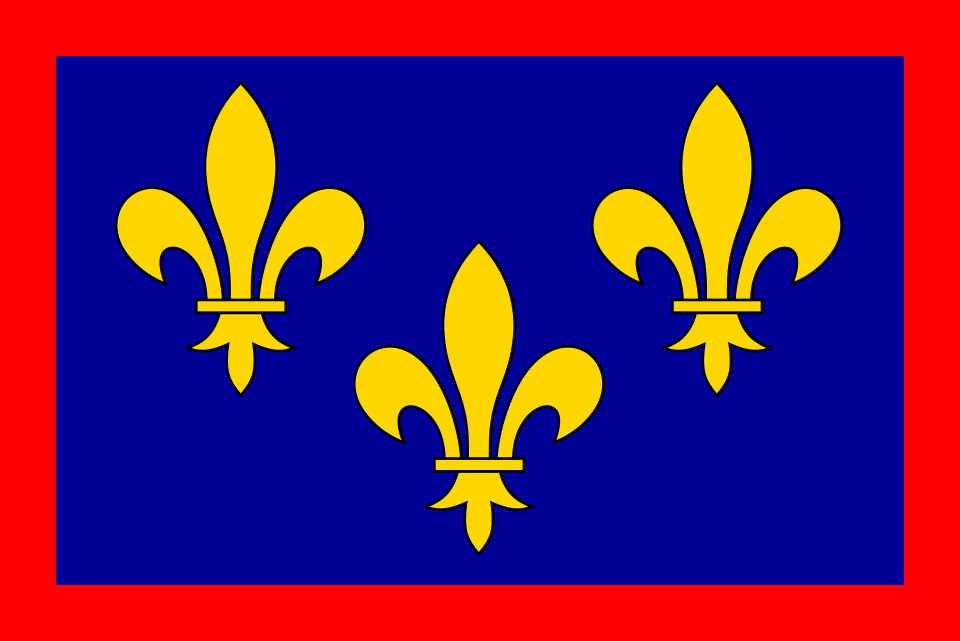
Current status: Historical western French province centred on Angers, now largely within Pays de la Loire; not a standalone contemporary administrative region. The historical area of Anjou lies in western France and centres on Angers along the Loire and Maine rivers. It is now chiefly within Maine-et-Loire and the wider Pays de la Loire region, rather than an administrative region named Anjou. The article focuses on this distinct traditional emblem, rather than relabelling a modern French regional council’s logo.
Anjou flag at a glance
| Historic area | Anjou, France |
|---|---|
| Flag classification | Traditional / historical province or cultural flag |
| Key places | Angers |
| Origins | Heraldic arms of Capetian Anjou, medieval origins |
| Main design | Anjou typically has a plain red border around three gold fleurs-de-lis on blue, while Berry’s red border has a scalloped, engrailed inner edge. |
| Modern administration | Historical western French province centred on Angers, now largely within Pays de la Loire; not a standalone contemporary administrative region |
What does the traditional flag look like?
Anjou’s traditional banner is a rich blue field with three golden fleurs-de-lis and a plain red border. It is a banner of the heraldic arms associated with Anjou’s medieval princely line.
The exact pattern shown on the illustration should be named, since many historical French areas have more than one provincial arms banner or later cultural flag.
What do the symbols mean?
The fleurs-de-lis express links to the French monarchy and Capetian princes who ruled Anjou. The red border differentiates the Anjou arms from the core French royal design of golden lilies on blue.
Some medieval versions show a field semé with numerous gold lilies rather than just three. Their appearance depends on period and heraldic lineage, and the simplified three-lily design should not be projected unchanged onto every century.
Meaning of the colours
Blue and gold occupy the central field, while a clearly visible red band forms the perimeter. The border is not the scalloped or engrailed design used on the Berry arms, an important detail when looking at small flag icons.
Heraldic colours identify families, territories and political traditions. Not every conventional colour can be reliably translated into a modern value or environmental association.
History of this regional emblem
The County and Duchy of Anjou played important roles in medieval French and English dynastic history. The three fleurs-de-lis with a red border are associated especially with a Capetian branch’s arms and were later used as provincial heraldic identity.
The age of an old coat of arms and the much later administrative reforms that reshaped French regions are separate historical questions.
Where is the historical area?
The historical area of Anjou lies in western France and centres on Angers along the Loire and Maine rivers. It is now chiefly within Maine-et-Loire and the wider Pays de la Loire region, rather than an administrative region named Anjou.
French historical provinces have never had perfectly fixed modern boundaries. A name on a heritage flag does not automatically name today’s elected regional council.
Traditional flag vs current French region
Historical western French province centred on Angers, now largely within Pays de la Loire; not a standalone contemporary administrative region
This featured banner is explained as a historical or cultural design. Current regional administrations may use other flags, official logos, coats of arms and civic branding.
Similar French flags compared
Île-de-France also uses blue and three gold fleurs-de-lis but usually has no red border. Berry has the same broad colour family, but its red border is traditionally engrailed with a scalloped inner edge. Anjou uses a plain red border in the common modern provincial banner.
For identifying a historical French flag, look closely at the placement of lilies, the shape of any red border, the number of animals or castles, and whether the background is quartered.
How to reproduce the illustrated flag
Anjou’s traditional banner is a rich blue field with three golden fleurs-de-lis and a plain red border. It is a banner of the heraldic arms associated with Anjou’s medieval princely line.
Download the original vector artwork from Wikimedia Commons if precise curves, medieval charges or heraldic border details are important. Do not substitute an unsourced illustration of a different historical variant.
Frequently asked questions
What is the difference between the Anjou and Berry flags?
Anjou typically has a plain red border around three gold fleurs-de-lis on blue, while Berry’s red border has a scalloped, engrailed inner edge.
Is this currently an official French region flag?
Historical western French province centred on Angers, now largely within Pays de la Loire; not a standalone contemporary administrative region The artwork above is a historical or traditional design.
Which city helps locate the historic region?
Angers.
What is the origin of the emblem?
Heraldic arms of Capetian Anjou, medieval origins.
Is this France’s national flag?
No. France uses the blue-white-red vertical tricolour as the national flag. This is a local heritage design.
Is the image freely reusable?
Check the linked Commons file for the specific artist’s licence, any required credit and separate restrictions governing official symbols.
Sources and image credit
Anjou traditional flag: historic and heraldic sources
French territorial flag index — historical and current designs
Traditional flags versus flags and logos of modern French regions
Wikimedia Commons image: Flag of Anjou.svg. Scaled SVG-to-PNG rendering. Verify creator, licence and any attribution requirements from the original file before reusing the image.
French national flag — blue, white and red explained.
Independent educational guide. It does not claim to be an official publication of a regional council. Reviewed 20 November 2026.