Dauphiné Flag: Blue Dolphins and Gold Fleurs-de-Lis
Discover Dauphiné’s historical banner, heraldic symbols, distinctive colours and how the old province relates to today’s French administrative regions.
Current status: Historical southeastern French province, not a current administrative region; now largely within Auvergne-Rhône-Alpes with some territory in Provence-Alpes-Côte d’Azur. Dauphiné centred on Grenoble and historically covered territory now mainly associated with Isère, Drôme and Hautes-Alpes. Its historical borders do not match the current Auvergne-Rhône-Alpes region. The article focuses on this distinct traditional emblem, rather than relabelling a modern French regional council’s logo.
Dauphiné flag at a glance
| Historic area | Dauphiné, France |
|---|---|
| Flag classification | Traditional / historical province or cultural flag |
| Key places | Grenoble |
| Origins | Medieval Dauphin of Viennois and French royal quartered arms |
| Main design | They are a heraldic play on the title Dauphin, historically used by the rulers of the region and later France’s royal heir. |
| Modern administration | Historical southeastern French province, not a current administrative region; now largely within Auvergne-Rhône-Alpes with some territory in Provence-Alpes-Côte d’Azur |
What does the traditional flag look like?
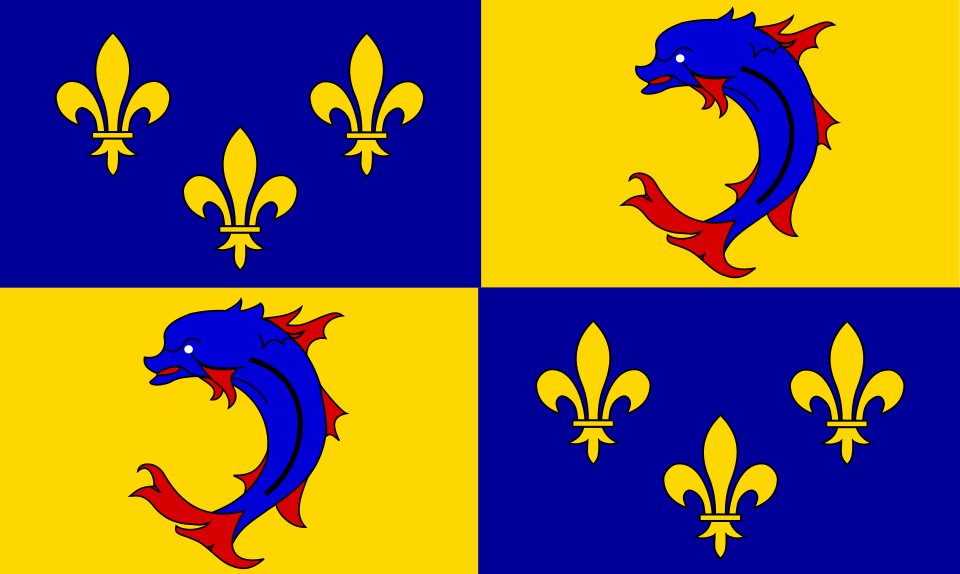
The traditional Dauphiné banner is divided into four quarters. Two blue quarters bear three golden fleurs-de-lis each, and the alternating golden-yellow quarters contain large blue dolphins, usually with contrasting red fins and details.
The exact pattern shown on the illustration should be named, since many historical French areas have more than one provincial arms banner or later cultural flag.
What do the symbols mean?
The dolphin is a heraldic pun on the title Dauphin, borne by rulers of Viennois and later by the heir to the French throne. The fleurs-de-lis represent the royal French connection after the Dauphiné passed into the orbit of the French crown.
The heraldic dolphin may look stylised and unlike a modern wildlife drawing. The fins, tail and side view follow medieval coat-of-arms conventions; those features should not be mistaken for a different animal.
Meaning of the colours
Blue and gold are repeated throughout the quartered pattern. The blue dolphins on yellow should not be mistaken for aquatic regional fauna selected for tourism; they carry the old title of the Dauphin in heraldic form.
Heraldic colours identify families, territories and political traditions. Not every conventional colour can be reliably translated into a modern value or environmental association.
History of this regional emblem
The historical County of Albon and Dauphiné developed under lords bearing the title Dauphin. In 1349 the region transferred to the French crown under conditions that gave the title Dauphin of France to the royal heir. The quartered flag preserves that connection.
The age of an old coat of arms and the much later administrative reforms that reshaped French regions are separate historical questions.
Where is the historical area?
Dauphiné centred on Grenoble and historically covered territory now mainly associated with Isère, Drôme and Hautes-Alpes. Its historical borders do not match the current Auvergne-Rhône-Alpes region.
French historical provinces have never had perfectly fixed modern boundaries. A name on a heritage flag does not automatically name today’s elected regional council.
Traditional flag vs current French region
Historical southeastern French province, not a current administrative region; now largely within Auvergne-Rhône-Alpes with some territory in Provence-Alpes-Côte d’Azur
This featured banner is explained as a historical or cultural design. Current regional administrations may use other flags, official logos, coats of arms and civic branding.
Similar French flags compared
The plain royal Île-de-France banner has gold fleurs-de-lis on blue but no dolphins. Dauphiné repeats fleur-de-lis and blue dolphin charges in alternating quarters. Burgundy also uses quartering, but its other quarters have diagonal stripes rather than dolphins.
For identifying a historical French flag, look closely at the placement of lilies, the shape of any red border, the number of animals or castles, and whether the background is quartered.
How to reproduce the illustrated flag
The traditional Dauphiné banner is divided into four quarters. Two blue quarters bear three golden fleurs-de-lis each, and the alternating golden-yellow quarters contain large blue dolphins, usually with contrasting red fins and details.
Download the original vector artwork from Wikimedia Commons if precise curves, medieval charges or heraldic border details are important. Do not substitute an unsourced illustration of a different historical variant.
Frequently asked questions
Why are there dolphins on the Dauphiné flag?
They are a heraldic play on the title Dauphin, historically used by the rulers of the region and later France’s royal heir.
Is this currently an official French region flag?
Historical southeastern French province, not a current administrative region; now largely within Auvergne-Rhône-Alpes with some territory in Provence-Alpes-Côte d’Azur The artwork above is a historical or traditional design.
Which city helps locate the historic region?
Grenoble.
What is the origin of the emblem?
Medieval Dauphin of Viennois and French royal quartered arms.
Is this France’s national flag?
No. France uses the blue-white-red vertical tricolour as the national flag. This is a local heritage design.
Is the image freely reusable?
Check the linked Commons file for the specific artist’s licence, any required credit and separate restrictions governing official symbols.
Sources and image credit
Dauphiné traditional flag: historic and heraldic sources
French territorial flag index — historical and current designs
Traditional flags versus flags and logos of modern French regions
Wikimedia Commons image: Flag of Dauphiné.svg. Scaled SVG-to-PNG rendering. Verify creator, licence and any attribution requirements from the original file before reusing the image.
French national flag — blue, white and red explained.
Independent educational guide. It does not claim to be an official publication of a regional council. Reviewed 20 November 2026.