Burgundy Flag: Ducal Quarters, Fleur-de-Lis & Cross Difference
Explore the Burgundy flag’s symbolism, heraldic origins, design and relationship with present-day French regions.
Status: Historical duchy and former administrative region, now part of Bourgogne-Franche-Comté since 2016. The historic duchy centred on Dijon and the Burgundy wine country in eastern France. The present Bourgogne-Franche-Comté administrative region includes territories with distinct heraldries, including Franche-Comté. The guide distinguishes older regional heritage from present French government branding.
Burgundy flag at a glance
| Area | Burgundy, France |
|---|---|
| Type | Historical / cultural regional flag |
| Cities to locate the area | Dijon |
| Historical tradition | Late medieval ducal heraldry; traditional banner |
| Main design | Not always. The illustrated historic ducal flag is quartered with fleurs-de-lis and diagonal bands; the Cross of Burgundy is a different ragged red saltire. |
| Modern status | Historical duchy and former administrative region, now part of Bourgogne-Franche-Comté since 2016 |
What does the flag look like?
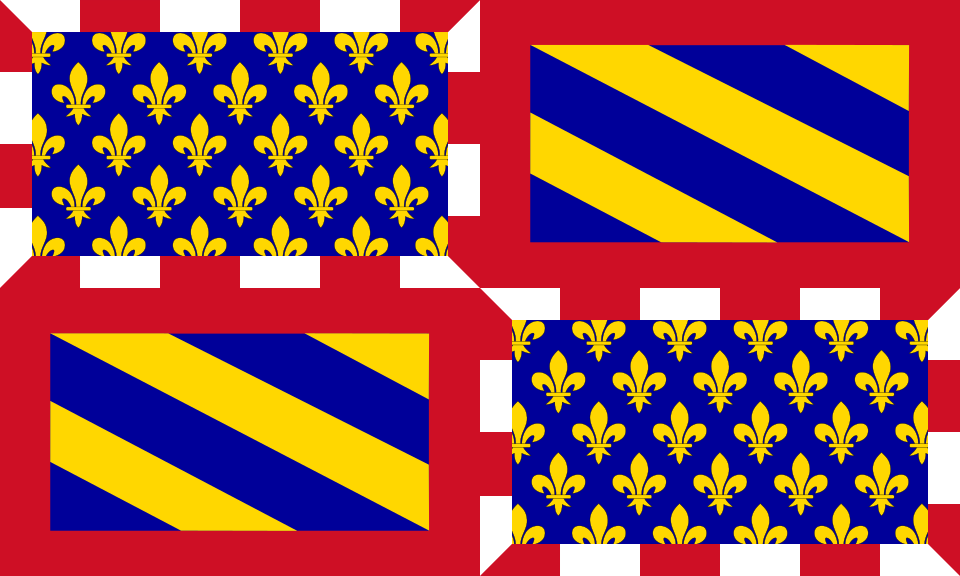
The historical ducal Burgundy banner shown here is quartered. Two quarters include blue-and-gold royal fleurs-de-lis associated with the Burgundy dukes; the other two display diagonal bands of gold and blue with red borders, the older Burgundian heraldic device.
This guide describes the particular artwork shown rather than treating every regional logo, provincial arms banner and cultural movement flag as the same design.
Symbols and historical meaning
The quartering combines the Burgundian ducal lineage’s royal French connections with the historic arms of Burgundy. It is a heraldic lineage statement, not an attempt to depict modern departments or cities individually.
There is no single medieval standard that should be presented as the modern government flag for all territory now called Bourgogne-Franche-Comté. Treat this illustration as a traditional ducal arms banner.
What do the colours represent?
Blue and gold dominate, with red outlining elements of the old Burgundy quarters. The mixture is visually complex compared with the red ragged diagonal cross sometimes called the Cross of Burgundy.
The colours are heraldic identifications. Where no historic explanation is recorded, claims about nature, freedom or regional character are interpretations, not documented legal meanings.
History of the banner
Burgundy was a major European duchy in the later Middle Ages. Its dukes developed prominent armorial standards. After territorial and dynastic changes the name Burgundy applied to different political entities, so identifying the duchy separately from the County of Burgundy is essential.
Many historical banners were used or reconstructed long before and after modern French regional boundaries were established.
Where is this historical area?
The historic duchy centred on Dijon and the Burgundy wine country in eastern France. The present Bourgogne-Franche-Comté administrative region includes territories with distinct heraldries, including Franche-Comté.
Historic cultural territories and modern administrative regions often have different borders. The place names help locate the heritage area without assuming it is an independent jurisdiction.
Is this an official modern region flag?
Historical duchy and former administrative region, now part of Bourgogne-Franche-Comté since 2016
France’s regional government logos and local cultural flags do not always have the same legal status. The featured image is identified as a historical or traditional regional emblem, not automatically a current official council flag.
Similar flags: avoid confusion
The Cross of Burgundy is a red ragged saltire on white, widely associated with Habsburg and Spanish military history. The flag illustrated here is a quartered ducal banner, not that saltire. Another image titled ‘Flag of Burgundy’ on Wikimedia depicts a Habsburg-era County of Burgundy flag, a separate historical context.
When identifying a flag, compare the animal count, orientation of stripes, heraldic field and whether a cross or motto is present. Exact designs matter more than place-name similarities.
How to reproduce the illustrated flag
The historical ducal Burgundy banner shown here is quartered. Two quarters include blue-and-gold royal fleurs-de-lis associated with the Burgundy dukes; the other two display diagonal bands of gold and blue with red borders, the older Burgundian heraldic device.
Start with the colour field, then trace any heraldic charges from the original Commons vector file. A complicated arms banner should not be redesigned as an approximate geometric logo.
Frequently asked questions
Is the Burgundy flag the red Cross of Burgundy?
Not always. The illustrated historic ducal flag is quartered with fleurs-de-lis and diagonal bands; the Cross of Burgundy is a different ragged red saltire.
Is this the current administrative-region flag?
Historical duchy and former administrative region, now part of Bourgogne-Franche-Comté since 2016 The featured artwork represents the historic or cultural banner specifically described here.
Where is Burgundy?
The historic duchy centred on Dijon and the Burgundy wine country in eastern France. The present Bourgogne-Franche-Comté administrative region includes territories with distinct heraldries, including Franche-Comté.
What are its main colours?
Blue and gold dominate, with red outlining elements of the old Burgundy quarters. The mixture is visually complex compared with the red ragged diagonal cross sometimes called the Cross of Burgundy.
What is the historical origin of this design?
Late medieval ducal heraldry; traditional banner.
Can I reuse the flag image?
Check the linked Wikimedia Commons file for its actual artwork licence and credit. Heraldic designs, individual vector drawings and restricted official insignia may have different legal rules.
Sources and artwork credit
Burgundy historic flag and heraldic reference
Wikimedia Commons overview of flags of French subdivisions
France regional flags — traditional, logo and government status distinctions
Wikimedia Commons original: Ancient Flag of Burgundy.svg. The featured PNG is a scaled rendering. Review the original page for the artist’s attribution, copyright licence and any legal restrictions.
France’s national flag is the blue-white-red tricolour, distinct from the provincial heritage flag shown here.
Independent educational guide, not an official publication of a French region. Reviewed 20 November 2026.