Surrey Flag: Gold & Blue Warenne Checks Explained
Why is Surrey’s county flag a gold-and-blue checkerboard? Explore the de Warenne earls, Caerlaverock siege in 1300 and centuries of county heraldry.
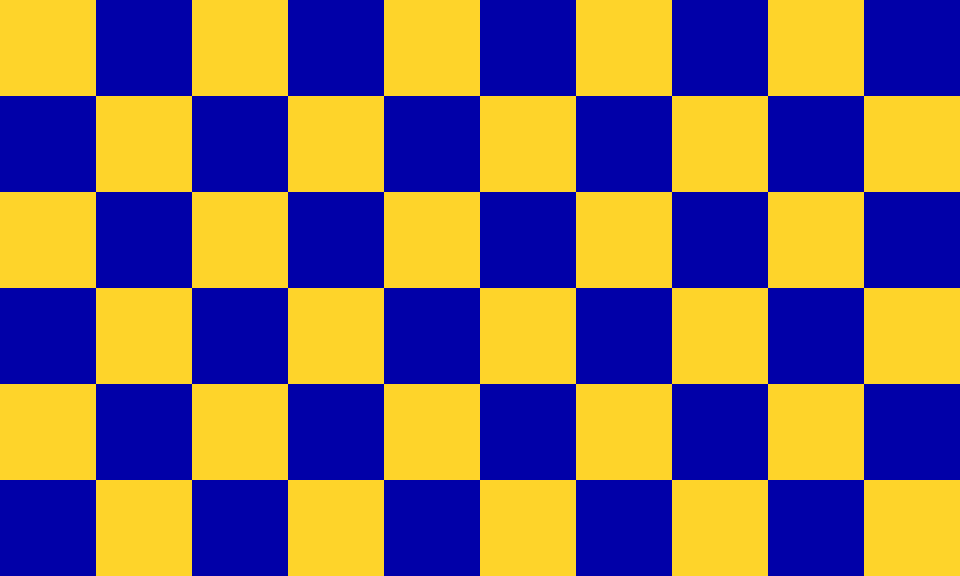
Surrey has a distinctive flag whose details are often lost in small icons or confused with neighbouring county designs. The flag is made entirely of alternating gold and blue squares in a repeating chequerboard pattern. There is no separate coat of arms at its centre. This guide explains the main motifs, supported historical milestones and its place in the UK Flag Registry.
Surrey flag at a glance
| Feature | Details |
|---|---|
| Historic county | Surrey, southeast England |
| Flag type | Traditional community county banner |
| Pattern | Gold and blue chequers |
| Heraldic family | De Warenne, Earls of Surrey |
| Documented banner | Siege of Caerlaverock, 1300 |
| Colour references | Gold 116 and Blue 286 |
| Ratio | 3:5 |
| Registry dating | Traditional, medieval |
Historic county identities, modern geographic regions and local-government authorities are different things. The dated flag reference below distinguishes inherited heraldic designs from modern public flag registrations.
What does Surrey’s flag look like?
The flag is made entirely of alternating gold and blue squares in a repeating chequerboard pattern. There is no separate coat of arms at its centre.
This stark geometric design is one of England’s simplest county flags, standing out from those with animals, crosses or roses. The colours and repeated squares are essential to its identity.
Who were the de Warennes?
The de Warenne family held the Earldom of Surrey and used a gold-and-blue chequered coat of arms.
Their emblem became associated with Surrey more widely, surviving after the end of the family’s direct line in the fifteenth century. The flag therefore represents a county through older noble heraldry.
How old is the Surrey checkered flag?
The Flag Institute points to the siege of Caerlaverock Castle in 1300, where a banner of the Earl of Surrey was described or represented using this pattern.
This is unusually strong medieval documentation for a county emblem. It does not establish every modern stitch or ratio, but it provides a historical link from medieval heraldry to a recognizable flag pattern today.
Does each square represent a district?
No. The checks are a heraldic pattern, sometimes described as chequy Or and Azure, meaning gold and blue.
The squares are repeated to fill the entire field; no individual one is assigned by official heraldry to a particular Surrey town, borough or parish.
Why gold and blue?
Gold and blue are the ancestral de Warenne armorial colours. The Flag Institute records Gold 116 and Blue 286 in its modern specification.
Although a checkerboard might remind people of fields or maps, there is no need to invent a landscape meaning where medieval family heraldry provides a clear and documented explanation.
How did the checks become a county emblem?
Surrey clubs, local societies and civic authorities adopted the gold-and-blue pattern over the centuries, embedding it in county identity.
The design remained useful even after the de Warenne family line ended in 1415. It is a good example of medieval heraldry becoming a modern public symbol.
Surrey vs Sussex and Kent
Sussex uses six gold martlets on blue. Kent uses a white horse on red. Surrey has no individual animal or flower, only repeated gold-blue squares.
Although all three are southeast English counties, their public flags make markedly different visual choices, making a flag identification exercise straightforward.
Is this a national flag?
Surrey is a historic English county. The Warenne Checks are its county community flag, not a national flag of a sovereign state.
A standard caption is Surrey county flag (Warenne Checks). Avoid confusing it with racing checkerboards or municipal corporate logos.
How to draw the Surrey flag
Divide a 3:5 rectangle into a regular grid and alternate gold and blue squares in a checkerboard. Maintain consistent dimensions and complete rows.
The most useful clue is ‘yellow and blue chequerboard‘. Unlike a chessboard, its colours are heraldic gold and blue, not black and white.
Frequently asked questions
What is Surrey’s flag called?
The Warenne Checks.
Why is it checkered?
The pattern comes from the arms of the de Warenne Earls of Surrey.
How old is the documented emblem?
It appears in connection with the 1300 siege of Caerlaverock.
What colours does it use?
Gold/yellow and blue.
Does it have a central badge?
No; the field is entirely checks.
Are squares assigned to towns?
No, they are a heraldic repeated pattern.
Is this a flag of a country?
No, Surrey is a historic English county.
How is it different from Sussex?
Sussex has six golden martlets on a solid blue background.
Official references and illustration credits
Flag Institute — Surrey county flag
Image rights and attributionFlag illustration: Wikimedia Commons — Surrey flag. The displayed PNG is a raster conversion of the Commons SVG. See the linked source for artist, copyright licence and applicable attribution/share-alike terms; official insignia may be subject to additional restrictions.
Independent educational guide. Research checked November 2026; no endorsement by the Flag Institute or local authorities is implied.