Réunion Flag: Lo Mavéli, Red Volcano & Yellow Rays Explained
Réunion’s widely seen Lo Mavéli flag uses a red volcano triangle with five yellow rays spreading across blue. Learn the history of this unofficial island flag.
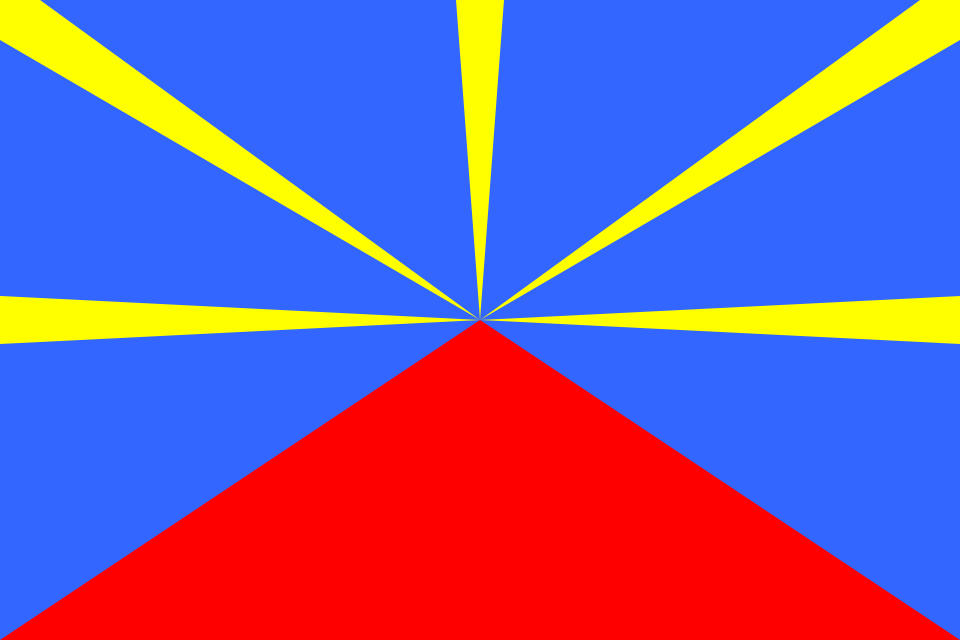
Réunion is a French overseas department and region in the Indian Ocean, east of Madagascar. Its red triangle and yellow rays resemble an erupting volcano under sunlight, making Lo Mavéli particularly easy to recognize in photos and flag quizzes.
The Flags of the World Réunion record distinguishes the Volcan Rayonnant from other flag proposals and describes its 1975 origin and 2003 competition selection. A recent Réunion flag guide similarly notes that the French national tricolour remains the official flag.
Réunion flag at a glance
| Feature | Details |
|---|---|
| Territory | Réunion, southwest Indian Ocean |
| Political status | Overseas department and region of France |
| Official national flag | French tricolour |
| Featured regional symbol | Lo Mavéli / Le Volcan Rayonnant |
| Creator | Guy Pignolet |
| First designed | 1975 |
| Vexillological competition selection | 1 March 2003 |
| Colours | Blue field, red triangle, five yellow rays |
| Flag status | Widespread unofficial regional use |
French overseas territories may have well-known local emblems alongside France’s official tricolour. Symbolism, local display and constitutional legal status should be kept distinct; the references below indicate which type of flag is discussed.
What does Lo Mavéli look like?
The background is blue. From its lower edge rises a large red triangle whose point touches an invisible central focal point. From that tip, five yellow rays spread toward the upper and side edges. The rays and red cone together form a simplified volcanic sunrise.
This is not a blue field with one yellow star or a solid red mountain without light. The striking ray layout is the signature of the widely photographed design; variations may alter its exact blue shade and ray width.
What does the red triangle symbolize?
The red triangle stands for a volcano, commonly identified with Piton de la Fournaise, the island’s active volcano. The triangular shape evokes both the mountain and the geological power of Réunion.
An active volcano is a defining characteristic of the island’s natural landscape and popular identity. The flag’s simplified red cone is symbolic rather than a scientifically precise rendering of the volcano’s actual profile.
What do the five yellow rays represent?
The five radiant yellow beams are associated with the sun, light and the island’s vitality. Descriptions also connect them with the plural cultural origins of Réunion’s population and a hopeful shared future.
Not every reference assigns each ray to a separate named ethnicity or municipality, so that explanation should not be given as a legal fact. For accurate flag identification, the five rays spreading from the red peak are more important than a speculative one-to-one symbolism.
Why is the rest of the Réunion flag blue?
The blue background refers to the surrounding Indian Ocean, the island’s sky and the calm space around the blazing volcanic form. The strong contrast among blue, yellow and red is what makes the design work visually.
The flag does not show the French national red-white-blue bands; instead it expresses a specifically Réunionese relationship with landscape and nature. Those informal meanings do not displace the French flag’s official role.
Who designed the Lo Mavéli flag?
The design is credited to Guy Pignolet, an engineer who proposed the radiant-volcano idea in 1975. It was later selected by the Association Réunionnaise de Vexillologie in a local flag competition on 1 March 2003.
The 1975 design and 2003 competition are different milestones: a modern flag can be drawn decades before it becomes widely accepted as a local emblem. Neither event should be described as a parliamentary adoption of a sovereign national flag.
Is Réunion’s radiant-volcano flag official?
The French tricolour remains the national flag of Réunion because the island is an overseas department and region of France. Lo Mavéli is a de facto local symbol, used by some municipalities, associations and residents.
Some other local flags are also displayed, so ‘official regional flag’ is too strong without a specific legal authority or use context. Its popularity is real, but widespread display and formal national-flag status are distinct concepts.
What are Réunion’s other proposed or local flags?
Réunionese flags have also included MLK cultural-symbol designs, red-yellow-green nationalist banners and other proposals. The regional government has its own visual identity and institutional branding, which is not the same as Lo Mavéli.
A proper comparison should label these designs by movement, historical period or administrative context. A general ‘Réunion flag’ image search is likely to mix them together. The vibrant volcano-and-rays design is simply the best-known community banner.
Réunion compared with Mayotte and Martinique flags
The Mayotte local flag is white and contains a coat of arms with two seahorses, a crescent and ylang-ylang flowers. Martinique’s adopted local identity flag has a red hoist triangle and green-black horizontal bands.
Réunion’s Lo Mavéli is a blue field with a red volcano and yellow rays. Despite being overseas territories of France, all three display different local or institutional symbols.
How to draw Lo Mavéli
Fill a rectangle blue. Draw a large red triangle rising from the centre of the bottom edge. Add five long yellow triangular rays radiating from the triangle’s upper point toward the upper and lateral edges.
For an educational flag chart, caption the picture ‘Lo Mavéli, widely used unofficial flag of Réunion’. That tells readers both what it depicts and how it differs from the French national flag.
Frequently asked questions
What is the flag of Réunion?
The legally official national flag is France’s tricolour; the popular local flag is Lo Mavéli, a blue design with red volcano and yellow rays.
What does Lo Mavéli mean?
It is the familiar name of the Réunionese radiant-volcano flag.
What is the red triangle for?
It evokes the volcano, especially Piton de la Fournaise.
How many yellow rays are there?
Five principal yellow rays.
Who created the flag?
Guy Pignolet, in 1975.
When was it selected in a vexillological competition?
1 March 2003.
Did the flag make Réunion independent?
No. Réunion remains an overseas department and region of France.
Is Réunion’s flag the same as Mayotte’s?
No. Mayotte’s local emblem has seahorses; Réunion’s shows a radiant volcano.
References and illustration credits
Flags of the World — Réunion: Volcan Rayonnant and other flags
Réunion flags explained — Lo Mavéli, 2026
Wikimedia Commons — Guy Pignolet’s radiant-volcano design vector
PNG derived from the Wikimedia Commons source for the Réunion local flag. Vector by Ch1902, based on the radiant-volcano design by Guy Pignolet. Wikimedia Commons contributor released the vector into the public domain. The file’s historical name says ‘proposed’ because the design is not a formally adopted French national flag.
Flag images are provided for educational comparison, without claiming any association with governmental authorities. Research checked November 2026.