Wallis and Futuna Flag: Four White Triangles & French Canton
Wallis and Futuna’s widely pictured local flag has a red field, four white triangles and a small French tricolour. Learn its use, symbolism and variant designs.
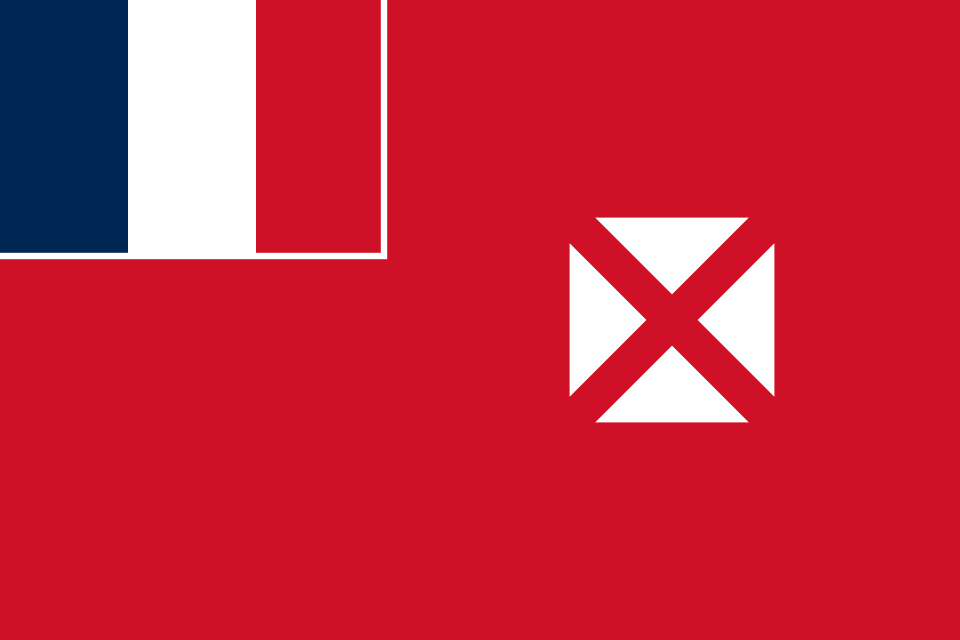
Wallis and Futuna is a French overseas collectivity in the South Pacific. Flag directories frequently show a striking red design with a white cross-like symbol and a French tricolour canton. Understanding its status matters because it is not a national flag of an independent Wallis and Futuna state.
The Flags of the World analysis records several local versions and differences between published drawings and flags actually seen in the territory. The French territorial administration’s institutional overview explains the three customary kingdoms within the French constitutional framework.
Wallis and Futuna flag at a glance
| Feature | Details |
|---|---|
| Territory | Wallis and Futuna, South Pacific |
| French constitutional status | Overseas collectivity of France |
| Official national flag | French blue-white-red tricolour |
| Featured design | Unofficial local red flag |
| Canton | Small French tricolour |
| Other symbol | White square with red diagonal cross |
| White geometry | Four inward-pointing triangles |
| Historic relationship | French missionaries and customary kingdoms |
French overseas territories may have well-known local emblems alongside France’s official tricolour. Symbolism, local display and constitutional legal status should be kept distinct; the references below indicate which type of flag is discussed.
What does the local Wallis and Futuna flag look like?
The common reference-book design uses a red field, a small vertical blue-white-red French flag in the upper hoist and, toward the centre or fly, a white square containing a red saltire. The red diagonal lines divide the white square into four white triangular areas.
The white shapes can look like an elaborate Maltese cross when reproduced at icon size, but their construction is a square and red diagonal cross. Some locally displayed variants feature a broad white cross rather than the inward-pointing triangles.
What do the four white triangles mean?
Traditional explanations link the four triangular sections with the territory’s three customary kingdoms—Uvea, Alo and Sigave—and the French administration. This is a customary interpretation rather than a formal French national-flag rule.
The symbolism reflects the territory’s distinctive administrative system, where customary monarchies coexist with French institutions. The precise flag variants and their use in local ceremonies should not be treated as identical in every community.
Why is the French flag in the upper-left?
The small blue-white-red French tricolour in the canton marks Wallis and Futuna’s relationship with France. It is framed in white on parts of its edge to contrast against the red field.
This is different from a British ensign’s Union Jack canton. The local red design borrows a French national emblem, while France’s tricolour remains the actual official national flag for state and government use.
Where did the red-and-white cross design originate?
Specialist histories associate the red banner and white Christian cross with nineteenth-century French Catholic missionaries in the islands. The later local variants preserve that religious and historical influence.
The flag should not be presented as an ancient pre-European national banner. Its present form reflects a period when missionary imagery, local kingdoms and French political institutions became intertwined.
What other Wallis and Futuna flags are used?
The most commonly reproduced version shows four white triangles inside a square. Other photographs show a white cross pattée or related cross designs against the same red field. Local ceremonies may also feature flags of particular kingdoms.
One specialist study notes that the four-triangle version may be far more common in global flag charts than in everyday local displays. A careful article should describe the pictured design without claiming every local institution uses one unchanging version.
Is Wallis and Futuna’s red flag officially adopted?
The French tricolour is the official national flag, since Wallis and Futuna is a French overseas collectivity. The red local design with a French canton is unofficial, even if widely reproduced in reference works.
The absence of independent national status should not be confused with lack of local cultural identity. Local customary and historical symbols have important meaning even when they are not established by national flag law.
What are the three customary kingdoms?
The territory contains Uvea, on Wallis Island, and Alo and Sigave on Futuna. They are customary monarchies with recognized roles within the territorial institutional system; they are not three separate internationally recognized sovereign states.
The French administration describes the councils and the participation of the traditional chiefs. This background makes the four-triangle explanation more meaningful than merely reciting colours.
Wallis and Futuna vs French Polynesia and New Caledonia flags
French Polynesia uses red-white-red bands and a canoe. New Caledonia is associated with the French tricolour and Kanak/FLNKS banner. Wallis and Futuna’s often shown local flag is red with a white cross or saltire form and French canton.
All are part of France, but their administrative arrangements and local symbols differ. A flag database should distinguish official national flags from local banners instead of labelling all local designs equivalent.
How to draw and identify the illustrated local flag
Begin with a red rectangle. Draw a small French vertical blue-white-red tricolour in its upper-left corner. Add a white square toward the centre or fly and a red diagonal cross over it, leaving four white triangles pointing inward.
Caption the drawing ‘widely reproduced unofficial local Wallis and Futuna flag’. To teach variants, explain that a white cross pattée may be seen on other local flags and that France’s national tricolour is the legally official flag.
Frequently asked questions
What is Wallis and Futuna’s official flag?
The national flag of France, the French blue-white-red tricolour.
Is the red flag official?
It is a locally associated unofficial flag, not a separate national flag with the legal status of France’s tricolour.
What are the white triangles?
Four inward-pointing shapes formed by a red diagonal cross on white.
What do the four triangles represent?
A customary explanation is three traditional kingdoms and the French administration.
Why is the French tricolour in the canton?
It expresses the territory’s constitutional connection with France.
Are there different local flag versions?
Yes. Some show a broad white cross rather than four triangles.
What are the three customary kingdoms?
Uvea, Alo and Sigave.
Is Wallis and Futuna independent?
No. It is an overseas collectivity of the French Republic.
References and illustration credits
Flags of the World — Wallis and Futuna local flag variants
French state administration — Territorial institutions and kingdoms
World Factbook historical flag description
Wikimedia Commons — Wallis and Futuna illustrated local flag
PNG derived from the Wikimedia Commons source for the Wallis and Futuna local flag. Simple geometric flag vector by Wikimedia Commons contributors; see original page for the applicable public-domain or licence statement and emblem notes. The picture depicts a reference-book local variant, not a separate legally official national flag.
Flag images are provided for educational comparison, without claiming any association with governmental authorities. Research checked November 2026.