Prince Edward Island Flag: Lion, Four Oak Trees & Meaning
Why does PEI’s flag have one big oak tree, three smaller trees and a golden lion? Learn the historical meaning, three counties, red-and-white border and 1964 adoption.
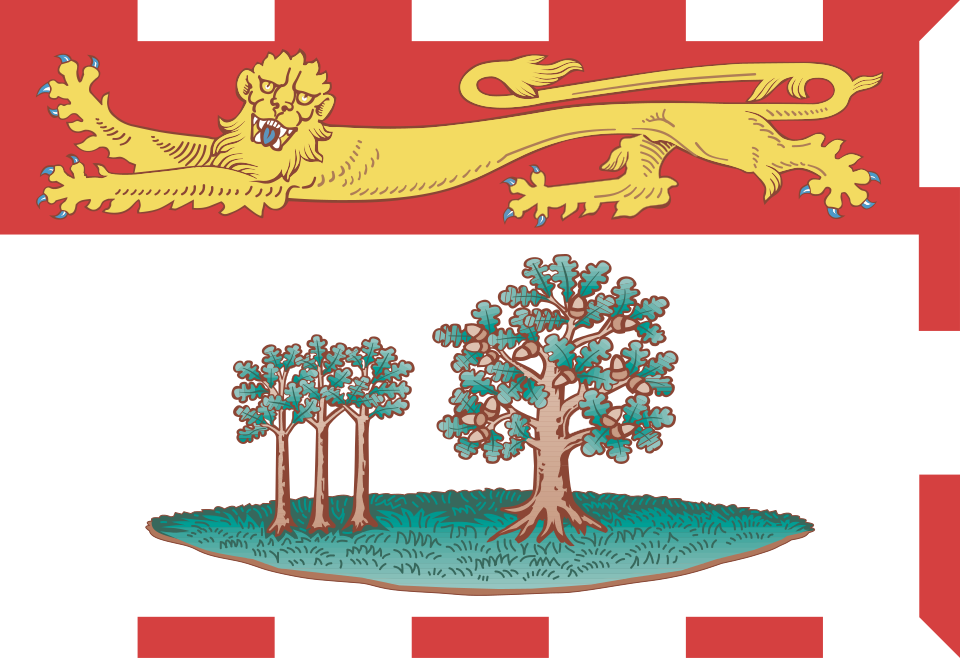
Prince Edward Island is Canada’s smallest province by land area and is located in the Gulf of St Lawrence. Its flag is unusually pictorial: one large oak and three young trees rise from the same base, below an English heraldic lion. The arrangement can seem like a forest scene, but it is an intentionally structured heraldic composition.
The Government of Prince Edward Island explains the historical tree meanings and the English lion. Canadian Heritage confirms the flag’s official adoption in 1964 and its relationship with earlier provincial arms.
This guide is distinct from a general PEI history page. It focuses on identifying the flag correctly, distinguishing its red-and-white decorative border, and comparing it with New Brunswick’s lion-and-galley design.
PEI flag at a glance: one mature oak and three young oaks
A narrow red top band bears a golden English lion. Below it, a green island supports a large oak on the right and three young oaks on the left. The flag has red-and-white border bands on the outer three sides, one of the design features most often lost in simplified digital drawings.
| Flag feature | What it means |
|---|---|
| Province | Prince Edward Island, Canada (capital Charlottetown) |
| Official adoption | 1964 |
| Heraldic roots | Provincial arms granted in 1905 |
| Upper device | Golden English heraldic lion on red |
| Lower device | One large oak and three young oaks |
| Large tree | Traditionally represents England |
| Saplings | Kings, Queens and Prince counties |
| Border | Alternating red-and-white bands on three sides |
What do the four oak trees mean?
The four trees have different roles. The large mature oak, usually on the right in standard front-view artwork, traditionally represents England. The three saplings to the left represent the three historic PEI counties: Kings, Queens and Prince.
These counties were established as administrative divisions in 1767. The imagery depicts the island’s relation to British colonial institutions: young trees rising alongside a parent tree. That interpretation is documented by the provincial government; it is not simply a modern explanation invented for a tourist leaflet.
The trees rise from a common green base, an intentional heraldic design choice that also evokes the island setting. A simplified drawing with four trees all of the same height would lose the distinction between the one mature oak and three young ones.
Is there a separate tree for each town?
No. The three smaller oaks stand for historic counties, not three cities or the province’s largest settlements. There are many towns and communities on PEI, but the flag is not a municipal directory.
Why is a golden lion at the top?
The lion is an English heraldic lion, shown walking across a red band. The PEI Government links it with the arms of Prince Edward, Duke of Kent, after whom the island was named, and with the royal arms of King Edward VII, who granted the province’s arms.
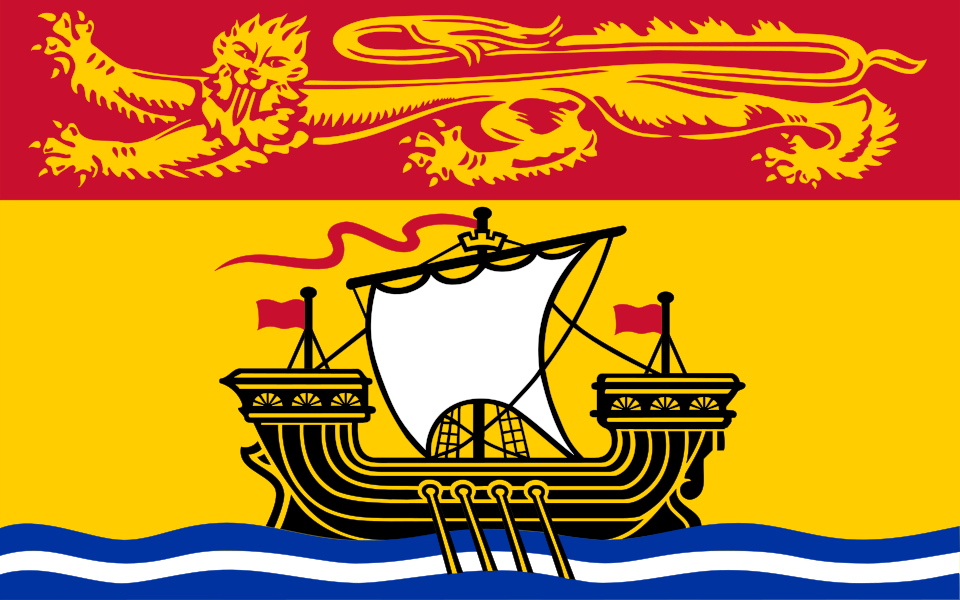
The lion signals British colonial heritage, not a living population of lions on Prince Edward Island. Its upper placement also provides a clear visual connection to New Brunswick’s flag, which places a gold lion on red above a different lower emblem.
PEI’s flag does not carry the Union Jack in a canton. Instead, the full banner uses the provincial arms. It is therefore better understood as a banner of arms than as a Blue Ensign or Red Ensign.
Why does the flag have a red-and-white border?
Unlike many Canadian provincial flags, PEI’s banner is surrounded along three sides by bands that alternate red and white. The border is easiest to see along the bottom and two vertical sides; it does not simply continue across the top above the lion band.
The provincial government explicitly includes this decorative element in its flag description. It is therefore not an optional souvenir fringe added by a manufacturer. An illustration that crops the outer red-and-white pattern can misrepresent the correct flag.
The border also makes PEI visually distinct from New Brunswick. Even when both flags show a golden lion on red, PEI has the oak trees and distinctive edge treatment, whereas New Brunswick has a galley over a golden field.
How did the provincial arms become a flag?
King Edward VII granted Prince Edward Island its shield of arms in 1905. The shield contained the lion above the familiar oak-tree arrangement and was later incorporated into the province’s public symbolism.
The flag, however, was officially adopted in 1964. The earlier arms and the newer provincial flag should not be assigned the same legal date simply because they use related imagery.
The 1964 flag developed the heraldic field into a rectangular banner with the red-and-white decorative border. It was adopted before Canada’s current maple-leaf flag was introduced in February 1965. This chronological difference is useful when comparing provincial flags selected around Canada’s national flag change.
What are PEI’s three counties?
Prince Edward Island has three traditional counties: Kings County, Queens County and Prince County. They are historic geographical and administrative divisions, not three separate provinces or independent states.
The saplings symbolize all three without assigning a different printed name or shape to each one. In a heraldic emblem there is no need to guess which particular sapling is Kings or Queens unless the official source gives a unique assignment; the group of three conveys the meaning.
The imagery reflects PEI’s historical British connection. The island and its population also have Mi’kmaq, Acadian and other important histories beyond the flag’s original imperial heraldry. An accurate civic guide can explain the old emblem without implying it depicts the complete history of everyone who lives on the island.
Prince Edward Island vs. New Brunswick and Nova Scotia
PEI and New Brunswick both use a golden lion on a red upper band. But below it PEI has one large oak plus three saplings, while New Brunswick has an ancient galley on yellow.
Nova Scotia also features a heraldic lion, this time a red Scottish royal lion in a central gold shield. Nova Scotia’s background is a blue diagonal cross on white, not PEI’s tree-covered green island and red-white border.
Newfoundland and Labrador has a modern geometric flag of blue triangles, red elements and a gold arrow. A classroom chart comparing these Atlantic provinces can ask what appears below the lion or whether there is a lion at all.
How to draw and recognize the PEI flag
Draw a wide banner. Across the top add a red band with a gold lion. Below, draw a green island or grassy base with one large oak on the right and three small oak saplings on the left.
Complete the design by adding the alternating red-and-white borders on three sides. This last step matters because a flag with a lion and trees but no border is not a precise rendering of the adopted provincial banner.
For a quiz, count the trees: one mature oak and three young oaks. Ask what those groups mean. The official answer is the historic connection with England and PEI’s three counties, rather than four named towns.
Frequently asked questions
What are the four trees on PEI’s flag?
One mature oak representing England and three saplings representing Kings, Queens and Prince counties.
Why is there a lion?
The gold lion reflects English royal heraldry and Prince Edward, Duke of Kent, after whom the province is named.
When was the PEI flag adopted?
In 1964.
Why does the border have red and white stripes?
The red-white decoration on three sides is part of the official provincial flag design.
Does PEI have three counties?
Yes: Kings, Queens and Prince.
Is PEI’s flag the same as New Brunswick’s?
No. PEI has trees and a red-white border; New Brunswick has a ship.
Are the trees maple trees?
No. They are oak trees.
Is this a Canadian national flag?
No. It is the flag of one Canadian province.
Is the large tree on the left or right?
In standard front-view artwork the large mature oak is shown on the right, with the three saplings on the left.
Official references and illustration credits
Government of Prince Edward Island — Provincial Flag
Canadian Heritage — Prince Edward Island Symbols
Canadian Heritage — Canadian provincial and territorial emblems
Flag graphic from Wikimedia Commons; converted from SVG to PNG for this guide. Please check that source file’s specific author, license and attribution before reuse. Comparison graphics are from the linked official flag guides or the FlagExplorers media library.
Official emblem use may have legal or protocol requirements independent of image copyright. Historical references consulted November 2026.