New Brunswick Flag: Gold Lion, Ship & Red-Yellow Meaning
Why does New Brunswick’s flag show a golden lion over an old ship? Explore the Duchy of Brunswick, maritime shipbuilding, 1868 coat of arms and 1965 adoption.
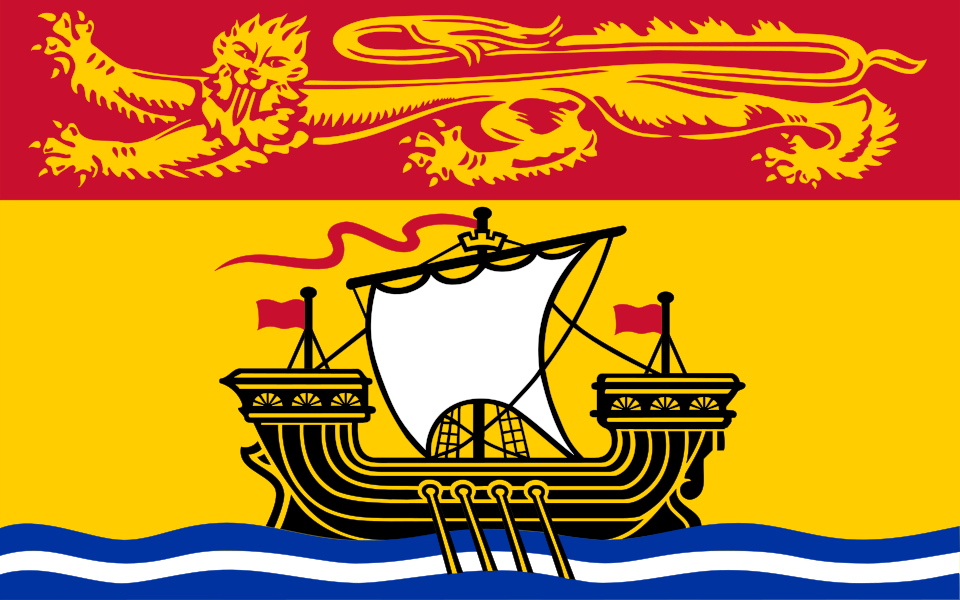
New Brunswick is a Canadian Atlantic province with a different flag from neighboring Nova Scotia, Quebec and Prince Edward Island. Its design looks like a medieval coat of arms stretched across a rectangle: a lion walks across the top, while a wooden galley occupies the broad lower section.
The Government of New Brunswick explains both symbols and the adoption date. The Canadian Heraldic Authority adds historical context for the vessel, which was already present on earlier provincial seals.
Unlike some other Canadian provincial flags, New Brunswick’s banner contains no Union Jack canton. Its full design is based on the shield of the provincial coat of arms, with red and gold heraldic imagery rather than a blue or red ensign.
New Brunswick flag at a glance: a lion and galley
A red band occupies the upper part of the banner, with a gold walking lion. A golden-yellow field below contains a traditional galley with its oars, sail and hull. The imagery connects the province’s British and German royal associations with historic shipping and shipbuilding on the Atlantic coast.
| Flag feature | What it means |
|---|---|
| Province | New Brunswick, Canada (capital Fredericton) |
| Adoption | February 24, 1965 |
| Upper band | Red, with one gold lion |
| Lower field | Gold/yellow, with an ancient galley |
| Historic arms granted | May 26, 1868 |
| Lion meaning | Royal links to England and Duchy of Brunswick |
| Galley meaning | Shipping, shipbuilding and maritime heritage |
| Has Union Jack? | No |
Why is a golden lion on the New Brunswick flag?
The gold lion is a heraldic lion shown walking, typically with its head facing the viewer. The New Brunswick Government connects this symbol to both England and the former Duchy of Brunswick in Germany.
When New Brunswick was established as a separate British colony in 1784, George III was also connected to the Brunswick royal dynasty through the House of Hanover. The colony’s name and heraldic lion thus recalled the monarch’s German dynastic association as well as British royal arms.
The lion does not represent a wild animal living in New Brunswick’s forests. It comes from European heraldry. The government explains the red-and-gold upper band as an historical identity symbol rather than an illustration of local wildlife.
Why only one lion?
The coats of arms of England and Brunswick feature different arrangements of lions. New Brunswick’s flag simplifies those dynastic references into a single gold lion in its red upper band. The number is a heraldic design choice, not a claim that the province was once ruled by one named lion.
What is the sailing ship at the bottom?
The lower field contains an ancient galley, a stylized boat with oars in motion. It represents New Brunswick’s long maritime history and, more specifically, the importance of shipping and shipbuilding when the shield was created in 1868.
The Canadian Heraldic Authority also explains that a ship appeared on the first great seal of New Brunswick in 1785 and links maritime arrival to United Empire Loyalist settlement. A galley is not intended as a photographically accurate drawing of one surviving nineteenth-century ship or a named ferry.
In an educational drawing, the distinguishing elements are a dark vessel with oars and a sail on a golden field. The sea below may be rendered as small blue-and-white waves in accurate artwork. Avoid changing the ship into a modern steamship; the official emblem is deliberately heraldic.
What do New Brunswick’s red and gold colors mean?
Red and gold are the dominant heraldic colors of the banner. The red upper third contains a gold lion; the golden lower area carries the ship. The colors come from the province’s historic coat-of-arms composition, rather than being selected as a modern tourist palette.
Gold in heraldry is called or and red is called gules. These terms appear in formal flag descriptions and help explain why illustrations may show bright yellow rather than metallic gold.
Neither color should automatically be identified as one named Canadian political party, a modern sporting club or a particular annual festival. The verified meanings belong to dynastic heritage and maritime economic history.
Why does 1868 matter if the flag was adopted in 1965?
Queen Victoria granted New Brunswick’s shield of arms on May 26, 1868. That is the origin of the flag’s lion-and-galley arrangement, after the province joined Canadian Confederation in 1867.
The provincial flag itself was established by proclamation on February 24, 1965, during the same year that Canada introduced its national maple-leaf flag. This was a decision to use the old arms as a distinctive modern provincial banner.
Confusing these dates leads to two mistakes: saying the flag was invented from scratch in 1965 ignores a century of heraldic history, and saying the exact provincial flag was officially flown since 1868 ignores the later legal adoption.
For a school timeline, use 1868 for the shield of arms and 1965 for the provincial flag. These are separate milestones, both confirmed by the province’s official sources.
How the ship connects to the Atlantic province’s history
New Brunswick’s rivers, Bay of Fundy coastline and Atlantic connections supported timber exports, shipbuilding, fisheries and maritime transport. The galley is a generalized maritime device representing those activities, rather than a specific ship built in Saint John.
The region’s history also includes Indigenous Wabanaki peoples, including Mi’kmaq, Wolastoqiyik and Peskotomuhkati communities, who lived and traveled here long before the creation of colonial seals. The 1868 heraldic ship expresses the colonial government’s maritime identity, not the province’s entire cultural history.
When captioning the flag, it is accurate to say the galley recalls shipping and shipbuilding. It is less accurate to describe the boat as a precise reconstruction of an Indigenous canoe or to claim a single voyage without documentary evidence.
New Brunswick vs. Prince Edward Island and Nova Scotia
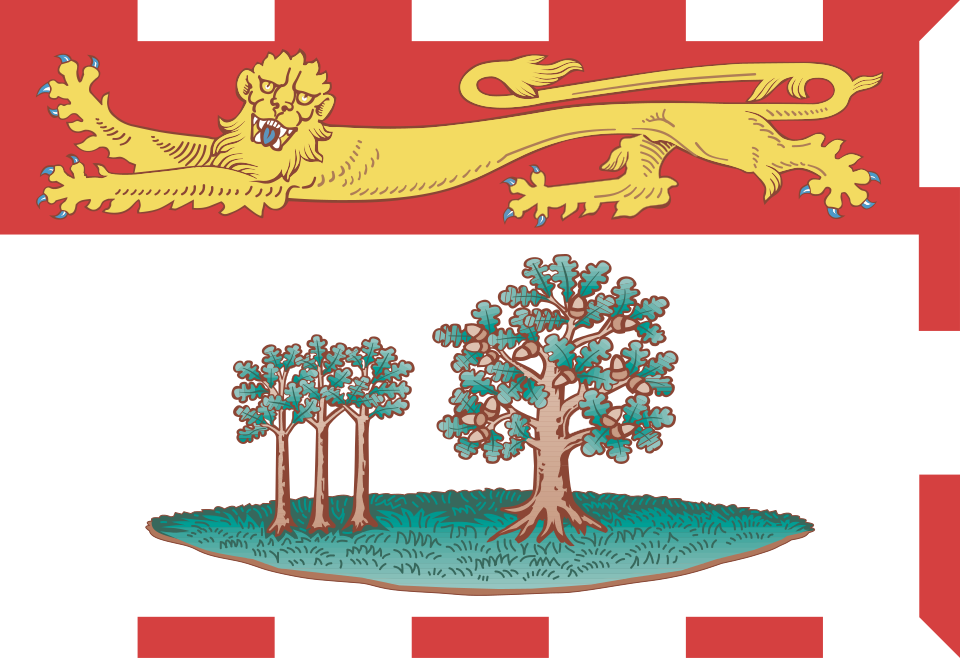
Prince Edward Island also uses a heraldic lion on a red band, but below it stand one mature oak and three young oaks. New Brunswick has a ship rather than trees. That difference is easy to detect in a side-by-side flag-identification quiz.
Nova Scotia’s design is completely different: a blue diagonal Scottish-style cross on white with a gold shield containing a red lion. Newfoundland and Labrador uses geometric blue and red triangles and a gold arrow.
These Atlantic provincial flags illustrate several heraldic traditions. A lion alone is not enough to identify the province; observe whether it is placed over a ship, trees or a saltire and central shield.
How to draw and identify the New Brunswick flag
Draw a wide rectangle and divide the upper third from the remaining lower area. Color the upper band red and place a gold walking lion there. Color the lower field golden yellow and draw a traditional wooden galley with a sail and oars, with a small suggestion of waves beneath the hull.
Do not add a Union Jack to the corner. The New Brunswick flag is a banner of arms and its own red-and-gold pattern fills the field. Nor should you replace the ship with three oak trees; that would resemble Prince Edward Island’s design.
For an educational worksheet, ask which flag shows “lion plus ship” and which shows “lion plus oak trees.” This tests the most reliable visual distinction between two geographically close provinces.
Frequently asked questions
What is on the New Brunswick flag?
A gold heraldic lion on red above an ancient galley ship on gold.
What does the lion represent?
New Brunswick’s historic ties to England and the Duchy of Brunswick.
Why is there a ship?
It represents shipping, shipbuilding and the province’s maritime past.
When was the flag adopted?
February 24, 1965.
Why is 1868 important?
Queen Victoria granted the original provincial shield of arms on May 26, 1868.
Does the flag have a Union Jack?
No, it uses a red-and-gold banner derived from the provincial coat of arms.
Is it the same as Prince Edward Island’s flag?
No. PEI has four oak trees below its lion rather than a ship.
What sort of ship is pictured?
An ancient heraldic galley with oars, a sail and a hull.
Is the lion native to New Brunswick?
No. It is a European heraldic symbol, not local wildlife.
Official references and illustration credits
Government of New Brunswick — Official symbols
Canadian Heritage — New Brunswick symbols
Canadian Heraldic Authority — New Brunswick arms and flag
New Brunswick Government — Flag display guidance
Flag graphic from Wikimedia Commons; converted from SVG to PNG for this guide. Please check that source file’s specific author, license and attribution before reuse. Comparison graphics are from the linked official flag guides or the FlagExplorers media library.
Official emblem use may have legal or protocol requirements independent of image copyright. Historical references consulted November 2026.