Canary Islands Flag: White, Blue, Yellow & Coat of Arms
Which color comes first on the Canary Islands flag, and why are there dogs and seven islands in the regional coat of arms? Compare the plain and institutional versions.
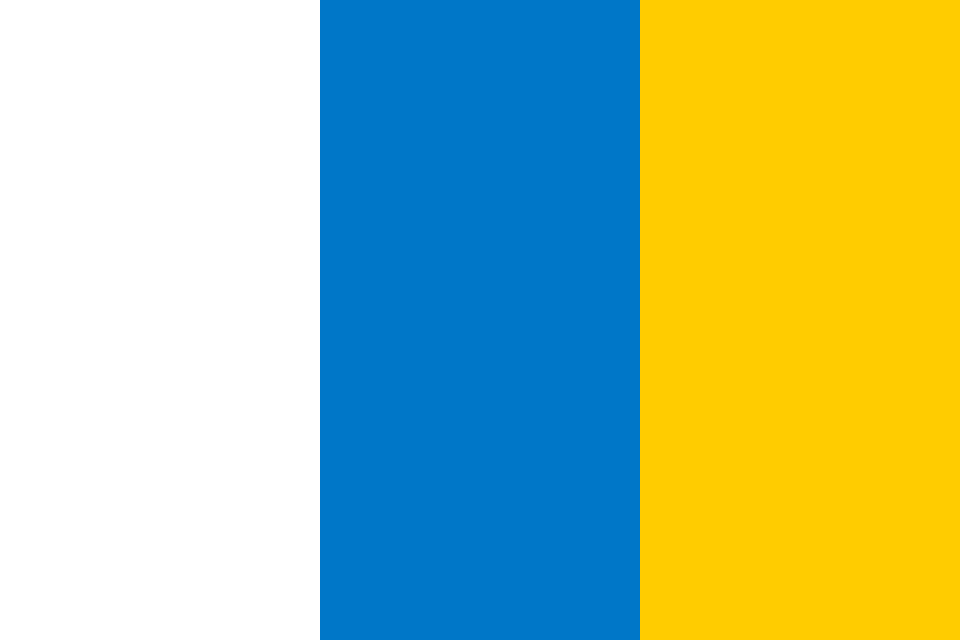
The Canary Islands are an Atlantic archipelago and autonomous community of Spain. Their regional banner is a simple vertical tricolour, which visitors may see on public buildings, ferries and at island celebrations. The order of the colors is the most common source of mistakes in online illustrations.
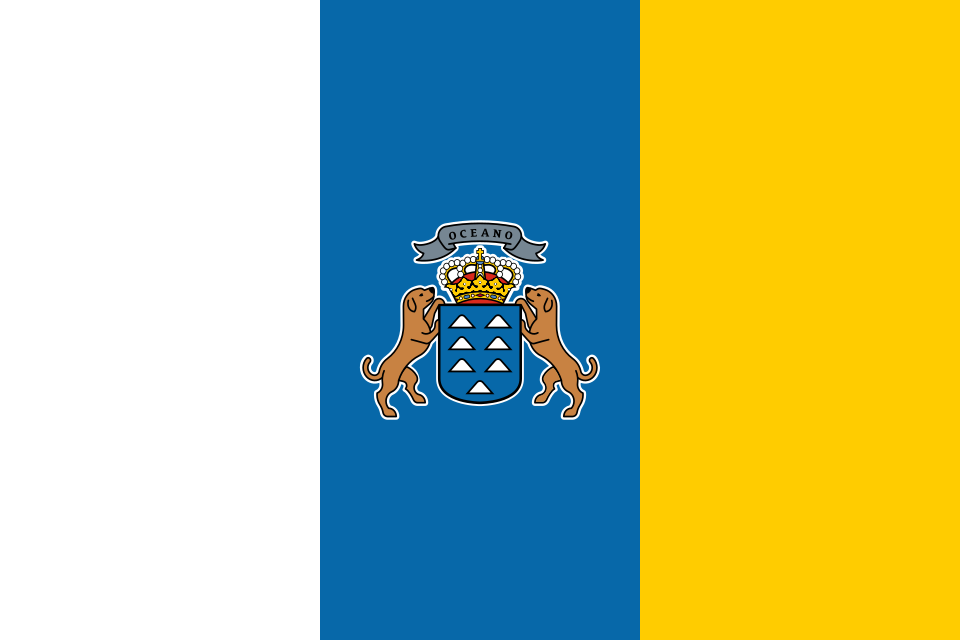
The Canary government’s official description states that the three vertical fields are of equal width and, starting at the hoist, are white, blue and yellow. The flag may also appear with a blue central coat of arms featuring the islands and two dog supporters. These versions are related but differ in how the regional institutions use their symbols.
For readers comparing Spanish regions, our Galicia flag guide covers a blue diagonal on white, while the Basque Country guide explains a red field with two crosses. The Canary tricolour has neither diagonal band nor cross.
Canary Islands flag: color order and official versions
The flag uses three equally wide vertical stripes. When the pole is on the left, white is on the left, blue is in the center and yellow is on the right. The regional coat of arms sometimes appears in the central blue stripe, but the autonomy statute identifies the three colors as the basic flag.
| Feature | Details |
|---|---|
| Place | Canary Islands (Islas Canarias), Spain |
| Flag sequence | White, blue, yellow (from the hoist) |
| Bands | Three equal vertical stripes |
| Autonomy framework | Statute of Autonomy, 1982; revised in 2018 |
| Colors’ historical source | White-blue and blue-yellow Canarian provincial traditions |
| Institutional emblem | Regional coat of arms, sometimes centered on blue stripe |
| Shield design | Seven silver island silhouettes on a blue shield |
| Shield supporters | Two dogs; a historical allusion to the island name |
Why is the Canary Islands flag white, blue and yellow?
The three colors have a well-documented connection to historical flags associated with the archipelago’s two provinces. The province of Santa Cruz de Tenerife contributed white and blue, while the province of Las Palmas contributed blue and yellow. Combining those colors produces the common white-blue-yellow sequence.
The Government of the Canary Islands’ educational history documents these provincial roots. Popular interpretations may associate white with Atlantic surf, blue with the ocean and yellow with sunshine or volcanic beaches. These may be appealing tourist associations, but they should not replace the source-based provincial explanation as if the statute assigned one natural feature to each color.
Yellow is at the fly side, the side farther from the pole. Blue is in the middle, and white is next to the pole. A blue-white-yellow flag, or a white-yellow-blue flag, is not the correct standard ordering even if it uses the same three colors.
What are the stripes’ proportions?
The autonomy statute states that the three vertical stripes are equal. This is an important distinction from Spain’s national flag, which has a wider central yellow band and red bands above and below. The Canary flag has three vertical panels of matching width, not horizontal bands.
When did the Canary Islands adopt their flag?
The flag was legally established with the Canary Islands’ 1982 Statute of Autonomy. It was reaffirmed through later statutory reform, including the 2018 Statute, which also describes the coat of arms as a regional symbol.
Because the basic white-blue-yellow combination existed in regional movements before the autonomy statute, it is useful to distinguish the legal adoption from the wider cultural history of the tricolour. In a historical timeline, 1982 is the important date for the modern autonomous community’s statutory flag.
The revised statute’s Article 7 addresses regional symbols. The Canarian government’s legal pages reproduce the exact order: white, blue and yellow from the hoist. If a designer needs an official-use reference, the regional administration’s identity guidance is more authoritative than a copied clip-art image.
May 30 is celebrated as Canary Islands Day because the regional Parliament held its first session on that date in 1983. It should not be confused with the flag’s first legal recognition in 1982.
What do the seven islands and dogs on the coat of arms mean?
The official coat of arms has a blue shield with seven silver island forms arranged in a traditional pattern. Above the shield is a crown, and the design is accompanied by two dogs as heraldic supporters. The motto “Océano” refers to the archipelago’s Atlantic setting.
The island shapes refer to the seven historic main islands named in the heraldic tradition. The Canary Islands have a more detailed contemporary island and administrative geography, so a student should not infer from the number of silhouettes that no other inhabited island exists.
The dogs are associated with the historical name Canaria and traditions linking the name to large dogs or Latin canes. Etymological explanations have been debated, and alternative interpretations exist. The coat of arms’ two dogs are a real heraldic feature; a single fixed scientific origin for the place name is a different question.
Because the coat of arms is small in a flag’s blue stripe, it can appear as a complicated central emblem. If you see a plain white-blue-yellow flag beside an arms-bearing version, do not assume one must belong to a different archipelago.
Flag with the coat of arms vs. without: which is official?
The statute defines the flag first by its three equal vertical stripes. The Canary Islands also has a separate official coat of arms, and institutional graphics may incorporate that coat of arms on the blue middle stripe.
The plain tricolour is therefore a correct flag of the autonomous community and is commonly used by residents and at festivals. The version with arms is widely associated with government and official representation. When writing an image caption, state which variant is shown rather than calling the plain version incomplete.
The government publishes identity rules for the flag, coat of arms and other institutional graphics. Those are important for precise public use; private educational drawings can identify the symbols accurately without claiming to reproduce every government brand specification.
The two pictures above show both approaches. In the version with arms, the three background stripes remain the same colors, order and widths.
Which islands does the regional flag represent?
The flag represents the Canary Islands autonomous community as a whole, not any one island or city. The archipelago includes Tenerife, Gran Canaria, Lanzarote, Fuerteventura, La Palma, La Gomera, El Hierro and La Graciosa, with their own geographical and administrative contexts.
Individual islands, municipalities and cabildos may also have their own flags. For example, a local banner seen in Santa Cruz de Tenerife should not automatically be treated as the official regional tricolour. Check whether its colors, arms and arrangement match the autonomy statute.
Tourism materials often simplify the archipelago into a few famous islands. The three-band regional flag instead expresses a shared Canary identity. The coat of arms reflects a longstanding heraldic convention, which does not have to update every time a local administrative classification changes.
Canary Islands flag vs. Spain, Galicia and other tricolours
Spain’s national flag consists of three horizontal bands in red, yellow and red, with the center yellow band twice as wide as a red band. The Canary Islands has three vertical equal bands, white, blue and yellow. That makes direction as important as color when identifying the flag.
The Galician flag is also blue and white, but its blue feature is one diagonal stripe rather than an entire vertical panel. The Basque Ikurriña uses two crosses over red. The Catalan Senyera is yellow with four red bars. All are Spanish regional symbols with distinct appearance and legal histories.
A simple classroom exercise is to sort flag pictures by whether their primary design uses a tricolour, diagonal, cross or repeated stripes. The Canary flag falls into the vertical-tricolour group with a white first stripe.
How to draw the Canary Islands flag correctly
Draw a horizontal rectangle and mark three vertical sections of equal width. Color the section at the flagpole white, the middle one blue and the far one yellow. For a plain flag, no other emblem is needed.
To create an institutional version, add the regional coat of arms to the center of the blue panel, keeping the crown, blue shield with seven island forms and two dog supporters in the correct overall proportions. Use official artwork for an accurate heraldic rendering rather than inventing animals or additional stars.
When teaching color order, repeat the short phrase “white-blue-yellow, from the pole.” This helps prevent an error introduced by viewing an image from the back or using a mirrored graphic.
For another distinctive regional exercise, compare the same three-color order with the flag of Romania, which uses blue-yellow-red vertical bands. Similar layout does not indicate the same territory or meaning.
Frequently asked questions
What colors are on the Canary Islands flag?
White, blue and yellow, in equal vertical stripes from the hoist.
Which stripe is in the middle?
Blue is the middle stripe.
What does the blue represent?
The flag’s colors are historically linked to provincial white-blue and blue-yellow flags; blue is not legally assigned one particular ocean feature in the statute.
When was the Canary Islands flag adopted?
It was recognized in the 1982 Statute of Autonomy, with regional symbols reaffirmed in the 2018 reform.
Does the official flag have a coat of arms?
A plain tricolour is valid under the statutory description, while institutional versions often add the regional coat of arms to the blue stripe.
How many islands appear on the coat of arms?
Seven silver island forms in the traditional shield.
Why are there dogs on the Canary Islands coat of arms?
They are historic heraldic supporters associated with interpretations of the name Canaria and canine symbolism.
Is the Canary Islands flag the same as Spain’s?
No. Spain has horizontal red-yellow-red; the Canary Islands has vertical white-blue-yellow.
Is the regional flag the same as Tenerife’s flag?
No. Individual islands have their own flags. The regional flag represents the entire autonomous community.
What is Canary Islands Day?
May 30, commemorating the first session of the Parliament of the Canary Islands in 1983.
The Andalusia flag has green-white-green horizontal bands and Hercules, whereas the Balearic Islands flag has red-yellow bars and a purple castle corner. Neither should be confused with the Canary Islands’ vertical tricolour.
Historical sources and artwork credits
Government of Canary Islands — official flag definition
Government of Canary Islands — regional identity and 2018 statute
Canary Official Gazette — 1982 Statute of Autonomy
Canary Official Gazette — 2018 revised Statute
Canarian government education — historical origin of colors
Wikimedia Commons — plain flag
Wikimedia Commons — coat-of-arms flag
Plain regional flag illustration by Zirland and Commons contributors, public-domain dedication, Wikimedia Commons. Institutional coat-of-arms flag by Zirland (public domain), Commons. Both rasterized to PNG with design intact.
The image files are PNG renderings of the linked Wikimedia Commons vectors and are used for identification. Follow credited source-file licenses when reusing the images. Regional symbolism and legal status checked November 2026.