How Many American Flags Are on the Moon? All Six Apollo Flags
Six NASA missions planted U.S. flags on the Moon between 1969 and 1972. Explore all six landings, see real lunar photographs, and learn what orbiters actually reveal about the flags left behind.
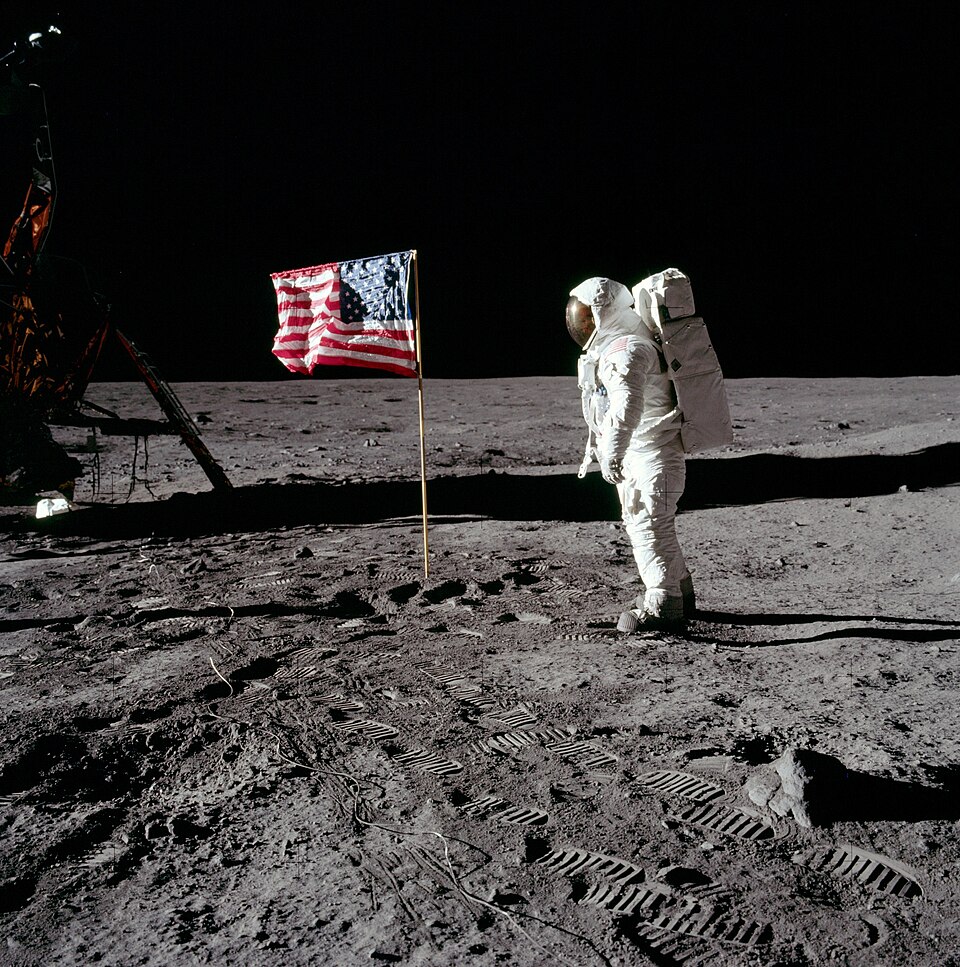
The American flag on the Moon is one of the best-known photographs of the space age. It is also the source of several questions: How many flags were actually planted? Did they wave even though the Moon has no wind? Can satellites see them now? And what happened to the first flag after Neil Armstrong and Buzz Aldrin lifted off?
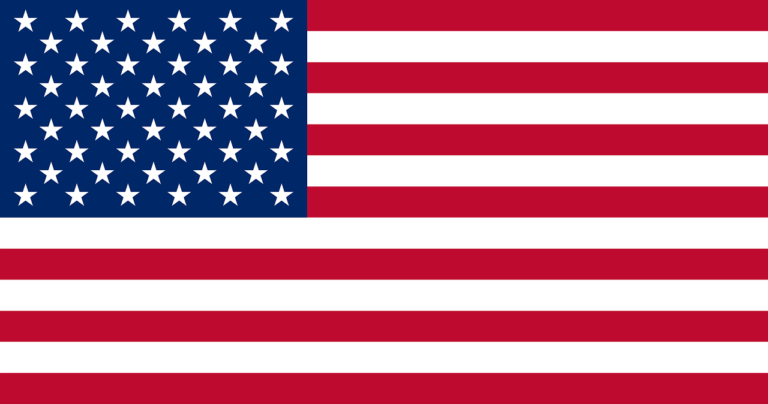
All six deployed surface flags used the familiar 50-star, 13-stripe United States design. The first was planted in July 1969, nine years after the modern 50-star flag became official. This article concentrates on the flags’ actual lunar history, equipment and evidence rather than repeating our complete U.S. flag stars-by-year reference.
How many American flags were planted on the Moon?
Six Apollo missions successfully placed people on the lunar surface: Apollo 11, 12, 14, 15, 16 and 17. Each crew deployed one United States flag during a surface excursion. Apollo 13 did not land after an in-flight spacecraft emergency, and Apollo 10 tested the landing craft in lunar orbit without touching the Moon.
The number six refers specifically to flags erected on the lunar surface by Apollo crews. Astronauts carried other small flags, patches and ceremonial objects in spacecraft, so the total number of American flag objects transported to space is far larger. Do not count the six planted flags as every flag carried on Apollo flights.
The earliest flag was planted at Tranquility Base, in the Sea of Tranquility, during Apollo 11 in 1969. The last was planted in the Taurus–Littrow Valley by the Apollo 17 crew in December 1972. They are artifacts of six separate expeditions, spread across different landing sites rather than grouped together in one place.
All six Apollo Moon flags at a glance
The table lists the landing date and location for each mission, the two astronauts who walked on the surface, and what NASA’s later orbital images and historical research say about the flags. A shadow in satellite imagery is indirect evidence of a standing flag or pole; it is not a close-up photograph showing pristine colored fabric.
| Mission | Landing date | Landing area | Moonwalking crew | Later flag evidence |
|---|---|---|---|---|
| Apollo 11 | July 20, 1969 | Sea of Tranquility | Neil Armstrong and Buzz Aldrin | No upright-flag shadow identified in Lunar Reconnaissance Orbiter views |
| Apollo 12 | November 19, 1969 | Ocean of Storms | Pete Conrad and Alan Bean | Flag shadow documented by NASA LRO |
| Apollo 14 | February 5, 1971 | Fra Mauro | Alan Shepard and Edgar Mitchell | Included in later NASA reporting on flag shadows at five landing sites, but condition of cloth not directly confirmed |
| Apollo 15 | July 30, 1971 | Hadley–Apennine | David Scott and James Irwin | Orbiter imagery offers indirect evidence; cannot determine the nylon’s color or strength |
| Apollo 16 | April 21, 1972 | Descartes Highlands | John Young and Charles Duke | Flag/pole and shadow observed in LRO investigations |
| Apollo 17 | December 11, 1972 | Taurus–Littrow | Eugene Cernan and Harrison Schmitt | Flag shadow documented in orbital images |
The Apollo 11 flag is the major exception. In a published account, Buzz Aldrin said he saw the flag fall over as the ascent stage lifted away. NASA’s lunar orbiter pictures show no corresponding upright-flag shadow there. At other sites, the LRO camera has provided shadow evidence indicating standing flags or poles long after the astronauts departed.
NASA’s 2024 review of Lunar Reconnaissance Orbiter achievements states that shadows of American flags are visible at five of the six Apollo landing sites. Its earlier site-by-site discussion was especially clear for Apollo 12, 16 and 17, while noting the limits of particular images at other locations. That history is why different articles may describe three confidently identified flags or five flag-shadow sites without necessarily contradicting one another.
Real NASA photographs of American flags on the Moon
These photographs were taken during the Apollo missions, not created as modern illustrations or AI-generated reconstructions. They show astronauts with flags in the airless lunar environment and the horizontal support bars that helped the fabric remain extended. The photos have their original NASA image identifiers and credited source links.
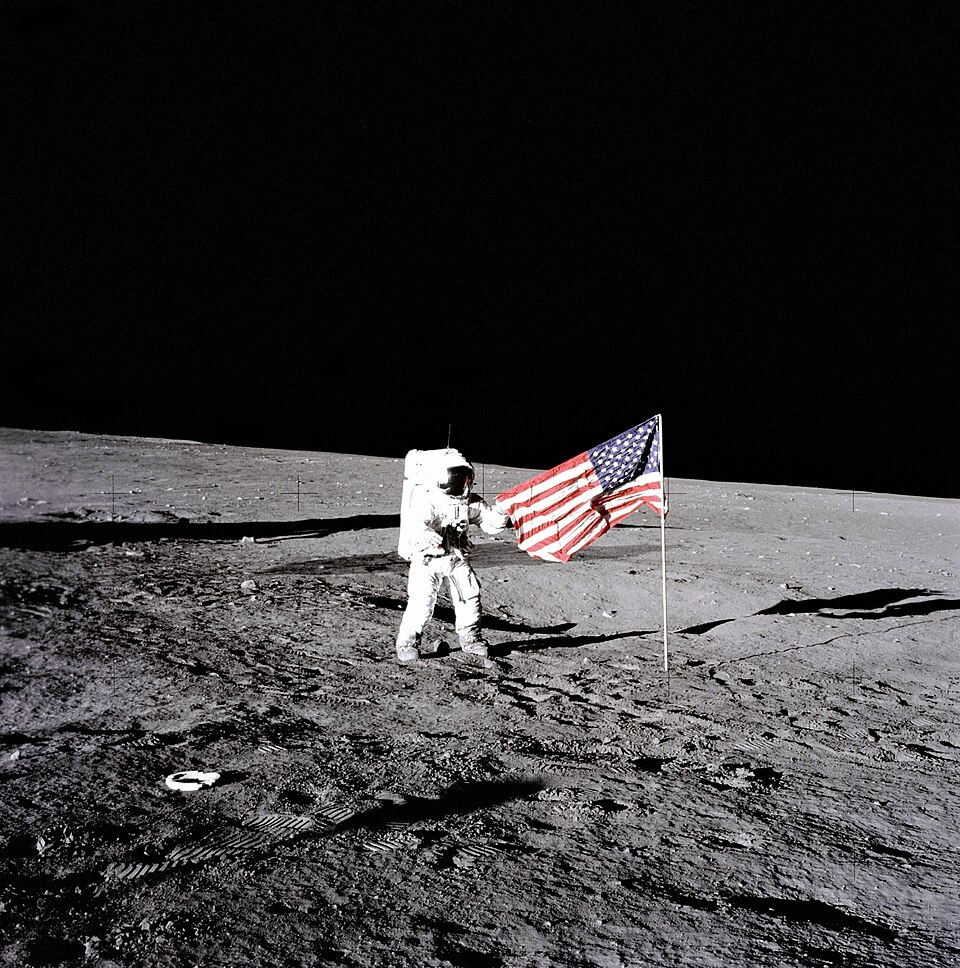
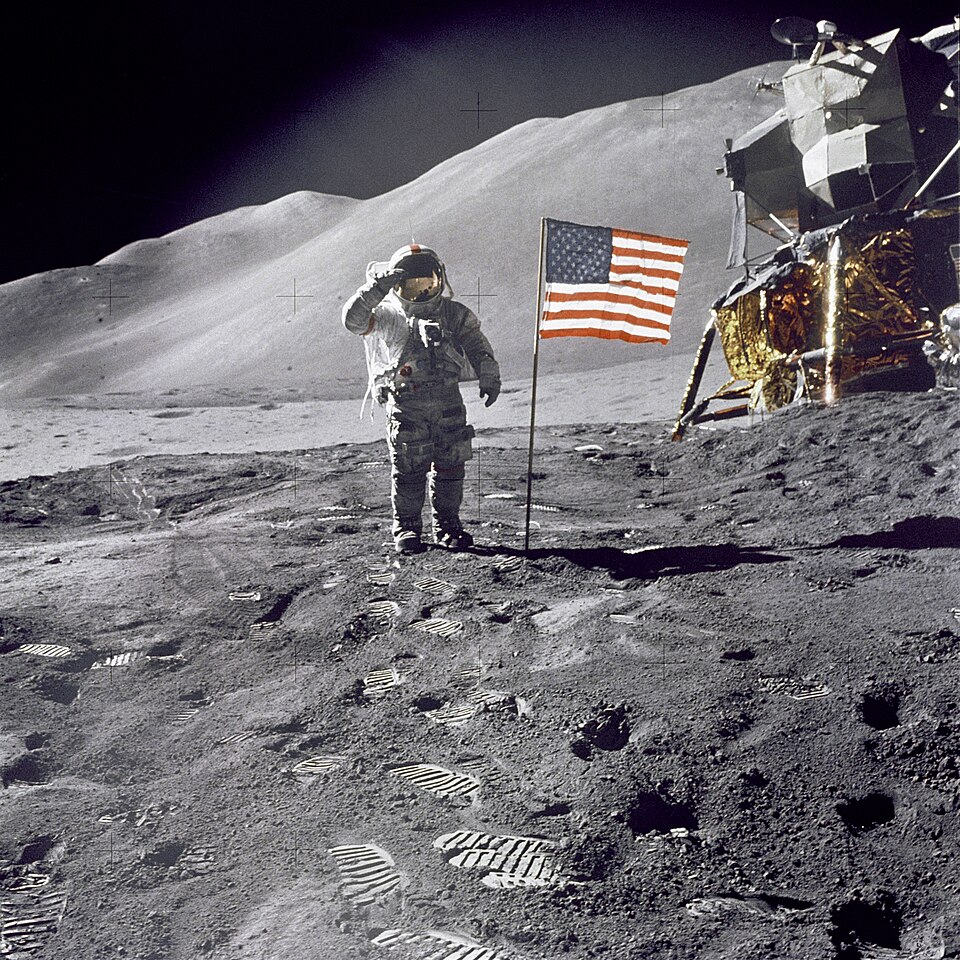
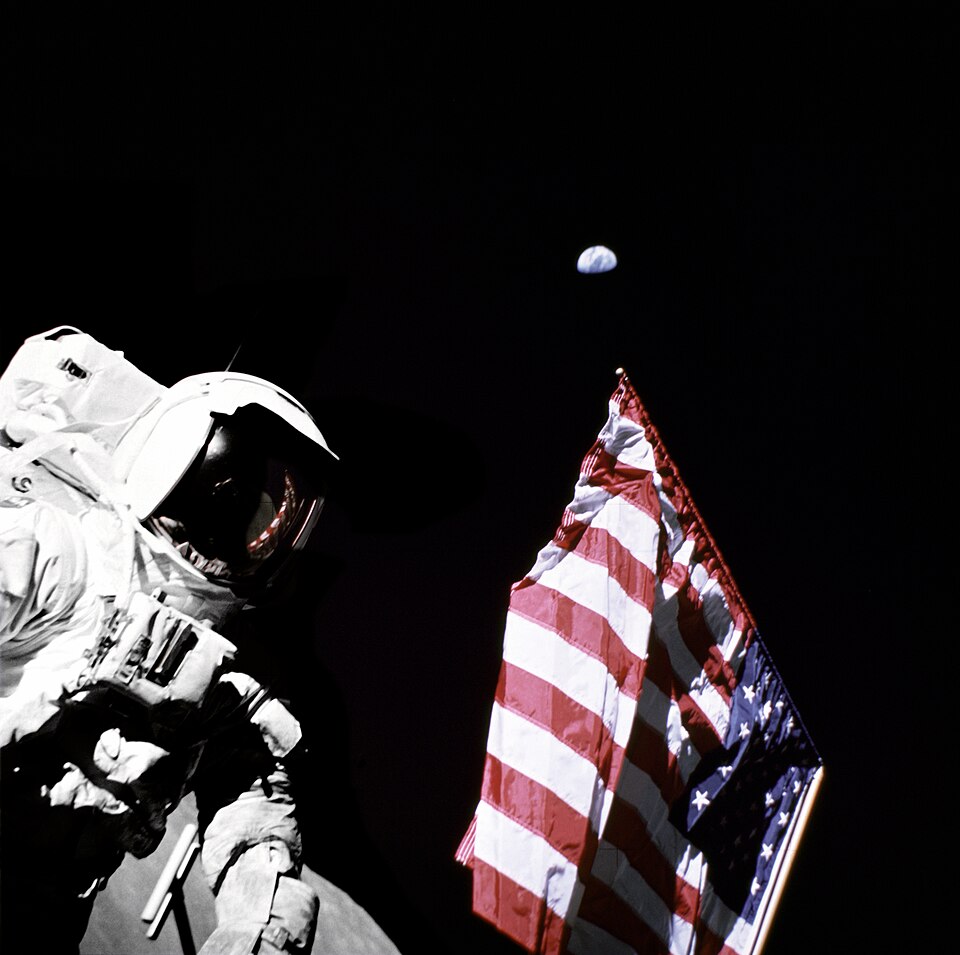
Notice that the flags do not look like cloth hanging limp from a vertical pole on Earth. A metal crossbar ran along the top to keep each flag visible. Creases from folding and the incomplete extension of the support on some missions created the familiar rippled appearance in photographs.
NASA lunar photographs generally are not copyrighted in the United States because they are federal government works, although its insignia and logos have separate restrictions. The article credits NASA and links to the original file records for each image. These historical images should not be presented as contemporary photographs showing the flags’ current condition.
What happened to the Apollo 11 flag?
The first flag planting in July 1969
Neil Armstrong and Buzz Aldrin erected a U.S. flag near their lunar module, Eagle, during the first human lunar landing. The flag was supported by a vertical pole and telescoping horizontal rod, a design developed because an ordinary flag would not spread out naturally in the Moon’s near-vacuum. Images of Aldrin beside the flag became iconic records of the mission.
Planting the flag was a ceremonial part of a much larger mission that included scientific instruments, lunar rock collection and a commemorative plaque. The 50-star U.S. flag was the national design then in use; it did not have a special new pattern created for NASA. Our stars-and-stripes explanation covers the meaning of its fifty stars and thirteen stripes.
Did the lunar module knock the first flag over?
Buzz Aldrin later recalled seeing the flag fall during the ascent stage’s liftoff from the lunar surface. The blast of engine exhaust may have toppled it because the pole stood relatively close to the spacecraft. NASA’s Lunar Reconnaissance Orbiter has not identified an upright flag shadow at the Apollo 11 site, consistent with his account.
Because no astronaut has returned to inspect that flag, its exact present position and fabric condition cannot be verified firsthand. The best-supported statement is that the first flag was apparently knocked down as Eagle departed, not that it vanished from the Moon or has been photographed as a pile of intact red, white and blue nylon.
Which Apollo flags are still standing?
What the Lunar Reconnaissance Orbiter can see
NASA’s Lunar Reconnaissance Orbiter, launched in 2009, has repeatedly imaged the Apollo landing sites. At favorable Sun angles, objects and flag poles can cast long shadows, making small structures easier to infer from orbit than from a single overhead photograph.
NASA’s historic Flag Day summary reports clear evidence of standing flags at Apollo 12, 16 and 17. A subsequent NASA overview describes flag shadows at five of the six landing sites. The key difference is between direct identification in individual high-resolution image sequences and a broader summary of later orbital observations.
For example, NASA’s Scientific Visualization Studio shows the Apollo 12 landing site with the American flag’s shadow visible in lunar-orbiter imagery. Similar work at Apollo 16 documented the object and associated shadow. These are useful cross-checks on the written reports and avoid treating a low-resolution dot as a detailed picture of a waving flag.
Can the photos prove that the original fabric remains?
No. A shadow or bright object consistent with the deployed assembly can establish that a pole and possibly some flag material are still present, but it cannot determine whether the nylon retains its original colors, whether all threads remain or how the surface has degraded. Orbital photographs do not have the close-range detail needed for a textile condition report.
Why did the flags look like they waved without wind?
There is essentially no atmospheric wind on the Moon. In photographs, however, American flags appear to have folds, curves and ripples like a flag blowing in a breeze. The reason is their hardware and the way astronauts handled them, not an unseen lunar atmosphere.
A horizontal telescoping rod ran through a sleeve along the upper edge. It held the flag stretched outward instead of hanging straight down. During deployment, astronauts twisted the pole to push it into the lunar soil. The movement could make the cloth oscillate briefly, and the wrinkles from being folded aboard the spacecraft remained.
On some missions the horizontal rod was not fully extended, leaving more pronounced folds. In a still photo those creases resemble a windblown wave. The flag did not need to be moving at the instant the photograph was taken for its edge to appear wavy.
A useful classroom demonstration is to hang a small cloth rectangle from a horizontal bar, then add pleats to it. The resulting shape resembles the Apollo flag while remaining perfectly still. This explains the photographs without needing to speculate about whether the Apollo program occurred.
Would the lunar flags still be red, white and blue?
The flags were made from nylon for deployment in space, with assembly details varying by mission. Their designers intended them as ceremonial equipment, not as artifacts guaranteed to survive decades of direct solar ultraviolet radiation, charged particles, vacuum, micrometeorites and extreme lunar temperatures.
On Earth, weather and sunlight can weaken and discolor textiles, and the Moon lacks an atmosphere or protective weather system. Prolonged exposure there could substantially bleach and embrittle the fabric. NASA historical analyses note that long-term material damage is likely, but the mission photographs and distant LRO images do not tell us the exact color of the flags in 2026.
You may encounter statements that every lunar flag is now pure white. That is a prediction about degradation, not a direct verified photograph of all six flags. A scientifically careful caption says the colors may have faded or the nylon may be badly weakened, with the present condition still uncertain.
Did the flags planted on the Moon have 50 stars?
Yes. Hawaii’s admission brought the United States to fifty states in August 1959, and the official 50-star national flag became effective July 4, 1960. Apollo 11 landed on the Moon on July 20, 1969, so the astronauts used the modern design that was already established.
All six lunar landing missions took place between 1969 and 1972, while the national count remained fifty. That means the flags had thirteen horizontal stripes and fifty white stars in a blue union, not the 48-star or 49-star patterns used earlier in the twentieth century.
For a full account of the earlier revisions, see our American flag stars-by-year table. For the design and proportions of the current national flag, use the U.S. flag drawing reference. The lunar flags are interesting because of their deployment location and survival questions, not because NASA adopted a separate national design.
Why didn’t Apollo 13 leave an American flag on the Moon?
Apollo 13 launched in April 1970 with the goal of a third crewed lunar landing. An oxygen tank failure seriously damaged the spacecraft’s ability to complete the mission safely. NASA cancelled the planned landing and concentrated on returning astronauts Jim Lovell, Jack Swigert and Fred Haise to Earth.
The astronauts orbited the Moon and survived the flight home, but none set foot on the lunar surface. As a result, Apollo 13 is absent from the list of missions that planted flags. The numbering jumps from Apollo 12 to Apollo 14 because only successful landings count in this particular list.
Other Apollo missions also did not plant surface flags: Apollo 8 and Apollo 10 orbited the Moon, and Apollo 7 and Apollo 9 operated in Earth orbit. The six flag plantings correspond specifically to missions whose lunar modules carried astronauts down to the ground.
Did planting a flag mean the United States owned the Moon?
No. NASA astronauts planted their national flag as a symbolic statement of the American space program’s achievement and of the country supporting the mission. It did not make the landing site part of U.S. territory or create a property claim over the Moon.
The 1967 Outer Space Treaty, to which the United States is a party, prohibits national appropriation of the Moon and other celestial bodies by sovereignty claims, occupation, use or other means. A flag on the lunar surface does not override that rule. Mission crews also carried international and scientific messages recognizing the wider human significance of the exploration.
In the context of flags, the distinction is simple: a national symbol can identify the people or organization involved in an expedition without changing the legal ownership of the ground beneath it. The U.S. flag at a NASA site marks a historic mission rather than a lunar border.
Quick facts and classroom activities
Six missions, one flag each
Ask students to identify the missing mission number in the six-landings sequence: 11, 12, 14, 15, 16, 17. The missing number is 13, because Apollo 13 was unable to land. Then ask them why the flag pictured on Apollo 17 has the same number of stars as the Apollo 11 photograph three years earlier. Both used the United States’ fifty-star national flag.
Which photograph can prove a flag is still standing?
Compare a surface image made by an astronaut in 1969 or 1972 with an orbital image captured decades later. The surface photo records the flag at deployment, while the orbiter image may record a shadow. An image of a shadow can support the inference that an object is upright, but cannot document its original fabric colors.
Why do the stripes look wavy?
Make a paper flag with a folded crease and attach its upper edge to a craft stick. It will look rippled without any breeze. Discuss how the Apollo telescoping rod made the flag visible in the Moon’s near-vacuum. The demonstration does not reproduce all lunar conditions, but it helps explain the photographs.
These activities fit with our broader United States flag facts and 50-stars-and-13-stripes explainer. They emphasize observational evidence and precise historical dates over misleading flag myths.
Frequently asked questions
How many U.S. flags were planted on the Moon?
Six. Each of the six successful Apollo crewed lunar landings planted one American flag: Apollo 11, 12, 14, 15, 16 and 17.
Are the six American flags still on the Moon?
They were left at their lunar landing sites. Their physical condition is not fully known. Lunar Reconnaissance Orbiter imagery shows flag shadows at five landing sites, but the Apollo 11 flag is thought to have fallen.
Which Apollo Moon flag fell down?
Buzz Aldrin reported seeing the Apollo 11 flag fall during the ascent of the lunar module in July 1969. Orbiting images do not show an upright flag shadow at that landing site.
Are any American flags on the Moon still standing?
Yes, NASA has reported flag shadows at five of the six Apollo landing sites. Clear shadows at Apollo 12, 16 and 17 were central to early LRO analyses. This supports standing poles, not a guarantee of undamaged fabric.
Did the first Moon flag blow in the wind?
No. The Moon has essentially no atmosphere capable of creating terrestrial wind. Astronauts moved the pole and a horizontal support rod, while wrinkles made the nylon look rippled.
Why did NASA put a horizontal rod on the flag?
A normal hanging flag would droop vertically in the Moon’s near-vacuum. The horizontal telescoping crossbar kept the flag extended and visible in photographs.
What color are the lunar flags now?
NASA has not directly measured the present fabric color of all six flags. Long-term ultraviolet light, temperature extremes and radiation may have seriously faded and weakened the nylon, but an exact present-day color cannot be confirmed from distant orbital photos.
How many stars were on the American flag in 1969?
Fifty. The modern 50-star national flag became official on July 4, 1960, nine years before Apollo 11’s landing. All six Apollo surface flags had that national design.
Did Apollo 13 plant an American flag on the Moon?
No. An onboard spacecraft accident prevented Apollo 13 from landing. Its crew returned safely to Earth, so there was no Apollo 13 lunar-surface flag deployment.
Who planted the first U.S. flag on the Moon?
Neil Armstrong and Buzz Aldrin deployed the first flag on the lunar surface during the Apollo 11 mission in July 1969.
What is the most recent American flag planted by an Apollo crew?
The sixth Apollo flag was planted during Apollo 17 at the Taurus–Littrow landing site in December 1972, the last Apollo human lunar landing.
Can a telescope on Earth see the American flags?
No current ordinary Earth-based optical telescope resolves the individual lunar flags. NASA’s Lunar Reconnaissance Orbiter can detect relevant shadows and surface features from orbit much closer to the Moon.
Did planting U.S. flags make the Moon U.S. territory?
No. The flags were symbolic mission markers. The 1967 Outer Space Treaty rules out national appropriation of the Moon by a claim of sovereignty, occupation or other means.
How much did the lunar flags weigh?
Flag assemblies varied by mission and included fabric, poles and support hardware. There is no single useful weight for every deployed assembly; NASA mission documents provide specifications for individual missions.
NASA research sources and image credits
NASA History — Flag Day: Flying High, the Stars and Stripes in Space
NASA Apollo Lunar Surface Journal — Six Flags on the Moon: What is Their Current Condition?
NASA — 15 Years Ago: Lunar Reconnaissance Orbiter Begins Moon Mapping
NASA — The Apollo Program (six crewed lunar landings)
NASA Science — High-Flying Flags
NASA SVS — Apollo 12 Landing Site, flag shadow
NASA — Apollo 11 Lunar Surface Journal Mission Overview
NASA JPL — Apollo 16 50th Anniversary
NASA — Media and Image Use Guidelines
United Nations Office for Outer Space Affairs — Outer Space Treaty
Apollo 11: Buzz Aldrin and the flag, July 1969 — NASA image AS11-40-5875, photographed by Neil Armstrong; public domain. The photograph was taken during the named Apollo mission and is a U.S. government NASA work. Photographs on this page are historical documentation; no image is labeled as a present-day close-up of the flag fabric.
Apollo 12: Pete Conrad and the flag, November 1969 — NASA image GPN-2000-001104, photographed by Alan Bean; public domain. The photograph was taken during the named Apollo mission and is a U.S. government NASA work. Photographs on this page are historical documentation; no image is labeled as a present-day close-up of the flag fabric.
Apollo 15: David Scott’s salute, 1971 — NASA image GPN-2000-001114; public domain. The photograph was taken during the named Apollo mission and is a U.S. government NASA work. Photographs on this page are historical documentation; no image is labeled as a present-day close-up of the flag fabric.
Apollo 17: Harrison Schmitt, flag and Earth, 1972 — NASA image GPN-2000-001137, photographed by Eugene Cernan; public domain. The photograph was taken during the named Apollo mission and is a U.S. government NASA work. Photographs on this page are historical documentation; no image is labeled as a present-day close-up of the flag fabric.
NASA imagery generally is not subject to U.S. copyright restrictions, but NASA’s insignia, logos and endorsements have separate usage rules. All four credited photographs were imported from Wikimedia Commons into the FlagExplorers WordPress library in November 2026. NASA materials are checked against historical mission records, and conflicting levels of certainty about individual standing flags are explained rather than hidden.