Culpeper, Taunton & Green Mountain Boys Flags: History and Meaning
Compare a Virginia rattlesnake standard, a Massachusetts Liberty and Union banner and the familiar green thirteen-star flag associated with Vermont. Learn what is documented and which claims remain disputed.
American flags from the years immediately before independence reflect a period when there was no single familiar national Stars and Stripes. Militia organizations, town protest groups and regional forces used their own words and visual symbols. Their flags spoke to different political positions, even when all three are now displayed together in historical flag collections.
The three designs in this guide are easy to identify visually, but their documentary histories are not equally straightforward. Taunton’s demonstration appears in a newspaper published in October 1774; the Culpeper militia’s rattlesnake banner is described in historical accounts; the green thirteen-star design has become a Vermont icon even though specialists dispute its precise original users.
For the yellow Gadsden snake, the Pine Tree and the South Carolina Moultrie flag, see our separate Revolutionary War flags comparison. For earlier national designs such as the Grand Union and traditional Betsy Ross circle, see Early American Flags Compared. This page is focused on the three different local flag traditions below.
Compare the three flags side by side
There are three fast clues: Culpeper has a coiled snake surrounded by slogans; Taunton uses a red field and British Union canton with the words “Liberty and Union”; and the traditional Green Mountain Boys design has a green field with a blue square containing white stars. In a classroom exercise, these features are more useful than starting with the flags’ complicated historical attributions.
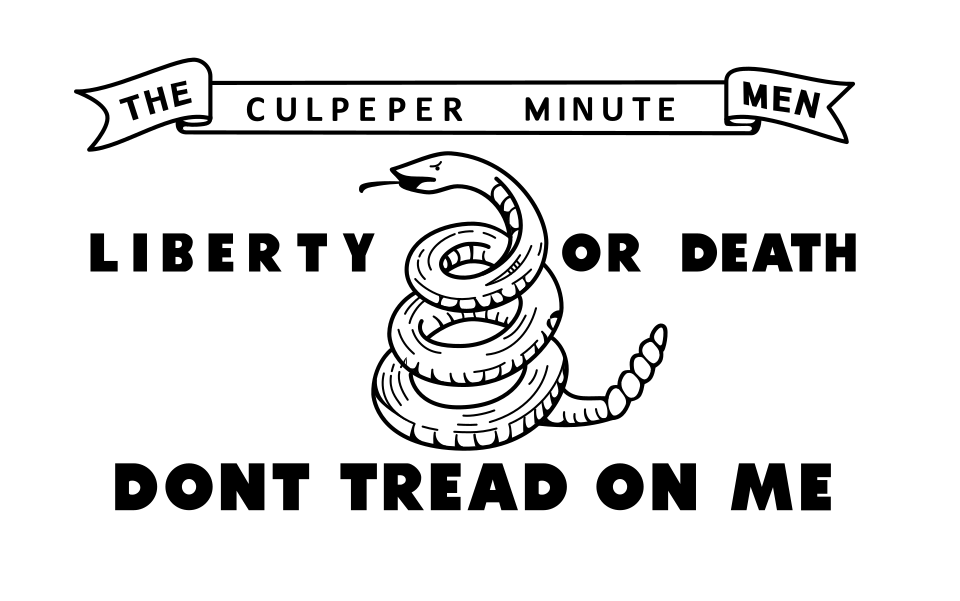
Rattlesnake and two political mottoes
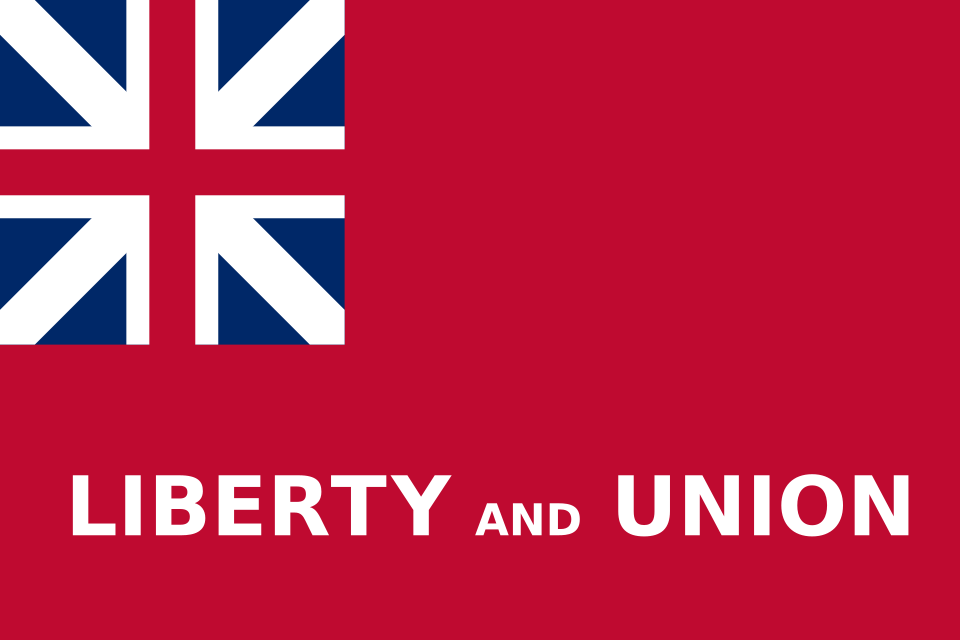
Red field, British Union canton, Liberty and Union lettering
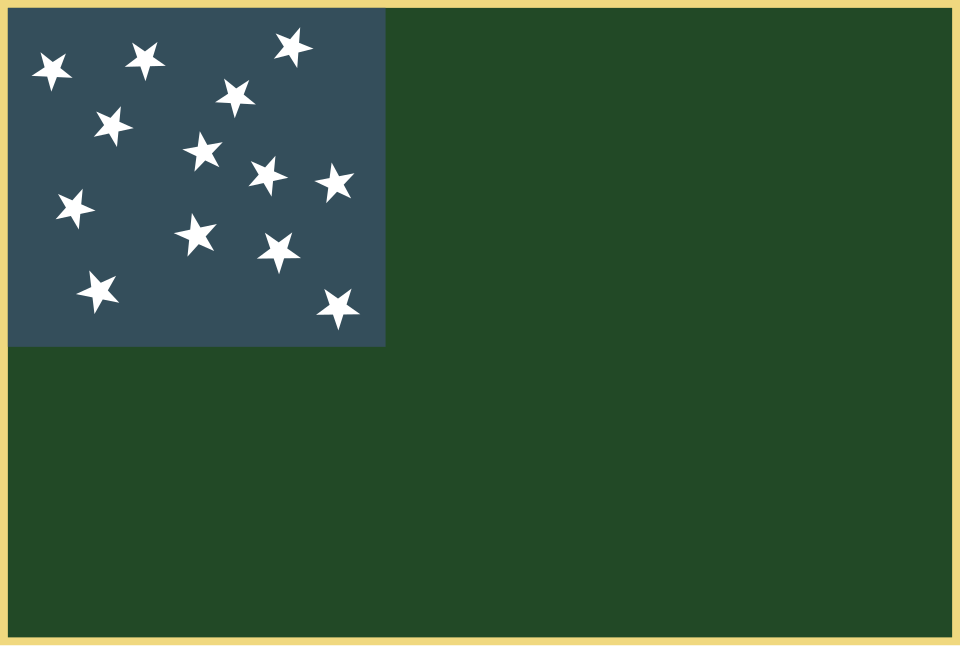
Green field and blue canton containing 13 white stars
| Flag | Quick visual clue | Associated period | Evidence and limitations |
|---|---|---|---|
| Culpeper Minutemen | Rattlesnake and two political mottoes | Associated with 1775 | Its unit, symbols and slogans are recognized in historical accounts; the exact form of a surviving 1775 cloth original is not established. |
| Taunton — Liberty and Union | Red field, British Union canton, Liberty and Union lettering | Documented October 1774 | A 1774 newspaper documents a Union flag with the words; precise colors and placement in today’s common reconstruction are not fully documented. |
| Green Mountain Boys (traditional) | Green field and blue canton containing 13 white stars | Associated with the 1770s | The commonly used reconstruction is attributed by modern tradition; specialist vexillological research disputes its identification as Ethan Allen’s unit flag. |
Culpeper Minutemen flag: rattlesnake, Liberty or Death and Virginia militia
Who were the Culpeper Minutemen?
The Culpeper Minutemen were a Virginia militia formed in the opening months of the American Revolution. They drew men from the Culpeper region and associated counties, responding to the call for organized resistance to British government authority. Their readiness to muster quickly gave them a name shared by other colonial minute companies.
Early descriptions emphasize their distinctive frontier clothing. Brown hunting shirts, decorated with “Liberty or Death,” marked their identity. Members sometimes added bucktails to their hats. Those details matter because the slogan was not just something modern flag sellers added to a design—it appears in historical traditions surrounding the actual militia.
What does the flag look like?
The commonly illustrated Culpeper flag has a light or white background, a large coiled rattlesnake and the motto “Don’t Tread on Me.” Additional lettering identifies the Culpeper Minute Men and proclaims “Liberty or Death.” Placement and spelling can differ in modern drawings: Culpepper with two p’s is frequently found in older references, while Culpeper is the modern county spelling.
The rattlesnake represents a warning against attack and was already a familiar emblem of colonial resistance. A snake ready to strike was used by other Patriot banners and political cartoons, including the yellow Gadsden flag. This does not prove that the Culpeper flag was a direct copy of every feature of Gadsden’s original standard; the two designs belong to the same broader Revolutionary symbolic language.
What does Liberty or Death mean?
“Liberty or Death” is associated with Patrick Henry’s March 1775 address to Virginia’s convention and expresses a willingness to risk life rather than accept the loss of political freedom. The phrase later became one of the most recognizable slogans of the Revolution. Together with the rattlesnake warning, it gives the Culpeper design a more elaborate verbal message than the Gadsden flag’s single famous line.
For a reader trying to distinguish the two snake flags, look at the background and the inscriptions. The Gadsden standard is yellow and normally carries “Don’t Tread on Me.” The Culpeper reconstruction is usually light-colored and adds the unit name plus “Liberty or Death.” The Gadsden flag guide explains why claims about the first Continental Navy jack require separate treatment.
How much of the original design is documented?
Federal government historical publications, Culpeper local histories and other references describe the militia banner and its coiled snake and slogans. However, the exact dating and provenance of a full surviving 1775 cloth specimen are not securely established by the modern illustration. A contemporary digital rendering cannot tell us the dimensions of every letter or the original ink’s shade.
Some commercial histories give the flag an exact first-raising date without citing a contemporary record. It is better to say that the standard is associated with Culpeper’s Revolutionary militia in 1775 than to invent a minute-by-minute ceremonial account. The flag remains useful evidence of how rattlesnake imagery and liberty slogans shaped popular recollections of the Virginia Patriot movement.
Taunton flag: the Liberty and Union protest of October 1774
What happened on Taunton Green?
On October 21, 1774, residents of Taunton, Massachusetts, raised a tall liberty pole with a flag carrying the words “Liberty and Union.” The Boston Evening Post reported the event three days later, on October 24. Its description mentions a liberty pole about 112 feet tall and a Union flag bearing the slogan. This newspaper account provides unusually direct evidence for an early American political flag.
The display took place before the opening battles at Lexington and Concord and well before the Declaration of Independence. That is why Taunton’s banner is often described as a pre-Revolutionary or colonial protest flag. It represented an attempt to defend political rights within the British Empire, not necessarily a fully developed call for a separate United States.
Why does its canton look British?
The flag commonly shown today uses a red field, the older British Union flag in its upper hoist corner and large white “LIBERTY AND UNION” lettering. This design belongs to the red-ensign family. The Union canton predates the red diagonal St. Patrick’s cross that was added to the modern British Union Jack in 1801.
That combination can seem contradictory from a modern perspective. But in 1774 many Patriots wanted what they considered traditional rights as British subjects and wished to demonstrate unity across the colonies. Keeping a British emblem in the canton while adding a liberty slogan made sense within that transitional political situation.
What does the 1774 newspaper actually prove?
The report confirms the presence of a Union flag and its “Liberty and Union” inscription. It does not preserve a full colored drawing of the exact cloth used that day, and a surviving original has not established every dimension, shade or letter placement. The familiar red-ensign reconstruction is grounded in flag practice of the time, but should be labeled as a representation rather than a visually certified replica of a photographed 1774 original.
The Old Colony History Museum has published research drawing on the newspaper notice and correspondence involving the family of Robert Treat Paine, a Massachusetts delegate to the Continental Congress. Those letters show the significance of flags and liberty poles in the town’s political activity. Readers interested in the evidence can follow the source links below rather than relying only on tourist brochures or sellers’ descriptions.
Is the Taunton flag a current local flag?
The design has continued to serve as a civic symbol for Taunton and is remembered at Liberty and Union celebrations. Its local status must not be confused with that of a national U.S. flag or the modern Massachusetts state flag. It predates the June 1777 congressional resolution establishing the familiar thirteen stripes and thirteen stars.
Green Mountain Boys flag: Vermont tradition and disputed attribution
Who were the Green Mountain Boys?
The Green Mountain Boys emerged from land disputes in the territory that became Vermont, where settlers contested the claims of New York authorities. Ethan Allen became their best-known leader. In May 1775, Allen and forces associated with the Green Mountain Boys joined Benedict Arnold in the capture of Fort Ticonderoga from the British, an important early Patriot success.
The history of this group is genuine and well documented, but that does not settle the origin of every flag later identified with it. Vermont’s Revolutionary experience included multiple militia and military formations, as well as New Hampshire troops serving under General John Stark at the Battle of Bennington. Later histories sometimes blurred the distinction between these units.
What does the traditional flag show?
The familiar illustration is a green field with a blue canton containing thirteen white stars. Green is naturally associated with the Green Mountains and with Vermont’s regional identity, while the thirteen stars are commonly interpreted as a reference to the original colonies. Today this simple design appears in heritage displays, local commemorations and Vermont National Guard contexts.
The stars are often arranged in an irregular or scattered pattern rather than the rows of the modern American flag. Because this is a reconstruction, the exact location of each star cannot be treated as an immutable 1777 government specification. The name “Green Mountain Boys flag” is widely recognized, even though it can imply a stronger unit-specific historical provenance than surviving evidence supports.
Why do specialists dispute its origin?
In a September 2026 discussion published by the North American Vexillological Association, researchers reviewing the flag’s surviving fragment and older accounts challenged the assumption that Ethan Allen’s Green Mountain Boys used this exact banner. The artifact is incomplete, consisting chiefly of a blue canton with star imagery and some green material. Its original complete field, exact unit association and timing remain uncertain.
One line of research associates it instead with New Hampshire troops connected to General John Stark, or potentially with a later Continental regimental color. The Battle of Bennington involved several forces and was commanded by Stark, a New Hampshire officer, not by Ethan Allen. A later Vermont heritage association does not establish which specific regiment first carried the fabric.
Is this the current flag of Vermont?
No. The official Vermont state flag uses a dark-blue field with the state’s coat of arms, including a pine tree, cow, mountains and deer-head crest. The green thirteen-star flag is a separate historical or commemorative banner. This distinction is important for a site that also maintains a complete gallery of current U.S. state flags.
Timeline: protest flags and colonial militias, 1774–1777
Town residents raise a liberty pole and flag. Its words are confirmed by a report in the October 24 Boston Evening Post.
Patrick Henry’s address gives a famous expression to the Patriot demand for liberty, later associated with Culpeper militia clothing and flags.
Forces including Ethan Allen and the Green Mountain Boys take the fort. This does not establish that the familiar thirteen-star green banner was present.
Virginia militia members gather and serve in the Revolutionary struggle. Their organization and snake-and-motto flag become part of Culpeper’s later civic memory.
The colonies publicly announce separation from Britain. Earlier flags, including Taunton’s Union-canton banner, emerged before that decisive change.
John Stark’s forces defeat a British-led detachment. Later histories associate different historic flags with this campaign; exactly which unit carried the green thirteen-star relic is debated.
Not every flag shown in an eighteenth-century themed exhibition can be assigned to a particular battle. A flag’s modern name, the location of an associated artifact and a commemorative festival are useful clues, but a dated military journal or surviving provenance record is stronger evidence of use.
How to tell these flags apart from similar designs
Culpeper vs. Gadsden
The white or pale Culpeper reconstruction includes the group name and “Liberty or Death” as well as a rattlesnake warning. The documented Gadsden flag uses a yellow field with the snake and “Don’t Tread on Me.” Both express resistance; they should not be presented as identical standards or as evidence that every Continental Navy flag had the same snake.
Taunton vs. Grand Union
Both incorporate the older British Union in the canton, which can cause confusion at small sizes. The commonly reproduced Taunton design has a red field with “Liberty and Union.” The Grand Union flag has thirteen horizontal red-and-white stripes and a British Union canton, without Taunton’s two-word motto. Taunton’s reported display in 1774 came before the Grand Union’s widespread Continental Army association.
Green Mountain Boys vs. the current Vermont flag
The popular historical design is green with thirteen white stars on blue; the present state flag is predominantly dark blue with the complex Vermont coat of arms. The two may share a regional association, but they differ completely in legal status, design purpose and period. For related historical designs, consult the Grand Union and Bennington comparison.
Which historical claims are confirmed and which remain uncertain?
Sources from the time of an event carry particular weight. Taunton benefits from a newspaper report dated just three days after its flag was raised. The Culpeper banner is part of a documented militia history and is described by government and local publications, although its exact original cloth form is not secured by the surviving digital art.
For the so-called Green Mountain Boys flag, the naming problem is more acute: researchers can examine a real fragment, but that physical evidence does not securely identify Ethan Allen’s troops as its original carriers. Later publications can preserve valuable stories while also repeating incorrect unit identifications. A historical flag guide should state both the tradition and the limits.
The same standards apply when researching the Betsy Ross circle or the Bennington “76” flag. Having an attractive illustration and a memorable name is not equivalent to finding an original dated order describing its appearance. FlagExplorers uses visual reconstructions for identification, while the source notes explain where history stops and later interpretation begins.
Classroom and family activities: recognize three early flags
First, hide the captions beneath the three pictures and ask a learner to identify each from one feature: a rattlesnake, a British-style canton or thirteen stars on green. Next, discuss what the slogans suggest. “Liberty and Union” was used before declared independence, while “Liberty or Death” is associated with a more uncompromising call for resistance.
For a second activity, create three evidence cards. One card states that the Boston Evening Post reported a Taunton liberty pole in October 1774. Another states that the Culpeper Minutemen used liberty slogans in their militia tradition. The last card records the NAVA researchers’ doubts about attributing the green-star flag to Ethan Allen’s unit. Ask learners to rank the certainty of each claim and explain why historians weigh documents differently.
Finally, compare these three historical banners with the modern U.S. flag and the stars-by-year timeline. Not every Revolutionary flag was an official national flag, and not every flag with thirteen stars had a federally prescribed arrangement. The aim is to learn to identify symbols while also understanding the dates and limits of the surviving evidence.
Frequently asked questions
Is the Culpeper flag the same as the Gadsden flag?
No. The familiar Culpeper Minutemen flag usually has a pale field and combines a rattlesnake with Liberty or Death, Don’t Tread on Me and the unit name. Gadsden’s documented yellow standard has a rattlesnake and Don’t Tread on Me but not the same layout and inscriptions.
When was the Taunton Liberty and Union flag raised?
A contemporary newspaper report dated October 24, 1774 described the flag raised the previous Friday, October 21, on a liberty pole at Taunton Green in Massachusetts.
Was the Taunton flag the first U.S. flag?
It predates the 1777 congressional Stars and Stripes resolution, but it was a local colonial protest flag, not the later national flag. Describing it as ‘the first U.S. flag’ is misleading.
Why does the Taunton flag include a British Union symbol?
In 1774 many colonists demanded recognition of their rights while remaining British subjects. The Union emblem and ‘Liberty and Union’ inscription expressed that transitional political position.
Did the Green Mountain Boys definitely carry the green thirteen-star flag?
No. That identification is a familiar tradition but is disputed by specialists. The surviving relic associated with the design is fragmentary and has also been linked to a New Hampshire regiment of John Stark.
What do the 13 stars on the traditional Green Mountain Boys flag represent?
The 13 stars are commonly read as the thirteen colonies involved in the struggle against Britain. Their presence in the modern reconstruction is clear, but the exact Revolutionary-era appearance of the flag remains contested.
Is the Green Mountain Boys flag Vermont’s official state flag?
No. Vermont’s current state flag is a dark-blue banner with its coat of arms. The green field and starred canton serve as a historical or commemorative design.
What does Liberty or Death on the Culpeper flag refer to?
It echoes Patrick Henry’s celebrated March 1775 appeal for resistance. The motto is also associated with the Culpeper militia’s clothing in early accounts, while the precise history of every modern flag reconstruction warrants caution.
Are the illustrations photographs of original 1770s flags?
No. They are modern vector or digital representations. The captions and sources identify the degree to which each composition can be traced to contemporary records.
Can these flag images be reused for educational material?
The Culpeper image is CC0 and the Taunton illustration is public domain; the Green Mountain Boys illustration is CC BY 2.5 and requires attribution, a license link and notice of modifications. Always check the linked file pages for the current terms.
Another set of early designs includes the Sons of Liberty’s nine-striped protest banner, Bedford’s surviving crimson militia flag, and the disputed thirteen-star Cowpens pattern. Compare their symbols and evidence in our Sons of Liberty, Bedford and Cowpens flag guide.
Historical sources and illustration credits
U.S. Government Printing Office — Our Flag (House Document 100-247)
Culpeper County, Virginia — local history and the Minutemen flag
Old Colony History Museum — Liberty and Union: They Have a Fine Flag Now
Liberty & Union — Taunton in the Revolution
North American Vexillological Association — Green Mountain Boys Flag attribution, September 19, 2026
Vermont Public — State flag and Green Mountain Boys flag
Vermont Air National Guard — History of the Vermont Green Mountain Boys flag
Culpeper Minutemen flag: Vwanweb, CC0 1.0
Taunton flag: Public domain
Green Mountain Boys flag: Peeperman / MJBurrage; based on image by Amber Kinkaid; CC BY 2.5
CC BY 2.5 license
The illustrations were imported into the FlagExplorers media library from Wikimedia Commons in November 2026 and converted from SVG to PNG. The Green Mountain Boys rendering is credited under CC BY 2.5; the Culpeper rendering is CC0 and the Taunton image is public domain. Flag designs are described as reconstructions or traditional renderings where documentary certainty is limited. Reviewed November 2026.