Vermont State Flag: Pine Tree, Cow & Freedom and Unity
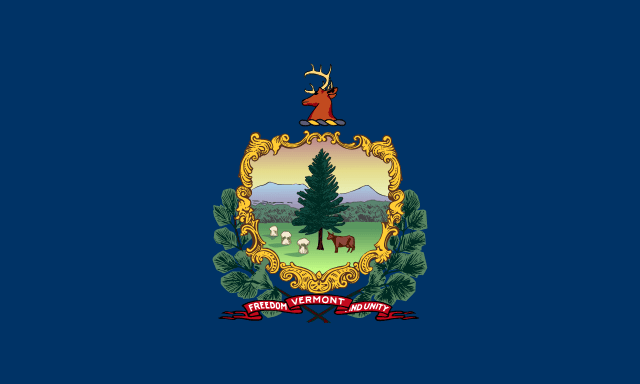
Vermont’s dark-blue state flag shows a coat of arms with a pine tree, cow, mountains, sheaves of grain and a deer-head crest above the motto Freedom and Unity.
Vermont flag facts at a glance
| Feature | Answer |
|---|---|
| State | Vermont, United States |
| Adopted / updated | March 26, 1923; effective June 1, 1923 |
| Key identifying symbols | Pine Tree, Cow & Freedom and Unity |
| Image | Current design, vector-derived reference illustration |
What is on the Vermont flag?
The state flag consists of a dark-blue field bearing Vermont’s full coat of arms. Inside the shield is a green landscape, with mountains behind a tall pine tree, grain sheaves and a cow.
Above is the head of a deer; below a red ribbon includes the name VERMONT and the motto FREEDOM AND UNITY. The design is rich in agricultural and woodland symbols rather than stars, stripes or a simple state outline.
What do the pine tree, cow and grain mean?
The pine tree points to Vermont’s forests and natural environment. Grain sheaves and the grazing cow represent the importance of farming and dairy agriculture in the state’s history.
The mountains refer to the Green Mountain landscape from which Vermont takes its name. The deer head and crossed pine branches further emphasize wildlife and forestry. These meanings can be checked against the state law defining the coat of arms.
What does Freedom and Unity mean?
Freedom and Unity is Vermont’s official state motto and appears in the scroll beneath the coat of arms. It reflects a relationship between individual liberty and collective life in a state community.
Although the motto has been linked to Vermont’s independent political history, it is best to describe it as the state’s long-standing civic statement rather than as an exact quotation from a battle or personal speech.
When did Vermont adopt its current flag?
Vermont adopted the modern blue flag on March 26, 1923, with the law taking effect June 1. The state already had a rich tradition of military and governmental banners, including a nineteenth-century design with stripes and a central star containing the coat of arms.
That older form could be mistaken for a variation of the national flag, so the new blue-field design offered a clearer identity.
Was the Green Mountain Boys flag the official state flag?
The famous Green Mountain Boys flag uses green with blue in the canton and thirteen white stars. It is an important historical and commemorative banner associated with Vermont’s early history, but it is not the current official state flag.
Vermont law treats it and the Bennington Battle Flag as distinct symbols for certain ceremonies. A gallery labeled current U.S. state flags should show the blue coat-of-arms design.
What does the coat of arms say about Vermont?
The green land, distant mountains, cow and wheat evoke a rural economy and distinctive landscape. The heraldic composition also preserves a political identity expressed in the motto.
It is possible to describe these details without suggesting the flag is a literal map or that the tree represents a single known tree in all artistic reproductions. Vermont’s coat of arms has developed through official versions and interpretive artworks over time.
How is Vermont different from New Hampshire?
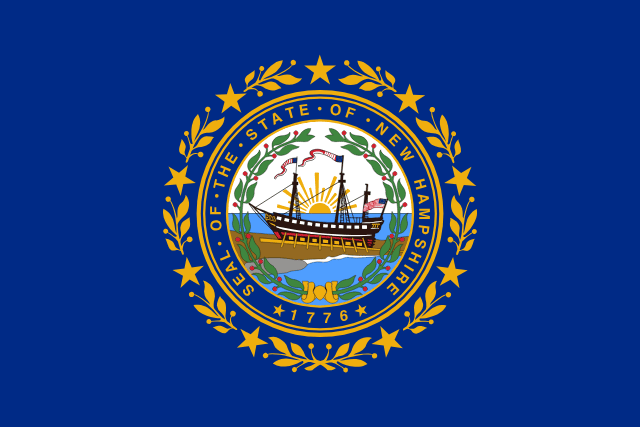
Both are New England states, but New Hampshire’s blue flag contains a ship under construction and nine stars in a laurel wreath. Vermont’s shows a cow, pine tree and mountains in a shield with a deer-head crest.
Maine also uses a pine tree and animal in its state arms, but Maine’s shield features a moose and is supported by a farmer and sailor; Vermont’s arrangement is entirely different.
How to draw Vermont’s state flag
Use deep blue for the background and place the heraldic arms centrally. Begin with mountain scenery and a pine tree, then the grain sheaves and cow. Add the deer-head crest above the shield and the motto ribbon beneath it.
To keep classroom artwork comprehensible, provide an enlarged inset with labels for the rural symbols. Do not use the Green Mountain Boys flag as the hero image.
Frequently asked questions about the Vermont flag
What is Vermont’s state motto?
Freedom and Unity.
When did Vermont adopt its current flag?
March 26, 1923, effective June 1 of that year.
Is the Green Mountain Boys flag the official state flag?
No. It is a distinct historical banner, not the current state flag.
Vermont’s current state flag should not be confused with the traditional green thirteen-star banner. Our Green Mountain Boys historical flag comparison examines its popular attribution and the evidence that has led specialists to question which unit originally used the design.
Vermont Statutes — Flag and Coat of Arms
Vermont Historical Society — Flag history
Flag image: FlagCDN / Flagpedia vector-derived state flag illustration imported into the FlagExplorers media library. Check the linked official state references for legal descriptions. Article reviewed November 2026.