California State Flag: Grizzly Bear, History & Meaning
The story of California’s Bear Flag—from the 1846 Sonoma revolt to the official modern state banner, complete with legally defined construction measurements.
What is on California’s state flag?
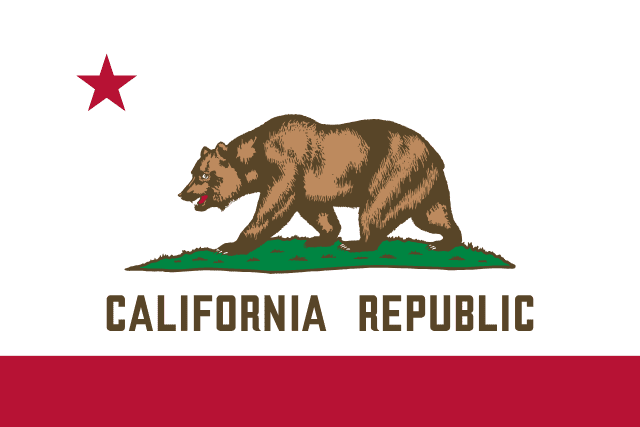
California’s flag has a white background, a red five-pointed star in the upper-left area, a large California grizzly bear standing on a patch of green grass, the words CALIFORNIA REPUBLIC underneath, and a broad red stripe along the bottom edge. It is usually called the Bear Flag.
Those elements reflect an episode in California’s nineteenth-century history, not a present-day claim that California is a republic separate from the United States. The words refer to the short-lived 1846 Bear Flag Revolt. The flag was later selected as an official state symbol under U.S. state law.
California’s State Capitol Museum describes the bear and red star as historical design elements and explains the legal steps that transformed the 1846 banner into today’s recognized state flag.
Why is there a bear on the California flag?
The bear is a California grizzly, an animal once native to the state and associated with its landscapes and frontier-era identity. Its large silhouette makes the flag recognizable at a distance and connects today’s design with the earliest revolt banner. The animal should not be confused with a black bear or with a generic heraldic lion.
The modern standardized bear was influenced by a nineteenth-century image from California artist Charles Nahl, according to the State Capitol Museum. The original banner from 1846 contained a much less standardized hand-painted bear; subsequent reproductions varied greatly before government specifications were tightened.
The official state flag’s bear is a standing animal walking toward the hoist, not an animal leaping or rising on its hind legs. The grass beneath the paws is part of the design. The bear’s importance was further recognized when California designated the grizzly as its state animal in 1953, although wild California grizzlies had disappeared from the state decades earlier.
What was the Bear Flag Revolt of 1846?
In June 1846, American settlers and other participants in the Sonoma area rebelled against Mexican authority in northern California. The episode became known as the Bear Flag Revolt because insurgents raised a makeshift banner featuring a bear, a star and the words California Republic.
The revolt occurred during a period of rapidly changing political and military control, alongside the U.S.–Mexican War. The self-declared California Republic was short-lived, and it is misleading to imagine a long-standing independent country with a lasting government similar to the modern state.
The original flag was an improvised design made from materials available to the participants. California State Parks describes its use of muslin cloth, red fabric and locally prepared pigments. After U.S. forces took control, the Stars and Stripes replaced the revolt banner.
The historical object later became part of a museum collection but was lost in the 1906 San Francisco earthquake and fire. Photographs and reproductions preserve its general appearance. The modern flag is based on that legacy rather than being the exact original cloth.
When did California officially adopt the Bear Flag?
California became a U.S. state in 1850, but it did not immediately make the 1846 revolt flag its official state flag. For decades the Bear Flag survived largely through historical associations, civic organizations and commemorative displays.
In 1911, the California Legislature adopted the Bear Flag as the state flag. Its basic elements were established, but flag-makers continued to produce different versions because precise colors and artwork had not yet been standardized.
In 1953, the Legislature settled the complete design details and color scheme. That second milestone matters when interpreting older photographs: a 1915 “official California flag” can look noticeably different from the standardized modern version without being a completely unrelated banner.
| Year | Event |
|---|---|
| 1846 | Bear Flag raised during Sonoma revolt |
| 1850 | California admitted as a U.S. state |
| 1906 | Original revolt banner lost in San Francisco disaster |
| 1911 | Bear Flag adopted as an official state flag |
| 1953 | Current detailed artwork and color standards established |
The California State Parks flag-history account makes the distinction between the initial adoption and later standardization particularly clear.
What do the red star and the words California Republic mean?
The red star has long been associated with the 1846 Bear Flag and older star imagery used in California’s political symbolism. Its location is near the upper hoist area of the white field. The official flag description specifies the star’s precise diameter and position so it is not simply added wherever a graphic designer finds convenient.
The words CALIFORNIA REPUBLIC recall the political declaration associated with the Sonoma revolt. They do not override the state’s current place in the United States, and they do not constitute a modern legal declaration of independence.
The red bottom stripe balances the large white field visually. Historical descriptions sometimes assign additional meanings to its color, but the current legal construction should be treated first as a design specification; do not claim that a single poetic interpretation is mandated by statute unless the law says so.
Readers often confuse the state flag with the California state seal, which features an entirely different composition, including Minerva, a grizzly, a miner and a landscape. The flag does not place that entire seal in the center.
California flag dimensions and official geometry
California Government Code §420 sets the main proportions: the flag’s height is two-thirds of its length, or 2:3 height-to-length. The red bottom stripe is one-sixth of the flag height. The imaginary circle through the red star’s tips has a diameter of one-tenth the flag length.
The star center is one-sixth the total length from the hoist. Its distance below the top is four-fifths of that horizontal distance. These values are useful when making a precise drawing instead of guessing.
| Measurement | 900 × 600 pixels | 30 × 20 cm |
|---|---|---|
| Total length × height | 900 × 600 px | 30 × 20 cm |
| Bottom red stripe height | 100 px | 3.33 cm |
| Star outer-circle diameter | 90 px | 3 cm |
| Star center from left | 150 px | 5 cm |
| Star center from top | 120 px | 4 cm |
The legal specification also controls the bear illustration and how it is positioned. For a formal flag reproduction, use the current state artwork and California Government Code §420 rather than reconstructing every contour of the bear from a low-resolution emoji.
How to draw California’s Bear Flag accurately
- Draw a horizontal rectangle in a 3:2 width-to-height ratio.
- Mark the lower one-sixth of the rectangle and color it red. Leave the area above white.
- Add a red five-pointed star in the upper-left white area; use the official distance from the hoist and the top edge.
- Place a carefully drawn California grizzly bear walking toward the hoist in the middle white field. Include the green strip of grass beneath its feet.
- Add CALIFORNIA REPUBLIC below the bear and above the red stripe, matching the official lettering as closely as your project permits.
- Check that the bear, lettering and star do not overlap the bottom red stripe.
For a school project, the star and the bottom stripe can be constructed precisely with a ruler. The bear is more complex: its legal depiction is based on specified artwork rather than an interchangeable silhouette. Use the Capitol Museum’s state-flag reference image when accuracy is essential.
California flag compared with other state flags
California is one of the most instantly recognizable animal-themed U.S. state flags. Wyoming also places a large mammal on its flag, but it uses a bison on a blue field framed by white and red. Louisiana uses a pelican and its young; California’s animal is a grizzly bear.
The flag also stands apart from the U.S. national flag. Both use red and white and include a star, but California contains one red star and a bear, while the Stars and Stripes uses fifty white stars against blue and thirteen stripes. These symbols represent different governmental levels and historical events.
Browse all flags by animal, star or emblem in the 50-state flag directory. The comparison is helpful for students learning to recognize flags without relying on written labels.
California Bear Flag frequently asked questions
Why is there a bear on the California flag?
It connects the current state banner to the 1846 Bear Flag Revolt and to the California grizzly, a historic animal associated with the state.
Was California once an independent republic?
The 1846 Bear Flag Revolt produced a brief self-declared republic in the Sonoma area; it was not a long-standing modern sovereign state.
What does California Republic mean?
It recalls the words printed on the 1846 revolt banner, not California’s present constitutional status.
When did California adopt the Bear Flag?
The state adopted it in 1911 and standardized its complete design and colors in 1953.
What is the red star’s size on the California flag?
The imaginary circle through its tips has a diameter of one-tenth the flag’s total length.
What is the proportion of the California state flag?
Two units high by three units long, expressed as 2:3 height-to-length.
Is the California flag the same as the state seal?
No. The flag has a grizzly, star, bottom stripe and California Republic text. The official state seal has an entirely different detailed composition.
California State Parks — History of the State Flag
California State Capitol Museum — State Flag
California Government Code §420
State flag illustration: public-domain flag artwork via Flagpedia/FlagCDN, hosted in the FlagExplorers media library.