History of the Suriname Flag: Independence and the 1975 Design
Suriname adopted its present national flag when it became independent from the Netherlands in 1975. The design deliberately emphasizes unity rather than separate ethnic identities.
Before independence
Suriname remained part of the Kingdom of the Netherlands until 1975. Earlier symbols did not use the current combination of five horizontal bands and one central star.
November 25, 1975
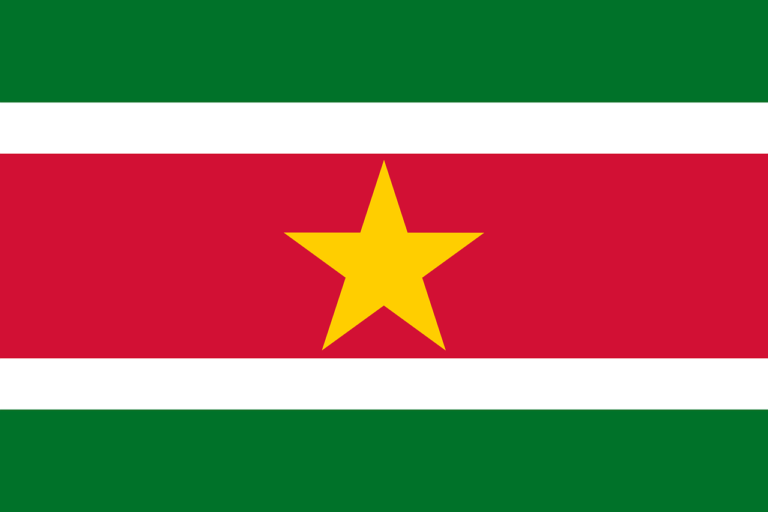
The current flag became the national flag when Suriname achieved independence on November 25, 1975. Its design uses five horizontal bands—green, white, red, white and green—with a single yellow five-pointed star in the centre.
Why one star?
The single star was chosen as a symbol of national unity. Rather than representing one region or cultural group, it brings the country’s communities together under one shared national emblem.
A flag designed around balance
The band heights follow a deliberate 2:1:4:1:2 relationship. The central red band is the broadest, the green bands are half its depth, and the white separators are narrower still. The overall flag ratio is 2:3.
The flag’s official symbolism
The Government of Suriname states that green represents fertility and future possibilities, white justice and freedom, red renewal and progress, and the yellow star unity, sacrifice and confidence in a “golden future.”
Why the 1975 design remains distinctive
Many national flags use stars, but Suriname’s combination of one large yellow star on a broad red band between green and white stripes gives it a highly recognizable structure that also works well at small sizes.