Falkland Islands Flag: Sheep, Ship Desire & Motto Meaning
The Falkland Islands flag pairs the Union Jack with a white sheep and a historic ship. Explore the coat of arms, its maritime symbolism and the motto.
The Falkland Islands, also called Islas Malvinas in Spanish, are a South Atlantic archipelago east of southern South America. They are administered as a British Overseas Territory, but sovereignty is disputed by Argentina. The flag described here is the British-administered territory’s official local flag, not a neutral resolution of that dispute.
The Falkland Islands Government displays the coat of arms in official documents, and specialist flag histories trace the design’s development. The two most recognizable badge elements are a sheep—reflecting historic sheep farming—and a sailing vessel named Desire.
Falkland Islands flag at a glance
| Feature | Details |
|---|---|
| Place | Falkland Islands / Islas Malvinas |
| Location | South Atlantic east of southern South America |
| Administration | British Overseas Territory; sovereignty claimed by Argentina |
| Administrative centre | Stanley |
| Field | British Blue Ensign |
| Flag badge | Sheep above sailing ship |
| Ship’s name | Desire |
| Motto | Desire the Right |
Flag dates and coat-of-arms dates are not always the same. These details distinguish the territory’s actual flag from older colonial badges, maritime ensigns and unofficial illustrations.
What does the Falkland Islands flag look like?
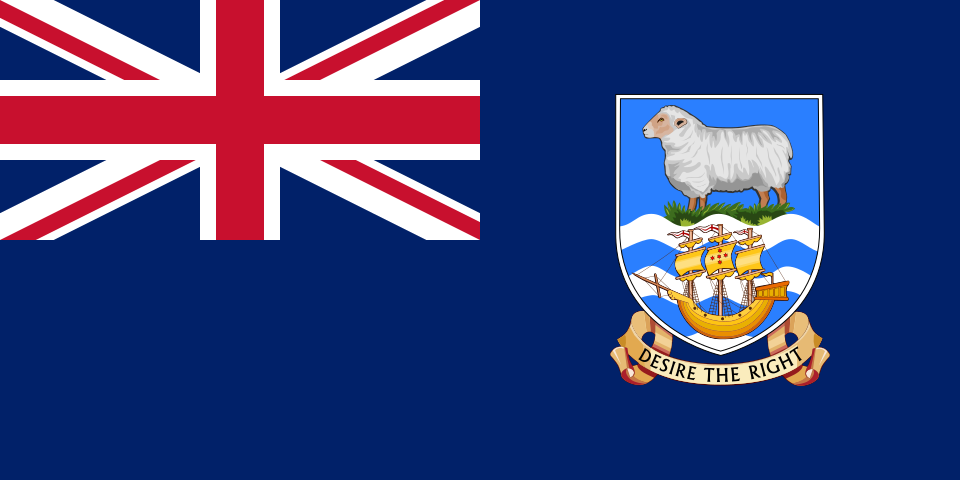
The flag has a dark blue field, the Union Jack at the upper-left and the archipelago’s coat of arms on the right. The shield shows a white sheep on green grass above a ship sailing on blue-and-white waves.
A golden scroll beneath the shield contains the words DESIRE THE RIGHT. Older flag pictures may show the local arms on a white disc. More recent official illustrations show a larger coat of arms without the white disc, a distinction worth noting when comparing historical images.
Why is a white sheep on the flag?
Sheep farming was historically one of the Falkland Islands’ dominant economic activities. The white sheep displayed above the ship refers to this pastoral history and is a locally meaningful symbol.
The animal is ordinarily called a sheep or ram in heraldic descriptions. It does not symbolize a mythical creature or indicate an exact sheep population. Its position above the ship gives a simple visual division between land-based economic history and maritime exploration.
What is the ship Desire on the flag?
The lower part of the coat of arms shows a historic sailing ship named Desire. It is associated with the English voyage of John Davis in 1592, an early British account of sighting the archipelago.
This is a specific ship reference, not a generic fishing boat. Different nations have their own accounts and histories connected with the islands, so identifying the ship should not be presented as decisive evidence resolving competing sovereignty claims.
What does Desire the Right mean?
The motto printed on the scroll is Desire the Right. It is a heraldic phrase emphasizing an aspiration toward what is right or just. The wording also echoes the ship name Desire appearing in the coat of arms.
The motto should be transcribed exactly as it appears in English. It is not a Latin inscription, and it does not say ‘Desire the Rights’ or ‘The Right to Desire.’
When were the Falkland Islands coat of arms and flag changed?
Earlier colonial badges included a sea lion and ship. The present-style arms showing a sheep above the Desire were introduced in 1948. At first, the arms were commonly shown on a white disc on the Blue Ensign.
Later flag practice enlarged the shield and removed the white disc, becoming standard around 1999. Older flag images should be labelled with their historical period rather than presented as mistakes. The 1948 arms date and later layout change describe different aspects of the design’s evolution.
What is the sovereignty status of the Falkland Islands?
The islands are administered by the United Kingdom as a British Overseas Territory. Argentina also claims sovereignty, referring to the islands as the Islas Malvinas. The dispute has a long history and includes the 1982 war.
The UK’s position emphasizes the islanders’ right to self-determination; Argentina’s position emphasizes its claim and the dispute’s international history. An accurate flag guide can state these facts without treating the appearance of a British Blue Ensign as a legal determination of the sovereignty dispute.
Falkland Islands compared with other South Atlantic flags
The Saint Helena flag also uses a British Blue Ensign, but its badge shows a wirebird and ship in front of rocky cliffs. The Ascension Island flag displays turtles, Green Mountain and seabirds.
The Falklands are easiest to recognize by the white sheep and the words Desire the Right. The Bermuda flag is particularly different, having a red field and a lion holding a small shipwreck shield.
How to draw and identify the flag accurately
Draw a navy-blue ensign with the Union Jack at upper-left. Place the coat of arms in the right half: a white sheep on a green area above a historic ship on blue-and-white waves. Add the scroll with the motto.
For an educational chart, use a licensed emblem vector because details of the ship and sheep are intricate. Distinguish the official British-administered territorial flag from other symbols associated with the islands and label it with the place’s two commonly used names where helpful.
Frequently asked questions
What is on the Falkland Islands flag?
A Union Jack, a coat of arms with a white sheep and sailing ship Desire, and the motto Desire the Right.
Why is there a sheep?
It refers to the islands’ history of sheep farming.
What is the ship called?
Desire, associated with John Davis’s voyage in 1592.
What does the motto say?
Desire the Right.
When was the present-style coat of arms adopted?
1948, with later alterations to its presentation on the flag.
Why do older flags have a white circle?
Older ensigns displayed the local badge within a white disc; newer versions generally omit that disc.
Who controls the Falkland Islands?
They are administered by the United Kingdom, while Argentina claims sovereignty and calls them Islas Malvinas.
Is the flag the same as Saint Helena’s?
No. Saint Helena’s badge features a wirebird, coastal cliffs and a ship.
Official references and image credits
Falkland Islands Government — Official website
Falkland Islands Government — Legislation
Flags of the World — Falkland Islands flag history
CIA World Factbook historical flag description
Image is rendered from Wikimedia Commons: Falkland Islands flag vector. Please check the original artwork for creator, licence and separate insignia-use rules. This is an independent educational flag guide, not an official government service.
Information reviewed November 2026.