Utah State Flag: New Beehive Design, Meaning & 2024 Change
See why Utah replaced its seal flag in 2024, what its beehive, star, mountains and red rocks symbolize, and how the new Beehive Flag differs from the historic design.
What does Utah’s new state flag look like?
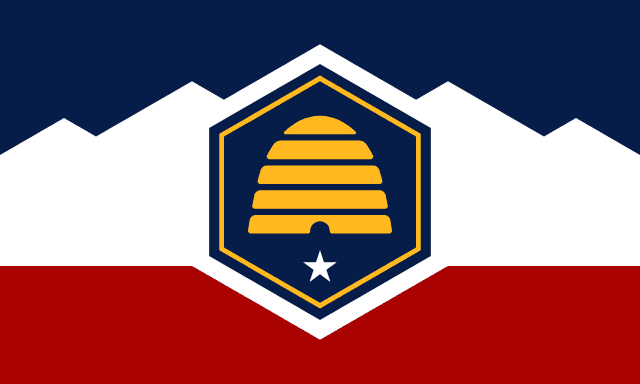
Utah’s current state flag, often called the Beehive Flag, has a deep-blue sky at the top, white snow-covered mountains in the middle and red-rock color across the lower portion. In the center, a gold-outlined hexagon contains a gold beehive and a single white five-pointed star. The geometry is intentionally bold enough to be recognized when flying from a pole or reduced to a small icon.
The white mountain ridge has five peaks, with its highest central peak aligned with the top of the hexagon. These are not five individually named mountains, and the number of peaks is not presented in the state law as a count of counties. Together with the broad fields of color, the peaks portray the state’s northern landscapes.
The new design is established in Utah Code §63G-1-501, which defines both its visible elements and their official meanings. The state also provides downloadable artwork through the Utah Beehive Flag website.
When did Utah change its state flag?
Governor Spencer Cox signed the redesign legislation on March 21, 2023. The new state flag became official on March 9, 2024, Utah State Flag Day. That is the date to use when asked when the new flag replaced the former state flag as Utah’s current official design.
The earlier blue flag bearing Utah’s Great Seal was originally adopted in 1911. Its seal includes an eagle, arrows, sego lilies, a beehive and other historic details. The new flag’s legal recognition did not erase that history: Utah designated the older banner as its historic state flag, which continues to have authorized ceremonial uses.
The official Utah Online Public Library notes that March 9, 2024 was exactly 113 years after the original state flag’s March 9, 1911 adoption. The coinciding anniversary was intentional. Do not describe a March 2023 news report as saying the new flag had already been in official use since 2023; legislative approval and the effective date are separate events.
| Date | Milestone |
|---|---|
| March 9, 1911 | Original seal-bearing Utah state flag adopted |
| 2022 | More Than A Flag public design campaign |
| March 21, 2023 | Governor signs the Beehive Flag legislation |
| March 9, 2024 | Beehive Flag officially becomes Utah’s state flag |
Sources: Utah State Flag and Historic State Flag, Utah’s Online Public Library.
What does the gold beehive symbolize?
The beehive expresses industry, cooperation and community. It is a longstanding Utah symbol that also appears on the state’s Great Seal and on the older historic flag. Utah’s state motto is Industry, so keeping the beehive on the simplified design maintains an important connection with the state’s older iconography.
Utah Code explicitly associates the beehive with 1847, the year Mormon pioneers first settled in the Salt Lake Valley. Utah’s history did not begin in 1847, however. Indigenous peoples lived in the region long before pioneer settlement, and the modern state’s official design separately acknowledges Utah’s Indigenous peoples in its mountain symbolism.
The beehive should not be interpreted as a count of the state’s beekeepers or an instruction to include live bees in the flag drawing. The law calls for one recognizable hive inside a gold hexagonal outline. The familiar symbol represents a broader civic ideal, not a particular agricultural statistic.
The official flag symbolism guide links the gold hexagon with strength and unity and describes the beehive as an image of Utah’s history and its emphasis on industry.
What does Utah’s white star mean?
The new Utah flag has one five-pointed white star immediately below the beehive inside the central hexagon. According to the statute, it stands for hope and recalls 1896, the year Utah entered the Union as the 45th state.
That statehood connection is easy to confuse with the U.S. national flag. The Utah star is a single emblem on its own state flag. The Stars and Stripes instead uses one star for each present-day state.
Some early redesign finalists featured eight-pointed stars or circles of several stars. Those proposals help explain the public selection process, but the current statutory flag has just one five-pointed star. A drawing based on an unselected design should be labeled as a proposal, not the official 2024 flag.
The star is white rather than yellow, even though the adjoining hive and hexagon have gold coloring. Separating these colors helps the star stand out at small sizes.
Utah flag colors and landscape meanings
Utah’s legislature specifies symbolism for the three large color bands. The blue upper field represents the state’s skies and symbolizes faith. The white middle mountain segment represents snow-covered mountains and peace, while the peaks acknowledge the state’s Indigenous peoples. The red lower field evokes southern Utah’s dramatic red rocks and symbolizes perseverance and distinctive local landscapes.
The hexagon’s gold border recalls prosperity, unity and strength. These are design meanings adopted by the state, not merely common interpretations borrowed from general color psychology. Utah’s official symbolism descriptions also explain blue as a reference to lakes, knowledge and optimism, and describe the gold beehive as an established emblem of the state.
| Element | What to look for | Official association |
|---|---|---|
| Blue | Upper field | Skies, faith and heritage |
| White | Five-peaked mountain band | Snow, peace, Indigenous peoples |
| Red | Lower field | Red rocks and perseverance |
| Gold hexagon | Border around the beehive | Strength, unity and prosperity |
| Beehive | Center of hexagon | Industry and community |
| White star | Below beehive | Hope and 1896 statehood |
Utah’s old flag vs. the new Beehive Flag
The historic Utah flag consists of a blue field with the detailed Utah Great Seal. It includes an American eagle, arrows, the date 1847, the state name, a beehive, flowers and other emblems. That older layout works as a formal ceremonial banner but is difficult to reproduce accurately without high-resolution seal artwork.
The new Beehive Flag keeps the idea of industry and state history but uses a simple beehive, a star, a hexagon and three landscape-colored areas. It can be recognized without trying to read tiny words on a seal. Both styles express Utah’s identity in different ways.
The older flag is not simply banned. State law recognizes it as the historic state flag, with specified ceremonial display rights; it is still seen on state grounds alongside the newer design. When an image search returns a blue flag with an eagle and shield, it may be a correct image of the historic Utah flag rather than an outdated error in every context.
For an educational worksheet asking for Utah’s current flag, use the Beehive Flag effective March 9, 2024. For a project on state history, include both and explain the legal distinction. See the official historic flag guide for variations of earlier artwork.
How to draw Utah’s new state flag
The statutory height-to-length proportion is 3:5. An easy drawing canvas is 900 pixels wide × 540 pixels tall, or 25 cm wide × 15 cm tall. Work from the official graphic so that the five mountain peaks and central hexagon retain their required shapes.
- Outline a rectangle with a 5:3 width-to-height ratio.
- Sketch two irregular boundaries for the broad blue, white and red sections. The upper boundary of white forms five mountain peaks; its center peak is the highest.
- Color the top section blue, the snowy middle section white and the lower canyon section red.
- Add a centered gold-bordered hexagon, aligned with the highest mountain peak.
- Draw the gold beehive inside the hexagon. Add one five-pointed white star beneath the hive.
- Compare spacing and proportions with the official Utah state flag artwork before exporting.
The flag is not made from three straight horizontal bars: the jagged mountain boundary and red landscape shape are important. Do not substitute a five-point star for the hive, or place a second star above the mountain peaks. The new design should also not include the older state’s eagle and formal seal.
In graphic software, use vector shapes or an official source SVG to keep edges crisp. Sample web HEX codes may approximate the colors, but the legally prescribed shapes and color appearance should take precedence over decorative effects or gradients.
Utah state flag FAQs
When did Utah get its new flag?
The Beehive Flag became Utah’s official state flag on March 9, 2024. Its legislation was signed March 21, 2023.
What does the beehive mean?
It represents industry, cooperation and community, recalling Utah’s 1847 pioneer-era history and its motto, Industry.
What does the white star symbolize?
Hope and the year 1896, when Utah became the 45th U.S. state.
Does Utah have two official flags?
The Beehive Flag is the current state flag, while the former seal-bearing design is legally preserved as the historic state flag for ceremonial uses.
How many mountain peaks are there?
Five, with the central peak higher than the others, as specified in Utah Code §63G-1-501.
What are the Utah flag’s dimensions?
The flag is three units high for every five units long, a 3:5 height-to-length ratio.
Utah’s Online Public Library — Current Flag
Utah’s Online Public Library — Historic State Flag
Utah Code §63G-1-501 — Official legal flag design
Utah Beehive Flag — Official symbolism and art
State flag image: public-domain Utah flag artwork via Flagpedia/FlagCDN, uploaded to FlagExplorers. For official flag manufacturing, use Utah’s current government artwork.