How to Draw the Nevada Flag: Silver Star, Sagebrush and Battle Born Emblem
Measured construction steps, practical examples and accuracy checks.
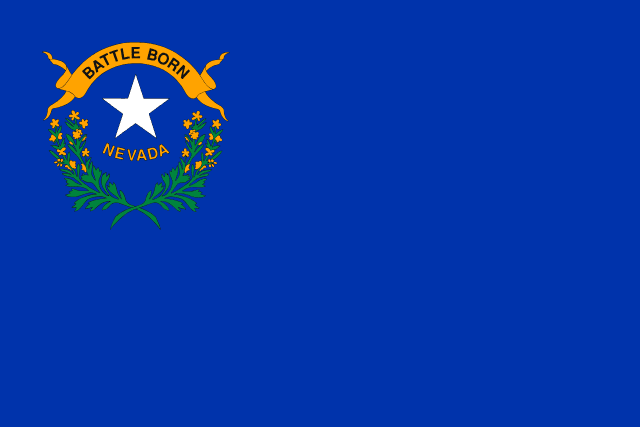
The Nevada state flag has a cobalt-blue field with a small emblem in its upper hoist quarter. Draw a silver five-pointed star surrounded below by two crossed sagebrush sprays, with a golden-yellow Battle Born scroll above and the name Nevada curved beneath the star. Nevada Revised Statutes §235.020 specifies the arrangement and lettering. The exact outline and coordinates of the botanical and banner details are best transferred from the state’s reference artwork.
For the history and symbolism, read our Nevada flag guide.
Construction measurements
| Field | Solid cobalt blue |
|---|---|
| Emblem location | Upper hoist quarter |
| Star | One silver five-pointed star, one point up |
| Plant | Two crossed sagebrush sprays |
| Scroll | Golden-yellow; black capital lettering |
| State name | Golden-yellow semicircular lettering beneath star |
Step 1: Choose a reference canvas and locate the upper hoist quarter
The first important decision in drawing Nevada’s flag is not the star size. It is the position of the complete emblem. Unlike a state flag with its seal centered across the cloth, Nevada deliberately places its design near the upper pole corner and leaves the rest of the blue field uninterrupted.
Use a rectangular sheet thirty centimeters long and twenty centimeters high for an introductory exercise. This approximates the proportions of the existing reference image, which measures 640 by 427 pixels. The statute cited in this article does not specify a universal numerical flag ratio, so these measurements are illustrative.
Mark the horizontal midpoint fifteen centimeters from the hoist and the vertical midpoint ten centimeters below the top. The rectangle above and to the left of those guides corresponds to the upper hoist quarter. The decorative group belongs in this region, not in the middle of the entire flag.
When measuring a reference, identify the outer extents of the complete emblem, including the scroll, the leaves and the crossed stems. Record those boundaries as fractions of the reference’s length and height. This prevents a drawing from becoming accidentally too large when transferred to a different sheet.
On a digital canvas, place a nonprinting guide at half the width and another at half the height. Import a documented reference on a temporary layer, with its original aspect ratio intact. Compare its emblem boundaries with the quarter guides before tracing individual features.
The large amount of empty cobalt-blue field is intentional. Do not enlarge the emblem to fill the central area simply because a smaller design is more difficult to draw. A larger paper canvas is a better solution if the letters or leaves are difficult to reproduce.
Step 2: Sketch the crossed sagebrush sprays
The wreath-like element is formed by two sprays of sagebrush whose stems cross at the bottom. The branches rise along opposite sides of the star and leave the upper part open. They are not a complete circular laurel wreath.
Start by identifying the bottom crossing point on the reference artwork. Mark that point on your working sheet, then draw the general paths of the two stems. The left-hand spray curves upward on one side of the star, and the right-hand spray curves upward on the other.
The stems should approach the upper scroll, which the statute places against the tips of the sprays. Plan those connections before adding individual leaves. If the two branches are made too short, the scroll will appear disconnected; if they are too tall, they can extend into the lettering.
Use a tracing grid to transfer the curved silhouettes. A useful method is to divide a close-up of the emblem into eight or ten rows and columns, then draw the same grid at the desired size. Mark where the stems cross the grid lines and join those points with smooth curves.
Add the smaller foliage shapes in groups, working from the main stems outward. Study the reference’s narrow leaves and details rather than substituting rounded olive leaves or a generic wreath clip-art image. The law names sagebrush, Nevada’s state flower, and the recognizable botanical treatment is part of the design.
For an editable digital drawing, create the main branches and the leaves as separate paths or groups. Keep their original relationship to the central star. If the leaves overlap the star’s tips or make the semicircular state name unreadable, compare their extent with the reference and correct it.
A classroom sketch can simplify the fine botanical detail, but it should still have two crossed sprays, a clear open top and enough space for the silver star. A simplified version is a learning exercise, not a substitute for an official production asset.
Step 3: Place the silver star in the center of the sprays
Nevada’s single star is five-pointed, silver in color and oriented with one point upward. Its location is within the two sprays, below the scroll and above the semicircular state name. These relationships distinguish the emblem from a star placed alone in the corner of a blue flag.
Use the reference image to determine the star’s outer radius relative to the emblem. Draw a temporary circle with that radius around its intended center. Then mark five equally spaced outer points, beginning at the top and continuing in seventy-two-degree increments.
Connect every second point to make the underlying pentagram. Trace the outside silhouette and erase the internal crossing lines. This produces a regular five-pointed star with clearly defined tips and notches.
A common vector drawing method uses alternating outer and inner radii. If the outer radius is ten millimeters, the inner radius of a regular pentagram-derived silhouette is about 3.82 millimeters. That calculation is a geometric tool for the example, not a numerical star size required by Nevada law.
The silver star is commonly represented with a light, almost white fill in flat flag artwork. A metallic gradient or shiny reflection is not required to convey the design. Check the state’s reference when preparing an exact visual reproduction.
The star’s bottom tips must remain above the word Nevada. Do not make the star so large that it collides with the botanical sprays or leaves insufficient room for the lettering. The individual components are parts of one compact emblem and must be scaled together.
Check that the star remains upright when the flag is viewed from the front with the hoist on the left. An image flipped vertically would reverse the position of the scroll and state name. Preserve the reference orientation and keep the finished star separate from any temporary guide circle.
Step 4: Reproduce the Battle Born scroll
The golden-yellow scroll sits above the sagebrush sprays. It bears the words Battle Born in black uppercase sans-serif gothic lettering. This is one of the flag’s most useful identification features, especially when comparing Nevada with other blue state flags.
Study the scroll’s outline in the state reference. It is a stylized banner with curved or folded portions rather than a plain horizontal box. Transfer the main curved face first, then add the terminal portions that meet the tips of the sprays.
Draw a temporary baseline along the front face of the scroll. Before coloring it, write the two words lightly and check that their spacing fits. The banner should remain a distinct golden-yellow shape even where small lettering becomes difficult to see.
For a digital drawing, keep the banner and text separate. A curved text path can help place the lettering along the shape. Select a clear sans-serif capital-letter treatment consistent with the reference, rather than a decorative script or a modern handwritten font.
The statute specifies the lettering category but does not name a particular commercial typeface or a complete set of font-file measurements. Do not label a conveniently available substitute font as the official Nevada typeface.
At small scale, the letters may be difficult to reproduce by hand. One useful classroom approach is to enlarge just the emblem as a separate reference sheet, practice the text there and then transfer it proportionally to the complete flag. Do not enlarge the scroll alone in the final illustration.
The words refer to Nevada’s admission to the Union during the Civil War. The state flag guide explains the history of the phrase. For construction, make sure the black lettering belongs on the golden scroll, not directly on the cobalt field or across the silver star.
Compare the scroll’s lower boundary with the top of each sagebrush spray. Its relationship with those tips is a statutory feature. Adjust the shape and placement as a group rather than simply leaving a large blue gap above the wreath.
Step 5: Curve the state name below the star
The word Nevada is written in golden-yellow letters below the star and above the crossed sagebrush. Its letters follow a semicircular pattern with evenly spaced increments, in the same style family as the scroll lettering.
This element is particularly important because an earlier version arranged the state name differently around the star. The Nevada Legislature’s state-symbol information describes the 1991 revision that moved the name to its clearer present location. An older flag reference can therefore lead to an inaccurate contemporary drawing.
Begin with a faint curved guide underneath the star. Mark six positions for N, E, V, A, D and A. Use equal spacing along the guide rather than fitting the first letters tightly and stretching the last ones to fill the remaining arc.
Write the complete name in light pencil, preserving the reference orientation of the characters. Check the distance from the lower star tips to the lettering and from the lettering to the foliage. Both areas need enough negative space for the individual shapes to remain identifiable.
For an editable vector illustration, place the characters along a semicircular path and adjust the text spacing to match the reference. Keep the underlying guide invisible in the exported flag. A red or white state name would not reproduce the golden-yellow lettering described by the law.
Do not write Nevada across the entire lower half of the flag as a large label. The name is contained within the small upper-hoist emblem. A separate caption beneath a flag drawing can identify the state for readers without altering the flag itself.
At very small sizes, the curved lettering may not be readable. Maintain its correct size in the source artwork, and provide a larger image or a text description rather than redesigning the official emblem for a thumbnail.
Once the lettering is complete, check the order of the three central features from top to bottom: Battle Born scroll, silver star, curved Nevada name. The sagebrush stems and leaves surround the lower and side portions of that arrangement.
Scale the emblem accurately using reference coordinates
Because the legal description does not provide a complete numeric construction table, a measured reference-transfer method is preferable to inventing coordinates. Start with the existing 640-by-427-pixel illustration and record the positions of important landmarks on a separate worksheet.
Useful landmarks include the topmost point of the scroll, the outer edge of each spray, the star center, the bottom stem crossing and the lowest point of the state-name lettering. Measure all horizontal coordinates from the hoist and vertical coordinates from the top.
If you enlarge the reference to 1280 by 854 pixels, every coordinate and measured detail doubles. A point measured at x equals 80 and y equals 60 in the source, for example, would move to 160,120 in the larger drawing. These are example coordinates to explain the calculation, not claims about a particular Nevada emblem feature.
For a printed illustration thirty-two centimeters long and 21.35 centimeters high, each source pixel represents 0.05 centimeters. Multiply each measured coordinate by that factor to transfer the landmarks onto the new paper canvas.
If you need to reproduce the artwork at a different rectangular ratio, avoid stretching the emblem independently in one direction. The five-pointed star should remain geometrically recognizable, and the scroll and branches should not become compressed. Consult the official reference if the intended format differs significantly.
This method also makes revisions easier. Save the original measurement table and the exact reference used. A future editor can enlarge the flag, verify a suspected mismatch or reproduce a particular scale without measuring a different image from scratch.
A reference transfer does not convert the observed coordinates into official statutory requirements. Identify the source image and scale in the construction notes. This is especially important where exact manufacturing specifications are not contained in the available legal text.
Apply the cobalt field and the emblem colors
The law expressly describes the main field as cobalt blue. It identifies silver for the star and golden-yellow for the scroll and state name, with black lettering on the scroll. The remaining botanical treatment should follow the established reference artwork.
When coloring paper, reserve the emblem before filling the blue field. A dark marker can be difficult to cover with a light silver or yellow pencil. Alternatively, assemble the emblem on white paper, cut it out carefully and attach it to a blue base.
In digital artwork, create a full cobalt-blue rectangle as the bottom layer. Add the sagebrush, star, scroll and lettering above it in the required order. Ensure that the exported image contains no transparent gaps between the emblem shapes.
Avoid assigning an exclusive hexadecimal value to the blue based solely on a photograph. The statutory color name establishes the broad color category, while physical textile and digital color references may require separate specifications.
The use of a silver star does not require actual metallic foil in an ordinary educational drawing. A flat light fill preserves legibility and remains consistent with the basic reference. Do not change the star to gold simply because the neighboring scroll is golden-yellow.
Check the illustration at its final size. Small details such as the lettering and leaves should remain as clear as possible without changing their original proportions. The main visual impression should still be a compact emblem in the upper left of a large cobalt field.
Final accuracy checks and historical-version test
Start with the position of the complete emblem. It belongs in the upper hoist quarter. A design with a large seal centered across the flag could be mistaken for another blue state flag but does not match Nevada’s current layout.
Count the stars: there is one silver five-pointed star with one point upward. Check that the sagebrush consists of two crossed sprays rather than a fully enclosed wreath. Locate the golden scroll above the foliage and read its black Battle Born lettering.
Next inspect the state name. It must be curved beneath the star in golden-yellow. If the letters instead surround the star in an older arrangement, consult the historical reference and determine whether the image depicts a pre-1991 design.
Verify the colors and remove all guide marks. The finished image should contain no added border or construction circle. For a classroom test, give students an older reference and the current one and ask them to identify the different placement of the state name.
As a second exercise, provide a 640-by-427 reference and ask students to calculate the dimensions of a half-size and double-size version. They should scale the complete emblem and field together and keep the source measurement notes separate from the finished image.
The main Nevada flag guide explains the state’s history and the meaning of the star, sagebrush and Battle Born motto. This construction guide concentrates on reproducing those details in the current legal arrangement.
Frequently asked questions
Where is Nevada’s emblem?
In the upper hoist quarter.
How many stars does it have?
One silver five-pointed star.
Where does Nevada appear?
In a curved golden-yellow arrangement below the star.
What changed in 1991?
The location of the state name was revised to its current position.
Sources and artwork
Nevada Legislature: NRS 235.020
Nevada State Assembly: state symbols and flag history
Flagpedia/FlagCDN public-domain reference artwork; attachment 2134. Original educational calculations; reviewed November 2026.