Northwest Territories Flag: White Fox, Shield & Blue Stripes
A white fox on a red field, gold rectangles on green, and a wavy blue line: the Northwest Territories flag tells a story of Arctic land and water.
The Northwest Territories is one of Canada’s three territories, alongside Yukon and Nunavut. Its flag is often confused with other blue-and-white provincial banners, but the central heraldic shield makes it easy to identify.
According to Canadian Heritage, the current flag was chosen after a nationwide competition and adopted in 1969. The official details distinguish actual heraldic symbolism from popular guesses about the white fox or gold bars.
Northwest Territories flag at a glance
| Feature | What to know |
|---|---|
| Status | Canadian territory |
| Capital | Yellowknife |
| Adopted | January 1969 |
| Designer | Robert Bessant |
| Design | Blue-white-blue with central shield |
| Ratio | 2:1 |
| Shield animal | White fox head |
| Resources | Gold billets for minerals |
The details above describe the recognized flag, not a proposed alternative design. Use the linked official references and artwork source if you need exact proportions, colour or emblem geometry.
What does the Northwest Territories flag look like?
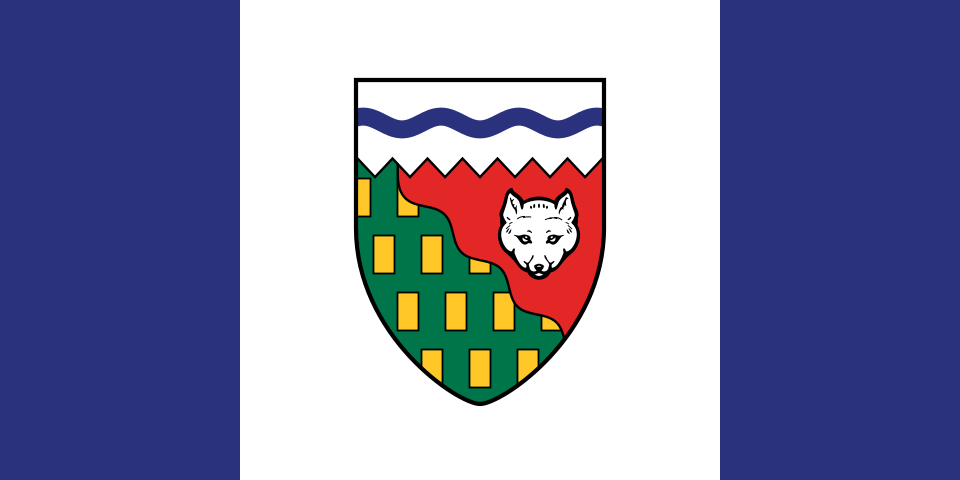
The flag is a horizontal rectangle with a white middle panel bounded by two dark-blue vertical panels of equal width. A shield sits in the middle of the white area, not in an upper corner. The design follows a 2:1 length-to-height ratio, as described by Canadian Heritage.
The shield’s top section is white crossed by a wavy blue line. Below it, a wavy diagonal divide separates a green area with gold rectangular shapes and a red area with a white fox head. The outer blue areas should not be mistaken for the blue stripes of a different country’s tricolour.
Why are the flag’s outer stripes blue and its centre white?
The blue panels represent the lakes and waters of the Northwest Territories. The white centre represents the ice and snow associated with the Canadian North. These explanations are recorded by the Government of Canada and the Canadian Heraldic Authority.
The white is deliberately broad enough for the shield to be visible. It also echoes the general three-panel composition of Canada’s national flag, without copying the red maple-leaf emblem. Blue should not be assigned the single meaning ‘the Arctic Ocean’ when the official interpretation explicitly includes lakes and waters throughout the territory.
What does the fox, gold and green on the shield mean?
The white fox head is shown on a red area representing the tundra north of the treeline. The fox speaks to the historical importance of fur in northern commerce. It is a heraldic representation, not a claim that the Arctic fox is the territory’s only important animal.
The green part signifies forested country south of the treeline. The small golden rectangles—called billets in heraldry—stand for mineral resources. The boundary between green and red is deliberately wavy, recalling the changing treeline rather than a straight political border.
What does the blue wavy line above the shield represent?
Across the shield’s upper white third runs a wavy blue horizontal line, a symbol of the Northwest Passage. The surrounding white area of the shield represents polar ice. These elements express an Arctic geography that differs from the gold-and-green resources shown below.
The territorial coat of arms includes further features above the shield, including narwhals and a compass rose. Those belong to the complete arms but are not printed on the flag. A flag graphic showing two narwhals above the shield is depicting the full coat of arms, not the official territorial banner.
When was the flag adopted, and who designed it?
The territorial council adopted the flag in 1969. The winning design came from Robert Bessant of Margaret, Manitoba, following a Canadian competition. The Northwest Territories Legislative Assembly records adoption in January 1969.
The coat of arms itself was granted in 1956, so its features are older than the flag. The flag adapted the existing shield into a simple blue-white-blue composition. This is why some histories give two important dates: 1956 for the arms and 1969 for the flag.
How is the Northwest Territories flag different from Yukon and Nunavut?
The easiest comparison is the central symbol. Yukon has green, white and blue vertical panels with its coat of arms and fireweed branches. Nunavut uses a large red inuksuk and a blue North Star on yellow and white.
The Northwest Territories instead uses a shield with a fox head on a white panel between two blue bands. Nunavut was created as a separate territory in 1999, decades after the Northwest Territories flag had been adopted. This distinction matters when identifying historical territorial maps or flag charts.
How to draw or identify the Northwest Territories flag
Start with a rectangle twice as long as it is high, divide it into four equal vertical units and color the leftmost and rightmost units blue, leaving the middle half white. In the centre place a shield with a white top, a blue wave, green and red lower areas, gold billets and a white fox head.
For an identification quiz, ask what Canadian territorial flag carries a white fox on a shield: the Northwest Territories. Do not add the narwhals from the full coat of arms or borrow the inuksuk from Nunavut.
Frequently asked questions
What does the Northwest Territories flag mean?
Blue represents lakes and waters; white represents ice and snow. The central shield illustrates the Northwest Passage, treeline, minerals and fur.
When was the Northwest Territories flag adopted?
It was adopted in January 1969 after a nationwide design competition.
Who designed the Northwest Territories flag?
Robert Bessant of Margaret, Manitoba.
Why is there a white fox on the flag?
The white fox head on red tundra recalls the historical importance of the northern fur trade.
What are the yellow rectangles on the shield?
They are heraldic gold billets representing mineral wealth.
Does the flag have a polar bear?
No. The animal head on the shield is a white fox.
Is the Northwest Territories flag the same as Nunavut’s?
No. Nunavut has a red inuksuk and blue North Star rather than a shield.
Official references and illustration credits
Canadian Heritage — Northwest Territories provincial and territorial symbols
NWT Legislative Assembly — Symbols of the NWT
Canadian Heraldic Authority — Northwest Territories
The flag illustration is a PNG rendering of the Wikimedia Commons vector file for Northwest Territories. Consult the linked file page for the original author’s attribution and stated licence, and official guidance for rules on use of government insignia. Article facts checked November 2026.