Why Are the Pitons on the Saint Lucia Flag?
The flag’s layered triangles are a stylized reference to Saint Lucia’s famous volcanic peaks and carry a broader message of hope and aspiration.
Why does the flag use triangles?
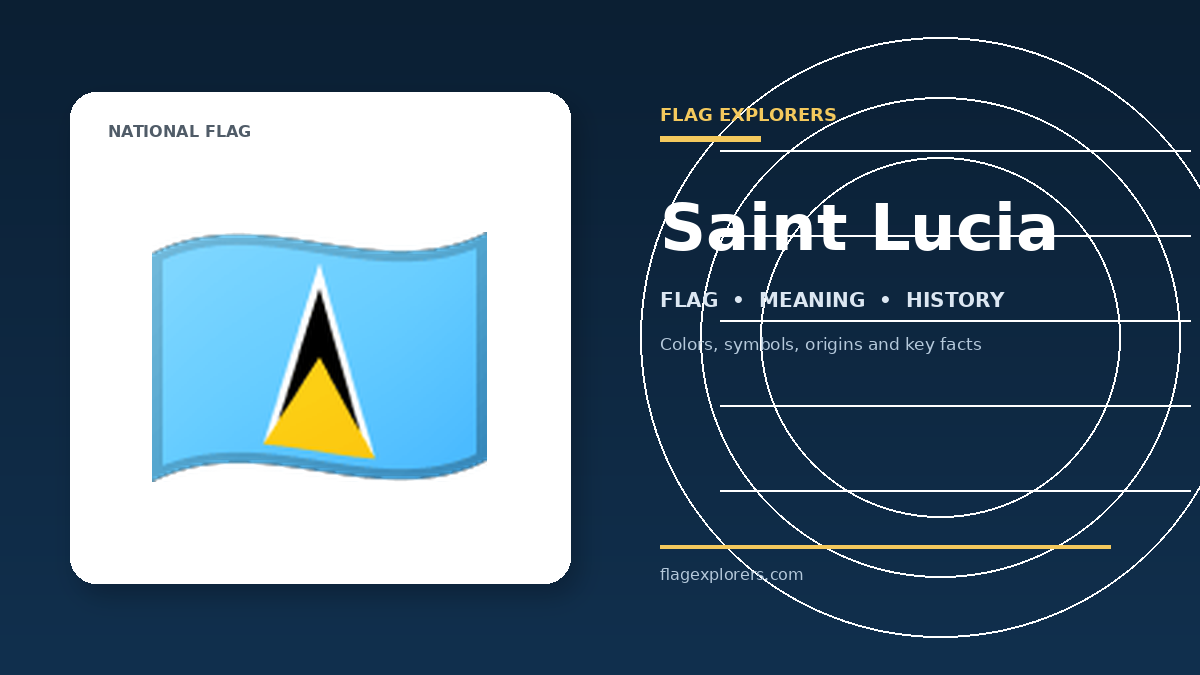
The Government of Saint Lucia describes the central device as a group of superimposed triangular forms. The tall black triangle, white edging and gold triangle are arranged so that the composition rises sharply from the base of the flag.
How do the triangles represent the Pitons?
The isosceles triangle shape recalls Gros Piton and Petit Piton, the twin volcanic peaks near Soufrière. Their steep silhouettes are among Saint Lucia’s best-known natural landmarks.
What do the Pitons symbolize?
Government guidance says the rising triangular forms symbolize the hope and aspirations of the Saint Lucian people. This turns a geographic landmark into a broader national metaphor.
Why are there three visible triangle forms?
The design layers black, white and gold. The official explanation connects the three triangles both with the Pitons imagery and with the interaction of cultural influences, sunshine, sea and national aspiration.
The overlapping geometry is what makes Saint Lucia’s flag immediately recognizable even without text, a coat of arms or stars.
FAQ
Are the Pitons literally drawn on the flag?
No. They are represented symbolically through the central triangular forms.
Which Pitons are represented?
The symbolism refers to the famous Gros Piton and Petit Piton at Soufrière.
What do the triangles mean beyond geography?
They represent hope and the aspirations of the Saint Lucian people.