East Anglia Flag: Three Golden Crowns, Blue Shield & Red Cross
Learn why East Anglia’s red St George’s Cross carries a blue shield with three gold crowns, and what the Wuffingas dynasty represents.
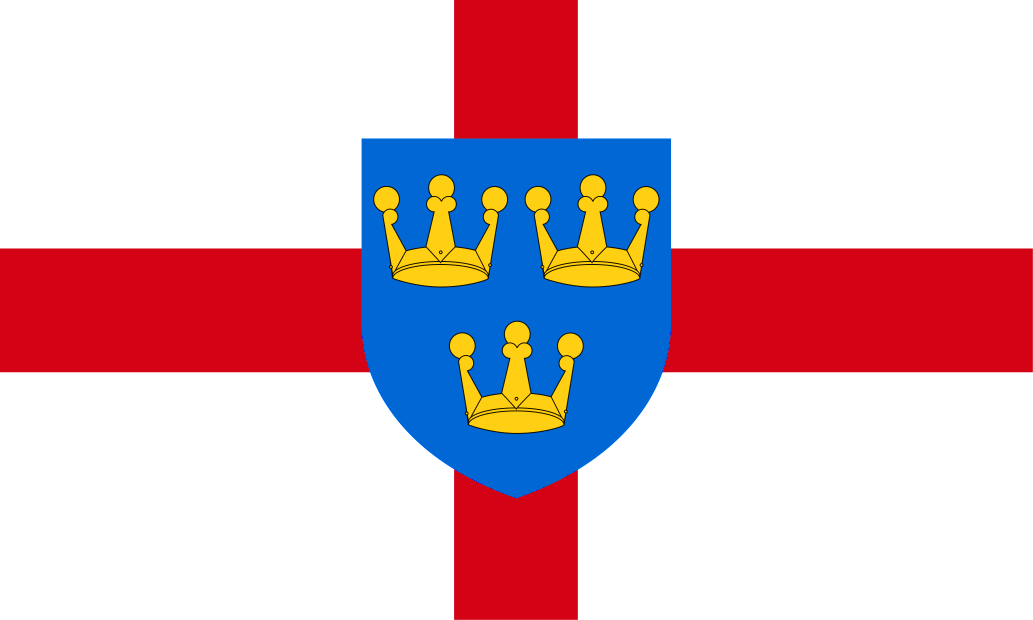
Learn why East Anglia’s red St George’s Cross carries a blue shield with three gold crowns, and what the Wuffingas dynasty represents. This guide uses the Flag Institute registered design and distinguishes modern public use from historic emblems.
East Anglia flag at a glance
| Region | East Anglia, England |
|---|---|
| Field | White with St George’s red cross |
| Shield | Blue at the centre |
| Emblems | Three gold crowns, two over one |
| Historic attribution | Wuffingas dynasty |
| Modern design | London Society of East Anglians |
Appearance
East Anglia’s flag consists of the red upright St George’s Cross on white, with a large blue central shield. Three gold crowns are displayed on that shield, two above and one below.
The blue shield is not an optional flourish. Removing it gives England’s national flag rather than the registered East Anglian regional version.
Three crowns
The golden crowns are heraldic arms traditionally attributed to the Anglo-Saxon Kingdom of East Anglia and its royal family, the Wuffingas.
This is an emblem assigned by later medieval heralds, not authenticated archaeological evidence of a seventh-century 3:5 flag.
The Wuffingas
The Wuffingas were early rulers associated with East Anglia, whose history includes kings such as Rædwald. Their political world predates modern county boundaries.
Heraldic crowns offer a concise visual way to recall that regional story, even though the exact medieval banner cannot be reconstructed with certainty.
Why a red cross?
St George’s Cross places the region visually within England. The addition of the blue shield creates a different emblem for the historical East Anglian community.
It can therefore be shown alongside the flags of England, Norfolk, Suffolk and Cambridgeshire without replacing any of them.
The modern regional flag
The Flag Institute credits the London Society of East Anglians with the recognizable modern design. Its current form emerged during the twentieth century.
The date of this modern arrangement should be distinguished from the early-medieval history of the Wuffingas dynasty and later heraldic attribution.
Which counties?
East Anglia is usually defined around Norfolk, Suffolk and Cambridgeshire, with broader cultural definitions sometimes including neighbouring eastern areas.
The historic kingdom did not follow current council boundaries. Regional and county flags represent overlapping but different geographic identities.
East Anglia vs Suffolk
Suffolk uses one crown with crossed arrows on a blue field, referring to St Edmund. East Anglia uses three crowns in a blue shield over the red English cross.
Cambridgeshire also carries three golden crowns but shows light-blue river waves on blue, without the St George cross behind a separate shield.
National and regional status
East Anglia is a historic English region, not a sovereign state. Its flag is registered for community and regional identification.
It is useful in heritage displays and educational flag charts, with a label explaining the historical region rather than presenting it as an independent country.
Drawing guide
Draw a white rectangle with a centred red upright cross. At the intersection place a blue shield with three golden crowns, arranged two in the upper row and one beneath.
The key recognition phrase is three gold crowns on blue over the red Cross of St George.
Frequently asked questions
How many crowns appear?
Three gold crowns.
Where are the crowns?
On a blue central shield.
What cross is behind the shield?
The red St George’s Cross.
Who were the Wuffingas?
An early royal dynasty of East Anglia.
Which counties belong to East Anglia?
Usually Norfolk, Suffolk and Cambridgeshire.
Is it the same as Suffolk’s flag?
No, Suffolk has one crown with crossed arrows.
Who designed the modern form?
The London Society of East Anglians.
Is East Anglia a country?
No, it is a historic region in England.
Official sources and image credit
Illustration reproduced from the Flag Institute’s downloadable registered flag artwork, offered for reuse. Independent educational article; no endorsement implied. Checked 20 November 2026.