Northumberland Flag: Red & Yellow Bars, Meaning & History
Northumberland’s flag uses interlocking red-and-yellow vertical bars with a distinctive battlement-like dividing line. Learn its heraldic origin and public adoption.
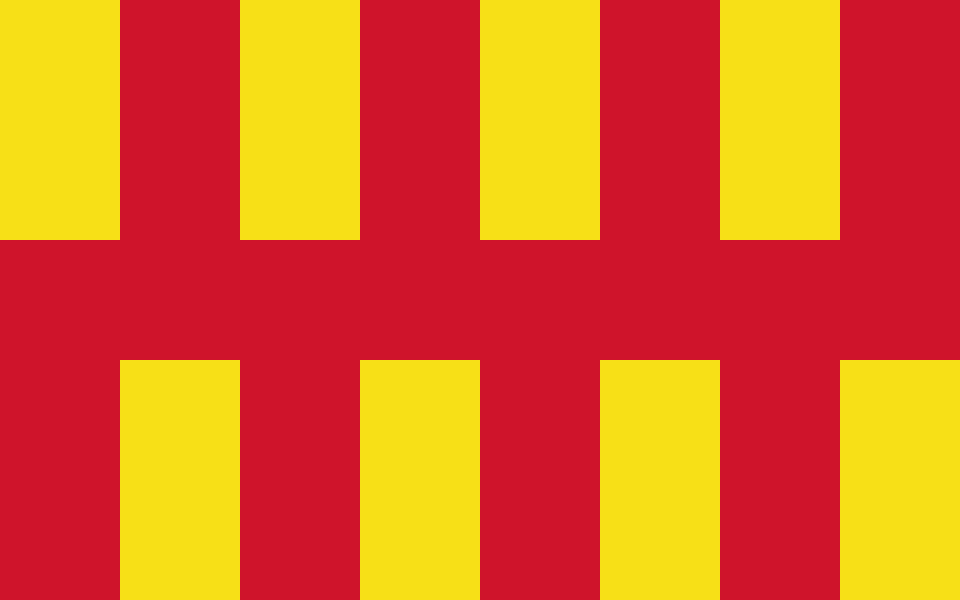
The Northumberland county flag is easy to mistake for the older striped banner of Northumbria. Both use red and yellow, but Northumberland’s flag has a distinctive interlocking stepped middle line rather than simple uninterrupted vertical stripes.
The Flag Institute’s entry records the 1951 grant and the 1995 public-flying decision. The British counties heraldry account connects the flag’s design with the region’s earlier Northumbrian heraldic traditions.
Northumberland flag at a glance
| Feature | Details |
|---|---|
| County | Northumberland, northeast England |
| Flag type | County community flag and banner based on council arms |
| Colours | Red and gold/yellow |
| Geometry | Interlocking vertical bars with embattled dividing line |
| Heraldic design | Eight vertical sections, counterchanged across the middle |
| Arms granted | 4 December 1951 |
| Public flying encouraged | November 1995 |
| Registry code | UNKG7401 |
| Flag proportions | 3:5 |
This is a county community flag, not a separate sovereign-state national flag. Dates for heraldic emblems, local flag designs, public selections and registry entries can differ; the sections below distinguish them.
What does the Northumberland flag look like?
The flag has alternating gold/yellow and red upright bars, interrupted across the middle by a stepped horizontal line reminiscent of a castle’s battlements. The red and yellow blocks interlock, making the pattern look like two rows of staggered rectangular bars.
This is not a normal set of four horizontal stripes. A traditional heraldic description is ‘paly of eight Or and Gules per fess embattled counterchanged’, meaning eight vertical sections of gold and red with the colours reversing across a battlement-like horizontal division.
Why does the flag use red and gold?
Red and gold have a long heraldic association with the historic Northumbrian area. These colours are connected with accounts of the banner associated with the early Northumbrian ruler St Oswald.
The modern Northumberland design uses red and yellow as a recognizable regional palette but introduces a particular stepped pattern. A general claim that every red bar means a specific castle or parish is unsupported by the registry’s formal description.
What does the stepped or embattled pattern mean?
The central division is described as embattled in heraldry: it resembles a sequence of castle crenellations. Its use distinguishes the county council’s arms, from which the public flag is derived, from other red-and-yellow striped patterns.
Northumberland is known for medieval castles and fortified landscapes, but the flag’s geometry is best understood as a heraldic rule rather than a literal diagram of a named castle. The stepped border is part of the registered image and should not be smoothed into a straight horizontal line.
When were Northumberland’s arms granted?
The design comes from arms granted to Northumberland County Council on 4 December 1951 by the College of Arms. The public flag is essentially a banner of those arms, with the design filling the whole cloth.
The year 1951 therefore describes the modern grant, not the first use of red-and-gold imagery in the region. That older symbolism stretches back much further, while the current stepped flag is a modern registered specification.
Why did public use become encouraged in 1995?
In November 1995, Northumberland County Council decided to allow and encourage the wider use of the banner by local people. This is significant because coats of arms are usually associated with the particular body to which they were granted.
The decision helped establish the same graphic as a public community county flag. It is distinct from the 1951 heraldic grant and from the much earlier history of the kingdom of Northumbria.
Northumberland flag vs Northumbria flag: what’s different?
The historical Northumbria flag is commonly drawn as unbroken vertical alternating red-and-yellow stripes. Northumberland’s county flag has a stepped horizontal counterchange in the middle of similar colours.
The names also refer to different geographic contexts: Northumberland is a county of England, while Northumbria describes a much wider early medieval kingdom and historical region. Their flags should not be used interchangeably in reference illustrations.
Does the Northumberland flag represent Newcastle too?
The historic county of Northumberland traditionally included the city of Newcastle upon Tyne, although modern administrative boundaries have changed. The Flag Institute describes its Northumberland flag as a flag of the historic county, not just the current council’s administrative area.
This distinction matters when people ask which places a county flag represents. The historic county identity can extend beyond the boundaries of present-day local government structures.
Northumberland compared with Yorkshire and Lancashire flags
The Yorkshire flag has a white rose on blue, and the Lancashire flag uses a red rose on yellow. Northumberland has no rose and instead uses a red-and-yellow interlocking geometric pattern.
All three are English county community flags, not separate national flags. Compare the emblem first—rose or no rose—then the colour arrangement.
How to draw and identify Northumberland’s flag
Draw a flag with vertical bars alternating gold and red. Across the midpoint, create a stepped embattled line and reverse the colours so the upper and lower rows of blocks interlock. Keep the exact number and spacing of bars consistent with the public-domain vector.
For an educational quiz, the clue ‘red and gold bars interlocked across a battlement-shaped centre‘ identifies Northumberland. A flag of plain alternating red-and-yellow stripes is more likely the historical Northumbria banner.
Frequently asked questions
What does the Northumberland flag look like?
Red and yellow upright bars that reverse colours across a stepped, battlement-like central line.
Why does the flag use red and gold?
They are traditional heraldic colours associated with Northumberland and the historic Northumbrian region.
When were its arms granted?
4 December 1951.
When was wider public use encouraged?
Northumberland County Council supported public flying in November 1995.
Is the flag the same as Northumbria’s?
No. Northumbria has straight alternating stripes, while Northumberland has a stepped central division.
What does embattled mean?
A heraldic edge shaped like a sequence of castle battlements or crenellations.
Does this flag include a rose?
No. Yorkshire and Lancashire use roses; Northumberland uses interlocking coloured bars.
Is Northumberland a country?
No. It is a historic county of England.
References and image credits
Flag Institute — Northumberland flag and public use
ABC Flag Blog — Northumberland’s arms and historical context
Flags of the World — Northumberland flag history
The illustration is a PNG rendering of Wikimedia Commons — Northumberland flag vector. Public-domain vector by Greentubing and contributors, Wikimedia Commons; rendered as PNG without modification to the flag design.
For identification and educational comparison. This independent guide is not affiliated with the Flag Institute or county government. Source descriptions reviewed November 2026.