Denmark vs Switzerland Flag: White Crosses, Square Shape and Exact Proportions
Side-by-side identification, documented history and practical measured comparison.
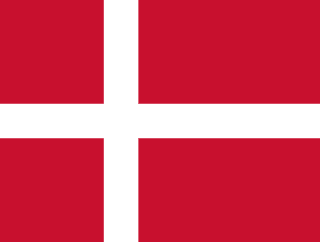
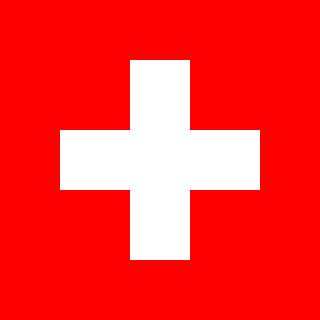
Denmark and Switzerland use white crosses on red backgrounds, but their crosses have fundamentally different shapes. Denmark’s Nordic cross reaches all four edges of a rectangular flag, and its vertical arm is offset toward the hoist. Switzerland’s centered white cross stops short of every edge of a square flag. The two designs have separately documented dimensions, histories and rules of use. Check whether red surrounds all four cross tips before relying on the flag’s outer shape.
Comparison at a glance
| Feature | Denmark | Switzerland |
|---|---|---|
| Cross type | Offset Nordic cross | Centered free-standing cross |
| Cross ends touch edges | Yes, all four | No |
| Ordinary reference proportions (height:length) | 28:37 | 1:1 |
| Cross construction | 12:4:21 horizontal; 12:4:12 vertical | 6:7:6:7:6 on each axis |
| Field | Red | Red |
| Special variant | Split flag | Rectangular maritime ensign |
The fastest distinction: does the white cross reach the edges?
Look at any of the four white cross tips on a full flag illustration. Denmark’s cross extends through the entire red field. Its horizontal arm reaches both the hoist and the fly, and its vertical arm reaches the top and bottom. Switzerland’s white cross is surrounded by red on every side.
That difference is more robust than the apparent shape of the overall flag. An image of a square Swiss flag may be stretched or cropped to fit a rectangular icon, while a rectangular Swiss maritime ensign legitimately exists. The cross still remains separate from the outer edges in those Swiss designs.
Next check the crossing point. The Danish vertical arm is closer to the hoist than the fly. The horizontal arm sits halfway down the flag. The Swiss crossing point is centered both horizontally and vertically, so the four white arms extend equal distances from the intersection.
A photograph of Denmark’s flag hanging downward can make the cross appear to have an unusually short upper or lower arm. Identify the original hoist before judging the offset. Switzerland’s equal-armed cross has rotational symmetry in the square design; turning it ninety degrees leaves the flat design unchanged.
If a close-up shows only the crossing point, both flags can look like a white plus sign on red. Obtain a view of the outer edges to determine whether the arms continue across them. Without that information, a definitive identification may not be possible.
This recognition method also helps separate the Swiss flag from generic white-cross logos. A plus sign alone is not necessarily a Swiss national symbol. The surrounding red field, centered arrangement and prescribed proportions matter.
Construct Denmark’s Nordic cross from the 37-by-28 grid
The Nordic cooperation portal gives the Danish flag’s horizontal construction as twelve red parts, four white parts and twenty-one red parts. Vertically, the sequence is twelve red, four white and twelve red. The total rectangle is therefore thirty-seven units long by twenty-eight units high.
Choose one centimeter per unit for an educational drawing. Mark the rectangle’s four corners at thirty-seven by twenty-eight centimeters. Place vertical guidelines twelve and sixteen centimeters from the hoist. Place horizontal guidelines twelve and sixteen centimeters from the top.
The white vertical arm occupies the full-height region between the two vertical guides. The horizontal arm spans the full length between the horizontal guides. Their intersection is a white square measuring four by four centimeters.
The crossing point lies fourteen centimeters from the hoist and fourteen centimeters down from the top. The flag’s horizontal midpoint lies eighteen and a half centimeters from the hoist. The cross is therefore offset four and a half centimeters toward the pole relative to that midpoint.
The four red rectangles have equal heights of twelve centimeters but different widths. The hoist-side rectangles are twelve centimeters wide and are squares. The fly-side rectangles are twenty-one centimeters wide. This is a useful way to check the Nordic cross layout without measuring every white region.
For digital artwork, use a seven-hundred-forty-by-five-hundred-sixty-pixel artboard. Each construction unit becomes twenty pixels. The white vertical arm extends from x equals 240 to x equals 320; the horizontal arm extends from y equals 240 to y equals 320.
Historical Danish regulations also allow a shorter fly proportion, producing a 28:34 height-to-length ratio rather than the 28:37 reference used above. The important recognition features remain the edge-reaching cross and its hoist offset. A shorter legitimate Danish flag is not automatically a Swiss flag or an inaccurate reproduction.
Construct Switzerland’s flag from its statutory 32-unit square
The Swiss federal law on the protection of public signs provides an exact construction diagram in Annex 2. It divides both the horizontal and vertical dimensions of the square into successive parts measuring six, seven, six, seven and six units.
Draw a square thirty-two centimeters on each side. The horizontal white bar is twenty centimeters long and six centimeters high. Its left edge begins six centimeters from the left side of the flag, and its right edge ends six centimeters before the opposite side.
The vertical white bar is six centimeters wide and twenty centimeters high. Its top begins six centimeters below the upper edge, and its bottom ends six centimeters above the lower edge. Both bars share the same center point at sixteen centimeters across and sixteen centimeters down.
The central white square is six by six centimeters. Each of the four projecting arms beyond that square is seven centimeters long and six centimeters wide. This is the precise meaning of the legal statement that each arm is one-sixth longer than its width.
Do not interpret seven-to-six as the ratio of the entire horizontal bar to its thickness. The whole bar measures twenty units from tip to tip. The seven-unit length refers to a single arm outside the central intersection.
On a six-hundred-forty-by-six-hundred-forty-pixel artboard, one construction unit equals twenty pixels. The horizontal bar occupies x equals 120 to 520 and y equals 260 to 380. The vertical bar occupies x equals 260 to 380 and y equals 120 to 520.
A vector drawing can be built from a red square and two overlapping white rectangles. Merge the rectangles if necessary for a single white shape. The outer red margins must remain visible, and all four white arms must stop before the flag’s edges.
These measurements come from the published statutory diagram, rather than from an approximate flag photograph. They also distinguish the national flag from the Swiss coat of arms, which places the cross within a shield rather than a square field.
Compare white cross areas at a common height
A useful mathematical exercise is to compare the proportion of each flag occupied by white. Denmark’s cross consists of a horizontal rectangle four units thick and thirty-seven units long, plus a vertical rectangle four units thick and twenty-eight units long. Their four-by-four intersection must be counted only once.
The resulting Danish white area is 148 plus 112 minus 16, or 244 square units. The complete flag area is thirty-seven times twenty-eight, or 1,036 square units. The white cross occupies approximately 23.55 percent of the rectangle.
Switzerland’s cross consists of two rectangles measuring twenty by six units, overlapping in a six-by-six square. Its white area is 120 plus 120 minus 36, or 204 square units. The complete square contains 1,024 square units. The white cross occupies approximately 19.92 percent of the flag.
These percentages are calculated from the specified reference geometry. They are not additional legal rules. Denmark’s shorter accepted rectangular variant would produce a slightly different area percentage, so the exact reference ratio should be named when making this comparison.
At the same physical flag height, Switzerland’s square is also narrower than Denmark’s rectangular reference. If both flags are twenty-eight centimeters high, the Danish flag is thirty-seven centimeters long and the Swiss flag is twenty-eight centimeters long.
The Danish white arms occupy four of twenty-eight height units, or one-seventh. The Swiss cross arms are six of thirty-two height units, or three-sixteenths. Switzerland’s white bars are proportionally thicker relative to the overall height, even though the cross occupies a smaller fraction of the entire flag area in this comparison.
The difference comes from the Swiss cross stopping short of the edges. A thicker cross does not necessarily cover more total area when its arms are shorter. This makes the flags a useful example of how geometric proportions and area interact.
For a classroom chart, show both at a common height with their natural aspect ratios preserved. Students can calculate the areas before coloring and then compare the finished visual result.
The red shades are documented, but geometry is a better clue
The Nordic cooperation portal lists a Danish red reference of Pantone 186C or 032C and gives an approximate digital RGB representation of 210, 16 and 52. The Swiss statutory diagram identifies its red through several color systems, including Pantone 485 C or U and an RGB reference of 255, 0 and 0.
Those references are useful when preparing artwork to an appropriate specification, but they do not guarantee that every photograph or computer display will reproduce the colors in the same way. Screens, paper, ink, fabric and lighting can alter perceived brightness and hue.
A red Danish flag in direct sunlight can appear brighter than a Swiss flag in shadow. A faded textile may have a different appearance from the official reference. Do not identify an anonymous red flag solely because its red appears closer to a particular digital value.
The cross structure is independent of those variations. In an accurate full image, Denmark’s cross reaches the edges and Switzerland’s does not. That difference survives ordinary changes in lighting and even monochrome reproduction.
For educational illustrations, use the published color references where appropriate and retain a source note. Formal textile, printed or governmental applications should consult the complete applicable standard, because color systems are not always interchangeable across media.
A white cross can also appear against a darker red due to contrast effects. Compare the whole flag rather than sampling a tiny antialiased pixel at the boundary between the red and white regions. The boundary pixel may be a mixture of both colors.
For most flag-recognition purposes, remember that both flags are red and white. Use the shape, placement and reach of their crosses as primary evidence, with documented red tones as secondary context.
Two independent cross traditions
Denmark’s national flag is known as the Dannebrog. A famous tradition associates it with an event in Estonia in 1219, when the flag is said to have fallen from the sky. The story is part of Danish cultural tradition; it should not be treated as a verified contemporary description of the flag’s creation.
The Danish cross is historically important because it helped establish the design family now associated with the Nordic countries. Sweden, Norway, Finland and Iceland use related offset cross layouts with their own color combinations and dimensions.
Switzerland’s white cross has a different history. The Swiss Federal Department of Foreign Affairs traces its use as an identifying sign among Swiss soldiers to the fourteenth century, including the Battle of Laupen in 1339. The modern federal flag developed through later political and military history.
The Swiss government’s account places the modern design in the nineteenth century, with the federal constitution of 1848 marking the adoption of the white cross on red as the national symbol. The legal definition of the cross’s proportions was developed further, and today’s flag specification appears in the federal public-signs protection law.
The two crosses therefore cannot be explained simply as one country’s flag copied by the other. Their shared red-and-white palette and Christian-era cross imagery are broad historical similarities, while their documented origins and construction are separate.
A useful comparative timeline distinguishes a traditional Danish origin story from documented later flag use, and Swiss military use from the establishment of the modern federal emblem. This avoids presenting legends, first documented appearances and modern statutory definitions as interchangeable dates.
Why some Swiss and Danish flags have different outlines
Switzerland’s ordinary national flag is square, but its maritime ensign is rectangular. The Swiss government’s historical account identifies the maritime version as an exception introduced in 1941. Sporting events may also use standardized rectangular representations.
A rectangular Swiss flag can still be recognized by the centered free-standing cross surrounded by red. It should not automatically be relabeled Denmark simply because it is not square.
Denmark also has flags with different outlines for specific official uses, including a split flag. Its shape differs from the ordinary rectangular national flag. The white Nordic cross continues to extend across the relevant field, and its vertical arm remains toward the hoist.
The Swiss coat of arms is another distinct representation, defined as the white cross in a triangular shield under the public-signs protection law. The ordinary square flag and coat of arms should not be substituted for one another in official or commercial contexts.
The federal law also distinguishes permitted uses of the flag from uses that could mislead about geographic origin or official affiliation. An educational flag comparison does not establish permission to place a Swiss cross on a product as a claim of Swiss manufacture.
Similarly, the Danish national flag has rules and traditions relating to display. A geometry guide explains the design but does not supersede applicable official-use requirements.
For a flag collection, label variants according to their purpose. Store the ordinary Danish flag, split flag, ordinary Swiss flag and maritime ensign separately if all are included. Accurate classification preserves the distinction between the national design and a specialized official-use version.
Cross flags that should not be confused with either design
Tonga uses a red field with a white canton containing a red cross. The cross is in the upper corner rather than at the geometric center, and the colors inside the canton are reversed relative to Switzerland.
The emblem of the Red Cross has a red cross on white. It is a protected humanitarian emblem with its own legal significance, not a generic inverted Swiss flag that may be freely used for any purpose. Do not use it as a substitute for medical decoration or a country icon.
England’s flag uses a red cross extending to the edges of a white rectangle. It shares the edge-reaching geometry associated with many cross flags but has the opposite color placement from Denmark and a centered rather than Nordic-offset crossing point.
Savoy’s historical flag also uses a white cross on red, and regional or historical cross flags can resemble one or both designs. Identifying an unfamiliar historic object requires the date and geographic context as well as the cross geometry.
When a flag finder receives a query for a white cross on red, ask whether the cross reaches the edges and whether it is centered. If the cross is contained entirely within the field, Switzerland becomes a strong candidate. If it extends to the edges and is shifted toward the pole, Denmark becomes a strong candidate.
The correct final answer should reflect the evidence available. A photograph of only the crossing point may not distinguish all possible designs. A full reference illustration and a trustworthy label are preferable to an unsupported guess.
Frequently asked questions
Which flag has a square shape?
Switzerland’s ordinary national flag.
Which cross reaches the flag edges?
Denmark’s Nordic cross.
Is a rectangular Swiss flag necessarily incorrect?
No; Switzerland has a rectangular maritime ensign and other standardized display exceptions.
How is the Swiss cross proportioned?
Its projecting arms are seven units long and six wide in the statutory 32-unit square.
Sources and artwork
Nordic cooperation: Danish flag and dimensional proportions
Swiss Federal Department of Foreign Affairs: Swiss flag
Swiss federal Coat of Arms Protection Act, Annex 2, current July 2025 text
Swiss Federal Department of Foreign Affairs: maritime and sporting variants
Flags of the World: historical Danish ratio variants
Reference artwork: Flagpedia/FlagCDN, public-domain flag images. Educational comparison, not official endorsement. Reviewed November 2026.