Central Bohemian Region Flag: Czech Lions, Black Eagle & Blue Waves
A guide to the official Central Bohemian Region flag: the distinctive quartered design, historical symbols, origins and how it differs from similar Czech regional flags.
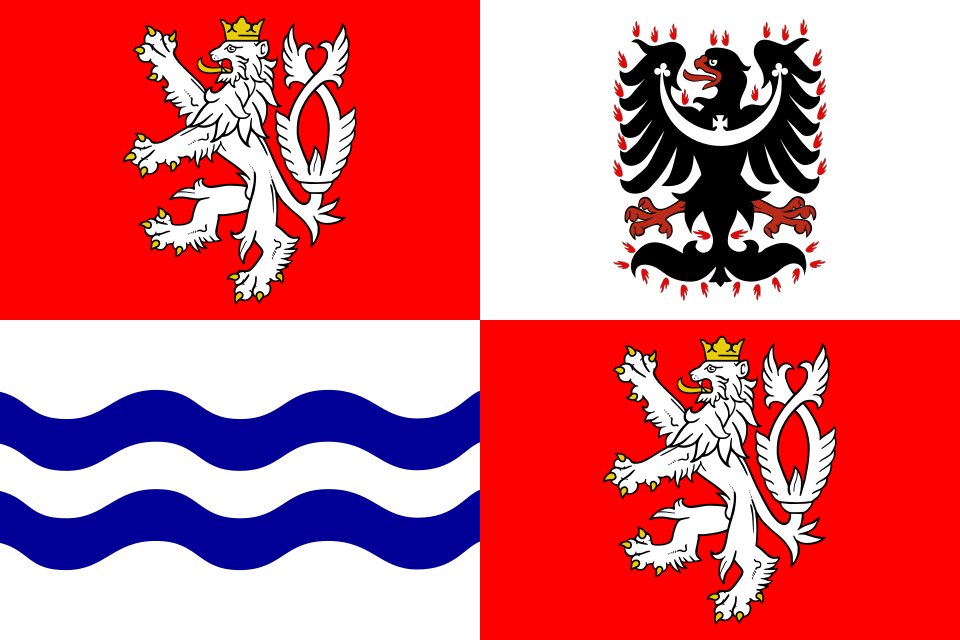
Středočeský kraj surrounds Prague, covering towns including Kladno, Mladá Boleslav and Kutná Hora. Its regional administrative seat is in Prague, although Prague itself is legally a separate region. The featured flag represents this particular region and should not be mistaken for the national flag or a municipal flag of a city with a similar name.
Central Bohemian Region flag at a glance
| Region | Central Bohemian Region (Středočeský kraj) |
|---|---|
| Country | Czechia / Czech Republic |
| Administrative centre | Prague (administrative seat outside region) |
| Flag adoption | 27 November 2001 |
| Defining design | The Central Bohemian regional flag is divided into four heraldic quarters. The first and fourth red panels bear the white crowned Czech double-tailed lion; one white panel contains a black eagle with red flames; another shows blue wavy stripes on white. |
What does the regional flag look like?
The Central Bohemian regional flag is divided into four heraldic quarters. The first and fourth red panels bear the white crowned Czech double-tailed lion; one white panel contains a black eagle with red flames; another shows blue wavy stripes on white.
Unlike the national Czech flag, regional banners often quarter several older civic and royal heraldic devices. The layout and individual symbols are important for correct identification.
Meaning of the regional symbols
The two lions express the region’s place within Bohemia and Czechia. The black eagle is an emblem of the Přemyslid dynasty and early Czech statehood; the blue waves are associated with the important regional rivers, notably the Vltava and Elbe.
The white double-tailed lion recurs in Bohemian heraldry. Other charges such as a camel, flower or river are the particular region’s own additions, not a new state flag for the whole country.
Historical background and adoption
The flag was adopted on 27 November 2001, following the creation of Czech self-governing regions in 2000. Its design deliberately combines national Bohemian heraldry with specific historical and geographical signs of central Bohemia.
The present Czech self-governing regions date to the administrative reform around 2000; their flags were subsequently approved during 2001–2003. Their incorporated heraldic devices can be centuries older.
Where is this region?
Středočeský kraj surrounds Prague, covering towns including Kladno, Mladá Boleslav and Kutná Hora. Its regional administrative seat is in Prague, although Prague itself is legally a separate region.
The Czech name is Středočeský kraj, and the regional centre is Prague (administrative seat outside region). A regional flag is different from the municipal flag of the capital city.
Colours and detailed heraldry
The Central Bohemian regional flag is divided into four heraldic quarters. The first and fourth red panels bear the white crowned Czech double-tailed lion; one white panel contains a black eagle with red flames; another shows blue wavy stripes on white.
Red and white identify the Bohemian lion quarters; other fields use blue, green, gold and various local charges. Use the exact original drawing when reproducing detailed arms.
Similar Czech regional flags compared
Prague uses only yellow-over-red horizontal bands. South Bohemia features a rose and towers alongside the Bohemian lion. Central Bohemia has a conspicuous black eagle and blue water-waves in its four-part design.
Because the white Bohemian lion appears in many Czech regional flags, compare the remaining quarters before naming a region. This prevents confusion between the district, the city and the administrative region.
How to draw or identify it
Central Bohemia’s administrative headquarters being in Prague does not mean the regional territory includes Prague. This is a useful distinction when comparing maps, flag galleries and government buildings.
Start with a rectangle divided into the proper quarters, then trace the distinct charges from the original image rather than making a generic heraldic icon.
Regional flag versus Czech national flag
The Central Bohemian regional flag is divided into four heraldic quarters. The first and fourth red panels bear the white crowned Czech double-tailed lion; one white panel contains a black eagle with red flames; another shows blue wavy stripes on white.
The national Czech Republic flag has a white stripe, a red stripe and a blue triangle from the hoist. Regional flags are separately authorised symbols of local self-government.
Frequently asked questions
Why does Central Bohemia’s flag have a black eagle?
It represents the early Czech Přemyslid ruling dynasty, alongside white Bohemian lions and blue river waves.
What is the regional name in Czech?
Středočeský kraj.
When was the flag officially adopted?
27 November 2001.
Which city is the regional centre?
Prague (administrative seat outside region).
Is the region a separate country?
No. It is a self-governing region of Czechia.
How does this regional flag differ from other Czech flags?
Prague uses only yellow-over-red horizontal bands. South Bohemia features a rose and towers alongside the Bohemian lion. Central Bohemia has a conspicuous black eagle and blue water-waves in its four-part design.
Can I reproduce the artwork?
Use the linked Wikimedia Commons original to check the official drawing, author and copyright status, and any rules concerning official heraldic use.
Sources and illustration credit
List of official Czech regional flags and adoption dates
Flags of the World: Czech regional symbols, historic explanations and variants
Wikimedia Commons: Flag of Central Bohemian Region.svg. The PNG was proportionally scaled from this vector illustration. The source page provides artwork attribution and the applicable copyright status for Czech official symbols.
Czech Republic national flag for the official white-red-blue design.
Independent educational guide, reviewed 20 November 2026; not an official regional-government publication.