Andorra vs Moldova Flag: Tricolor Designs and Coats of Arms
Two emblem-bearing tricolors, with distinct heraldry, stripe widths and official proportions.
Quartered shield; wider central yellow field.
View official flag diagram →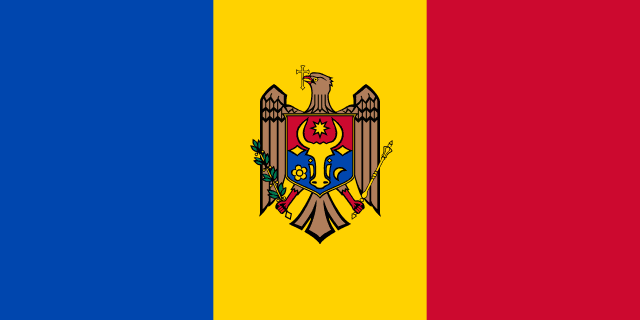
The key difference is the shape of the central arms
Andorra and Moldova both have blue, yellow and red vertical flag bands and a national coat of arms in the center. Neither country can be identified reliably merely by observing that the flag is a tricolor with an emblem. In a complete, normally oriented reference image, inspect the outline of the arms. Andorra displays an ornate quartered shield, while Moldova displays an eagle bearing a smaller shield on its chest. The outlines of the devices differ before you need to distinguish every detail.
The background also provides two geometric clues. Andorra’s government graphic manual gives the yellow field a little more width than either of the outer fields. Moldova’s official state flag has three equal bands. Furthermore, the government reference for Andorra gives a height equal to seventy percent of its length, while Moldova’s diplomatic description gives a height equal to half its length. The Andorran rectangle therefore appears comparatively tall when both are drawn at the same length.
The emblem is the most reliable clue in an ordinary complete image. Stripe widths can be useful when the flags have been drawn accurately, but the difference is relatively subtle. Aspect ratio is more informative when you have a flat reference illustration than when you are viewing a folded flag or a standardized icon.
The four-country comparison with Romania and Chad, which ordinarily use plain vertical tricolors, is also useful. An emblem-bearing flag narrows that choice, but you still need to identify the device. The table below separates the shared elements from the features that actually distinguish these two flags.
| Feature | Andorra | Moldova |
|---|---|---|
| Height:length | 7:10 | 1:2 |
| Band widths | 32%, 36%, 32% | Three equal bands |
| Central arms | Four-quarter shield | Eagle and shield |
| Emblem width | 30% of length | 20% of length |
Understanding the Andorran heraldic shield
The traditional arms of Andorra contain four heraldic quarters. The government’s state-emblem law identifies the historical houses represented in those quarters: the Bishopric, Catalonia, Foix and Béarn. The official graphic manual provides a reference for the arrangement, rather than leaving users to infer the exact design from a verbal summary.
In the upper-left portion as viewed on the reference flag is a bishop’s mitre and crozier. The upper-right and lower-left quarters contain vertical red bars on a gold field. The lower-right quarter displays two red cattle. The frame around the shield and the motto contribute to the compact, ornate appearance of the complete emblem. The Latin motto is Virtus Unita Fortior, expressing the idea that united strength is greater.
The four parts are not four unrelated images printed separately on the yellow band. They belong to one coat of arms. The visual relationship between the quarters, frame and motto is important when distinguishing the official arms from an informal shield-shaped graphic. A small thumbnail may show only a gold-colored outline with red areas inside; a larger reference is needed to inspect the individual devices.
Andorra’s law also recognizes that historic representations of the traditional arms have not always been identical. A historical object with a different arrangement should therefore be examined alongside its date and provenance, not automatically dismissed because it differs from a current official graphic. The reference intended for present-day recognition is not a universal catalogue of every historic Andorran symbol.
The arms reflect historical relationships associated with the principality and its co-princes. This background helps explain why a flag found in the Pyrenees has heraldic elements very different from the Moldovan eagle, even though the main stripe colors are arranged in the same order.
Understanding the Moldovan eagle and shield
Moldova’s national arms are arranged around an eagle with a shield on its chest. The presidency’s description identifies a horned aurochs’ head on the divided shield and a star between the horns. The bird bears a cross, an olive branch and a scepter. These details create a different outer profile from Andorra’s framed quartered shield.
The strongest identification cue is the eagle itself. Its extended wings and the objects associated with it are positioned around the shield, rather than occupying four rectangular compartments. Inside the shield, the horned head provides another clue if the image is large enough. You do not have to count all of the fine heraldic elements to distinguish the two designs in a normal flag quiz.
Do not confuse the red cattle within Andorra’s shield with Moldova’s aurochs symbol. Both can be described in broad terms as bovine heraldic imagery, but they appear in different compositions. In the Andorran device the cattle are whole animals in one quarter; the Moldovan emblem uses a horned head on the central shield. The distinction is especially useful if someone describes a flag as having a cow or bull on it without showing the complete design.
An accurate identification starts with the overall structure and proceeds to the details. If the outline is an eagle, inspect the shield that it carries. If the outline is a framed shield, inspect the quartering. Do not begin by trying to read lettering in a tiny image, because the text may not survive the reduction.
The shared tricolor background is a visual similarity, not evidence that the emblems have the same origins. The Moldovan device belongs to Moldova’s own heraldic history and is part of the independent country’s national identity. The earlier Romanian versus Moldovan comparison on this website explores the separate issue of a shared background with a plain tricolor.
Compare the proportions and unequal stripe widths
The Andorran government’s authorized graphic reference, sheet 1.2.3, sets out the flag using its total length as the reference quantity. The three horizontal measurements across the vertical bands are 0.32, 0.36 and 0.32 times the length. The total height is 0.70 times the length. These specifications correspond to a 7:10 height-to-length ratio and a slightly enlarged central yellow band.
Moldova’s diplomatic state-symbol reference uses a 1:2 height-to-length ratio and divides the horizontal length into three equal parts. The width of the state arms is one fifth of the length. Andorra’s graphic manual instead gives the central arms a reference width of three tenths of the flag length. These figures describe the authorized reference designs rather than all historical or informal renderings.
For a useful numerical comparison, suppose the two flags have an overall length of thirty centimeters. In the Andorran specification the height is twenty-one centimeters, the outer bands measure 9.6 centimeters each, and the yellow band measures 10.8 centimeters. The arms have a reference width of nine centimeters. Moldova’s rectangle at that length is fifteen centimeters tall, with three ten-centimeter bands; its arms have a reference width of six centimeters.
The numerical exercise also reveals how difficult it can be to determine the stripe widths from a small picture. In a ten-centimeter-long representation, the Andorran yellow band is only four millimeters wider than either outer band. A folded edge, a poorly aligned crop or a few pixels of compression can obscure that difference. At equal overall lengths, however, the height difference between the two correctly proportioned flags is much more apparent.
Using the proportion data to study the geometry is different from creating an authorized reproduction. If you are producing an official flag or emblem for commercial use, consult the applicable permissions and graphics standards. For an educational comparison, you can record the measurements in a table and refer directly to the original government diagrams. That method allows the reader to examine the precise reference without relying on a distorted thumbnail.
Why the flags have similar colors but different histories
The principal colors are shared by both flags, but their historical contexts are not the same. Andorra’s national archives describe older evidence of a yellow-and-red flag preceding the modern tricolor. That history is connected with the principality’s distinctive position between France and Spain and with the heraldry associated with its co-princes. It should not be confused with the historical development of the Romanian and Moldovan tricolors.
The Andorran Constitution refers to the traditional flag and coat of arms. The subsequent state-signs law clarifies the distinction between traditional representations and the officially established forms. This helps explain why some historical illustrations of the flag may use variations of the arms or omit details that appear in the government’s current graphic manual.
In Moldova, the return of the tricolor was part of the political and cultural changes that occurred toward the end of the Soviet period. The National Museum of History of Moldova dates its adoption to April 27, 1990, before independence was declared in 1991. The addition of the national arms makes the Moldovan state flag distinguishable from the plain Romanian tricolor and expresses its own national identity.
When comparing the history of the two flags, avoid constructing a story solely from the palette. The fact that both have blue on the hoist side and red on the fly does not establish that one country borrowed the design from the other. Similar color combinations can emerge in different settings because each color is common in heraldry and because national designs develop in their particular regional contexts.
A useful historical exercise is to make separate timelines. On Andorra’s timeline, record the traditional arms and the modern constitutional and regulatory references. On Moldova’s, record the modern tricolor adoption and independence. Then compare the dates and meanings of the relevant documents. The result is more informative than merely arranging two flags next to one another and claiming that they have a common design origin.
Plain tricolors, reduced forms and flag icons
The Andorran government’s reference manual specifically allows a form without the arms in certain small-scale applications, such as ribbon-like reproductions. The law’s annex also recognizes such reduced forms. Thus the absence of the full shield from a tiny Andorran design is not automatically evidence of an error. You need to establish the purpose of the item.
The complete ordinary Moldovan state flag, by contrast, includes the national arms according to its official description. Historical or simplified graphics may require individual identification, but the standard design in a national flag reference contains the central device. A plain tricolor should not be described as Moldova’s complete current flag without a qualification.
Romania and Chad supply another reason not to treat a plain blue-yellow-red flag as self-explanatory. Both use a similar vertical arrangement without an ordinary central emblem. If an Andorran ribbon is stripped of its arms, the resulting visual comparison is less straightforward. The context, official labels, proportions and nature of the object become more important.
A flag rendered as a small circular icon can hide both stripe boundaries and emblem details. Even if the original reference image is accurate, the graphic mask may cut away the edges of the red and blue fields. A reader might therefore conclude incorrectly that one country’s central stripe is much wider. The correct approach is to compare uncropped images or reference diagrams.
On a sporting scoreboard, read the country names or abbreviations as well as the icons. Andorra is commonly represented by AND in three-letter sporting labels and Moldova by MDA. Depending on the organization, a different coding convention may be used. The event’s own legend provides an independent identification clue when the graphic is too small.
For a photographed flag, the central emblem may fold into an indistinct vertical patch. Do not claim a confident identification when the entire distinguishing feature is hidden. In that situation a source caption, a second photograph or the location of the documented event can help resolve the ambiguity.
State-emblem rights and reliable reference images
Andorra’s state-signs legislation contains restrictions on certain unauthorized uses, including commercial uses within Andorra, trademark use and manufacture or marketing of the flag and arms. The text also assigns authority for permissions. A public-domain statement from an image library addresses copyright in the artwork; it does not necessarily resolve these independent legal provisions.
For this reason, this comparison links readers to the government’s graphic reference rather than newly reproducing the Andorran state arms. This is an editorial precaution, not a conclusion that any educational depiction is prohibited worldwide. The precise application of the legislation depends on the nature of the use and the jurisdiction. A reader who intends to sell a reproduction, use the emblem in branding or otherwise suggest state authorization should obtain appropriate legal and regulatory guidance.
The Moldovan flag image used for general identification is supplied by Flagpedia, which describes its flag artwork as public domain. Moldova likewise has legislation governing its state symbols. An educational reference should not be represented as a licensed state mark or a certified manufacturing proof. For precise reproduction of the Moldovan arms, refer to the presidency and diplomatic specifications.
When creating a research notebook, distinguish three things: the source of the factual description, the source of the graphic and any conditions on use of the symbol itself. A government source may provide the most authoritative geometry without granting a blanket permission for every commercial purpose. Conversely, a permissively distributed image may not represent the most current official form. Keeping separate records for these questions makes the final resource more reliable.
These distinctions matter beyond this particular pair. A website, classroom and souvenir manufacturer can use the same national symbol in very different ways. A flag guide should provide the official references for readers and avoid making broad assurances about permissions it has not established.
A practical recognition exercise without guessing color shades
Open the government reference diagram for Andorra and the official Moldovan state-symbol description in separate tabs. Write a short description of each emblem before examining the color specifications. One description should mention the four quarters, and the other should identify the eagle and shield. Then compare the widths of the yellow fields and the overall proportions.
Prepare a chart with four columns: country, number and orientation of bands, central device and height-to-length proportion. Fill in the entries from the official references. Add Romania and Chad as two further comparison examples using their national flag guides. Underline the features that distinguish each example, rather than highlighting only the shared palette.
Now imagine that the central emblem is concealed by a fold. Which of your recorded features would still be visible? The general color order might survive, but the most dependable clue would be lost. The official ratios could help only if the entire rectangle were visible and correctly proportioned. This exercise teaches when evidence is sufficient and when further information is needed.
Finally, describe the two flags to a partner without saying either country’s name. Ask the partner to identify each from the description and explain the reason. If the answer relies entirely on a shade of blue, repeat the exercise using the shapes and structural features. The goal is to recognize designs from reliable clues that survive imperfect reproduction, lighting and display conditions.
Frequently asked questions
Are the flags of Andorra and Moldova identical? No. Both use the blue-yellow-red vertical arrangement with arms, but the arms, stripe widths and overall proportions differ.
Which has the eagle? Moldova’s complete national flag carries an eagle with a shield on its chest. Andorra’s government reference shows a framed shield divided into four quarters.
Which flag has the wider yellow band? The Andorran graphic manual specifies a central band occupying thirty-six percent of the length, with thirty-two percent for each outer band. Moldova’s three bands have equal widths.
Can a flag without arms be Andorran? Certain reduced or specific forms can omit the arms under the official reference. Consider the format and purpose before identifying a plain tricolor.
Are the two countries historically related because their flags look similar? The resemblance alone does not establish a historical relationship between the designs. Their separate political and heraldic contexts are more informative.
Where can I see the official Andorran flag diagram? Use the government graphic standards linked in the source section. The manual provides the proportions and official arms reference, rather than relying on a simplified internet icon.
Sources and official reference artwork
- Government of Andorra – official graphic standards for the flag and arms
- Government of Andorra – state-signs law (2022 consolidated reference)
- Andorra National Archives – historic flag evidence
- General Council of Andorra – Constitution
- Moldovan Embassy in the United States – proportions and national symbols
- Moldovan Presidency – state symbols
- National Museum of History of Moldova – tricolor adoption
- Flagpedia / FlagCDN artwork terms