Egypt vs Iraq Flag: Pan-Arab Colors, Symbols and History
Learn to distinguish the golden Egyptian eagle from Iraq’s green Arabic inscription, and recognize the historical flag variants.
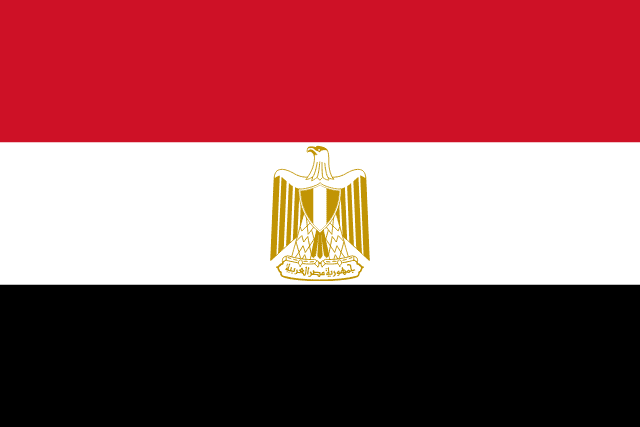
Red, white and black; green Arabic inscription.
Official reference →Egypt and Iraq: the central symbol is the key
Egypt and Iraq have national flags whose backgrounds look closely related. Three equal horizontal bands appear in the same order: red on top, white in the middle and black below. Look at the white band before trying to identify either country. Egypt has a golden eagle in that position. Iraq has a green Arabic inscription. The two centerpieces are completely different kinds of design: one depicts a heraldic bird and the other uses written words.
A complete image of the Egyptian flag should show the Eagle of Saladin. Its compact shape stands upright on the white band. An image of the current Iraqi flag should show the expression Allahu Akbar, often translated as God is greatest, in a stylized Arabic script. The Iraqi writing runs across the middle field rather than forming an eagle-like silhouette. This makes it possible to identify the flags even if the reader does not know Arabic.
The general color order is not the distinguishing feature between these two countries. If the flag is partly hidden and only its red and black bands are visible, a confident identification may not be possible. The same is true of a small illustration whose central mark has disappeared because of compression or cropping. Seek the complete center field, a reliable caption or a larger photograph.
This guide focuses on the current ordinary national designs. Earlier versions of the flags, special government emblems and military banners may require a separate historical identification. Their differences are discussed below so that older photographs do not become a source of confusion.
| Feature | Egypt | Iraq |
|---|---|---|
| Bands | Red, white, black | Red, white, black |
| Central device | Golden eagle | Green Arabic inscription |
| Basic ratio | 2:3 | 2:3 in 1986 legislative reference |
| Present design history | 1984 | 2008 amendment |
The Egyptian flag and the Eagle of Saladin
Egypt’s State Information Service describes the national flag as a red-white-black tricolor with three equal horizontal fields and a gold-colored eagle in the middle. Article 223 of the Constitution identifies the eagle with the Eagle of Salah El Din, also known in English as Saladin. This is an important detail when someone describes Egypt’s flag as having a bird but cannot identify the species or heraldic device.
The eagle is recognizable by its upright form, wings, chest shield and the scroll beneath it. In a complete official reference the graphic is a specific national emblem, not an interchangeable illustration of any bird of prey. A common simplified drawing error is to replace the heraldic figure with an ordinary flying bird. That may communicate the idea of an eagle but does not reproduce the national flag.
The shield on the eagle’s chest echoes the flag’s color family. Its presence can make the center of a small image appear much more detailed than the plain red and black bands. The scroll contains Arabic lettering associated with Egypt’s official name. These parts belong within the single national emblem. They should not be interpreted as separate inscriptions stretching across the white stripe in the way Iraq’s central writing does.
Egypt’s government references identify the golden eagle as a central expression of the country’s national design. When comparing its flag with another country’s, distinguish a description of the bird from a claim about what each detail means. An explanation of the entire national emblem needs a reliable source for the heraldic interpretation, not merely a visual resemblance to another eagle.
The complete eagle is the clue to prioritize during a two-country quiz. The exact color of gold may differ between printed, embroidered and digital examples, but the structure of the heraldic figure is quite distinct from the shape of Iraq’s script.
Iraq’s green Arabic lettering and its 2008 design
The current Iraqi flag uses a green inscription within the middle white band. The expression is commonly called the takbir, from the Arabic term for declaring the greatness of God. It is written in Kufic-style lettering. The design therefore has a linguistic component as well as a visual component. A learner can recognize the lettering’s overall form without needing to read every character.
Iraq’s parliament archives contain Law No. 9 of 2008, an amendment to the previous flag legislation. It removes the three green stars and the older reference to presidential handwriting, and specifies the inscription in Kufic script. The change is essential to understanding why many older Iraqi flag illustrations display three stars even though the current ordinary flag does not.
A useful recognition distinction is that Arabic script is not unique to Iraq’s flags or symbols. Other countries use Arabic words on their national designs. The identification comes from the combination of the phrase, its green color, the position in the white band and the red-white-black background. Saudi Arabia, for example, uses a very different green field with white lettering and a sword. Do not identify every flag with Arabic text as Iraqi.
Readers unfamiliar with Arabic may find the Kufic design particularly interesting because of its angular, connected forms. However, an approximate scribble or an arbitrary geometric substitute is not a faithful depiction. If the text is being studied for a drawing or translation task, consult a trustworthy official reference that retains the correct letter order and shape.
The official Iraqi report to the United Nations in 2025 still identifies the flag under the 2008 act. The fact that the amendment originally contemplated a later new flag law is not a reason to substitute an unadopted design or to restore the old stars. A proposal, a transitional legislative provision and an actual current official flag are different kinds of evidence.
Compare the basic geometry of the stripes
The horizontal structure of the two flags provides a simple proportional exercise. The white field occupies the middle third of each rectangular design. The upper and lower bands each occupy one third of its height. Egypt’s 2014 flag law specifies the familiar 2:3 height-to-length rectangle. Iraq’s 1986 flag-law text specifies the same general proportion, while the 2008 amendment concentrates on the central content. For contemporary official manufacturing, check the applicable consolidated specifications rather than treating a reference thumbnail as a certified pattern.
In an educational chart using a height of twelve centimeters and a length of eighteen centimeters, each of the three horizontal bands is four centimeters high. On paper, the centerline of the whole flag lies six centimeters from the top, inside the white field. A student comparing the two designs can mark this position on both sketches before consulting the respective central-symbol references.
The Iraqi amendment provides a further construction detail for the inscription: its specified extent is expressed relative to the white rectangle, including the central third of its length and the middle two quarters of its width. This is a geometric instruction about the placement of the authorized writing. It is not permission to invent different letters to occupy those measurements.
For Egypt, the official law refers to the accompanying model for the eagle. Its outline, shield and scroll should therefore come from a faithful official reference rather than from an arbitrary drawing scaled to the same width as the Iraqi lettering. The two centerpieces have different shapes and need not occupy identically sized boxes simply because their background flags are similar.
When making a side-by-side comparison in a document, do not place an extra colored line between the red and white fields to make the stripes easier to see. Such a divider would alter the design. If the white band blends with the background of the document, place a neutral border outside the flag image instead. This distinction between artwork and its presentation is useful for creating accurate educational references.
Why the backgrounds resemble each other
The red-white-black arrangement belongs to a wider family of Arab flag designs. Egypt and Iraq each have their own political history and distinct legislation, but their flags draw on overlapping regional traditions. The similarity is most useful when it leads readers to examine specific historical documents instead of assuming that the two states adopted one shared national flag.
The Egyptian presidency’s national flag timeline documents the United Arab Republic design that used two green stars in the central field. Those stars referred to Egypt and Syria. The same historical timeline records the later change to a gold bird emblem and the adoption of the present eagle-bearing flag in 1984. Thus a photograph of Egypt from the period of the United Arab Republic may look closer to other red-white-black flags than the current national flag does.
Iraq’s flag likewise underwent changes to its central devices. The 1986 law and its later amendments document the earlier stars and the addition of writing. The 2008 amendment replaced the old central arrangement with the present script without the three stars. The colors remained a recognizable background through these changes.
These different histories explain why a visual comparison of the two present flags should not be used to label every flag shown in archival footage. A flag with two green stars may belong to an earlier political period; a flag with three stars and lettering may be an older Iraqi design. The date and provenance of the photograph are necessary to confirm the particular interpretation.
Shared flag colors often encode a broader historical vocabulary. They do not establish a common political position today, a shared government or agreement between the states on contemporary affairs. This article treats the flags as national symbols and historical objects, rather than drawing conclusions about current politics from their appearance.
Other flags that can enter the comparison
A two-choice identification exercise is relatively straightforward because the Egyptian eagle and Iraqi inscription are different. A larger selection may include Yemen, whose national flag has the same basic red-white-black horizontal arrangement without a central eagle or script. In that three-way comparison, the central field is still the first place to look: bird, writing or plain white.
Other Arab flags use related colors in different structural arrangements. A flag may have a triangular or trapezoidal area at the hoist, a green stripe in place of one of the other fields, or a separate geometric symbol. Those changes matter more than broad color similarities. Start by determining whether the background is a three-band horizontal tricolor and whether the band order matches the pair under discussion.
The Iraqi state coat of arms also uses an eagle. This is a valuable distinction for anyone studying national symbols. Seeing an Iraqi government emblem with a bird does not mean that the national flag itself contains that bird. The eagle on an Iraqi official document is a different symbol from the green inscription printed on the ordinary Iraqi national flag. In the same way, a ministry logo should not automatically be substituted for the flag of Egypt.
An effective quiz can present the complete national flags first, then ask learners to distinguish each from its coat of arms. It can add historical designs only after identifying their dates. This avoids rewarding a learner for treating an older Iraqi flag as if it were the ordinary current national design or confusing a separate emblem with a national flag.
If the flag is on a map, inspect the map legend and the country name. If it is on a sports scoreboard, the usual three-letter labels EGY and IRQ can help when the central device is too small to see. The abbreviations are supporting clues, not a substitute for correctly labeling the original reference picture.
Practical exercises for classroom and independent study
Use the government reference illustrations and descriptions to create a comparison chart. Begin by writing the shared structure in one column: three horizontal fields in red, white and black order. In two further columns, describe the Egyptian central emblem and the Iraqi central lettering. The result is a compact reference that can be used without relying on subtle shades.
Next, record the date of a modern official source for each design. For Egypt, the constitutional description and presidential flag timeline are helpful. For Iraq, use the parliamentary amendment and the recent government report. Mark older flags separately with the period to which their symbols belong. This turns a simple visual quiz into an exercise in identifying reliable historical evidence.
For an observation exercise, look at two correctly labeled reference images. Describe the middle field without reading the country label. A description of the Egyptian flag should refer to a golden heraldic eagle. A description of Iraq should refer to green Arabic lettering. Now imagine both centerpieces have been hidden by folds. Explain why the remaining shared bands cannot reliably settle the choice.
Repeat the task with Yemen’s plain tricolor as a third choice. It is now necessary to consider whether the center field really is empty or whether a symbol has been concealed by the angle of the photograph. That is the difference between observing a complete design and making an inference from incomplete evidence.
Finally, compare an old Iraqi flag containing stars with the current legislative description. Write down what changed rather than merely naming the country. A learner who can recognize both the historical and modern designs, and explain why they differ, has developed a more useful understanding of the national flag than one who memorizes only a single picture.
When documenting the activity, add a source caption rather than copying flag images into a product or public design without checking their conditions of use. A description, a measurement chart and a link to an official reference can be useful even where the separate rights associated with reproducing a symbol are uncertain.
Reproduction, display and source limitations
Egypt’s 2014 flag legislation distinguishes respectful display from misuse, including the use of the national flag as a trademark or part of one. Iraq’s older flag legislation includes a permission provision for manufacture, printing and sale. The precise application of those provisions to an international educational website is a separate legal question from the copyright status of a flag image file.
This comparison therefore uses a labeled educational reference for Egypt and directs readers to the Iraqi government’s submitted reference for Iraq rather than newly reproducing Iraqi flag artwork. This precaution does not mean that all digital educational depictions are unlawful. It means that the applicable authorization requirements for all possible uses have not been established here.
Neither flag should be used to imply that a product, publisher or event has been endorsed by a government. Readers ordering an official flag or designing merchandise should check the relevant jurisdiction and national-symbol requirements. A statement by a graphics provider that its flag illustrations are public domain does not override separate restrictions involving national symbols.
A good reference chart should also preserve the Arabic text accurately. Do not reverse it independently of the official design, change its words, add decorative symbols or substitute a personal translation for the original writing. When an exact reproduction is required, use the authoritative model and the applicable permissions rather than treating an illustrative exercise as a production file.
Frequently asked questions
Do Egypt and Iraq have the same flag? No. They share a red-white-black tricolor background. Egypt’s central symbol is a golden eagle, while Iraq’s is green Arabic lettering.
What does the Iraqi flag say? The inscription is Allahu Akbar, commonly translated as God is greatest. It is shown in Kufic-style script under the current design.
Does Iraq still have three green stars? Not on its current ordinary flag. The 2008 parliamentary amendment removed the three stars. Older photographs and historical flags may still show them.
What is the Egyptian eagle called? Egypt’s constitution identifies it with the Eagle of Saladin. It is part of the national flag, not merely an optional decorative picture.
Are the two flags the same proportions? The legal design references describe the familiar 2:3 rectangular structure. The distinctive central features are more useful for recognizing them than the overall rectangle.
Can I identify the flags if their centers are hidden? Not confidently from the shared bands alone. Seek a complete view or an independent country label before giving a definite identification.
Sources and official reference artwork
- Egypt State Information Service – national flag
- WIPO Lex – Egyptian Constitution, Article 223
- Egyptian Presidency – flag history
- Reproduced Egyptian Law 41/2014 – dimensions and use
- Iraq Parliament – Flag Act 9 of 2008
- Reproduced Iraq Flag Law 33 of 1986 – dimensions and restrictions
- Republic of Iraq – 2025 common core document submitted to the United Nations
- Flagpedia / FlagCDN artwork terms
Egyptian educational flag illustration supplied by Flagpedia / FlagCDN under its stated public-domain artwork terms. Separate national-symbol restrictions may apply.