Kent Flag: White Horse on Red, Invicta Meaning & Horsa Legend
Kent’s flag is a white rearing horse on a red field. Understand its Invicta name, historic sources and why Horsa’s fifth-century horse should be described as a legend.
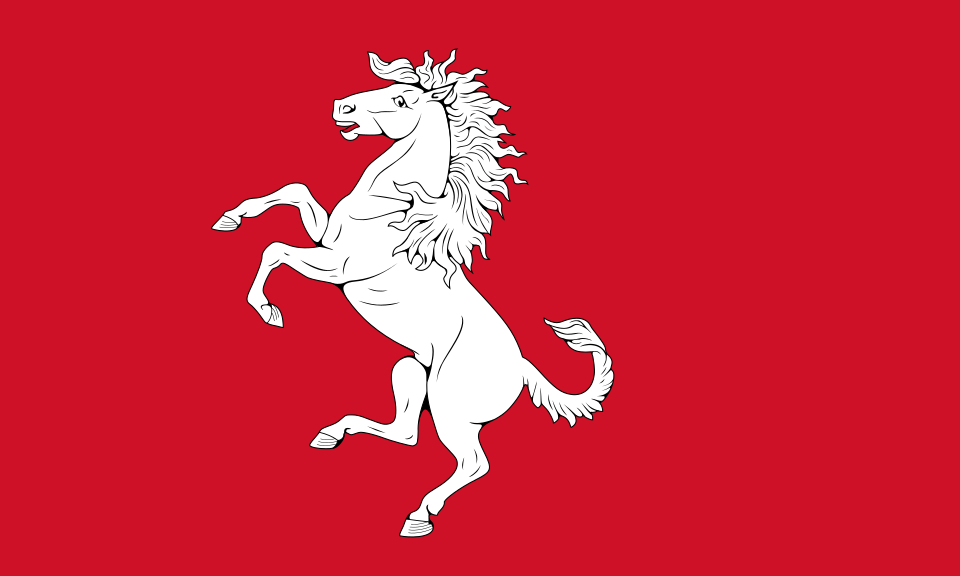
Kent’s white horse is among the most recognizable county emblems in England. It can be seen on local signs and logos as well as on the red county flag, and it is often accompanied in civic contexts by the Latin word Invicta.
The Flag Institute dates the documented flag tradition to 1605. A specialist Kent History & Archaeology study examines the Horsa legend and cautions against treating the modern emblem as an authenticated fifth-century standard.
Kent flag at a glance
| Feature | Details |
|---|---|
| County | Kent, southeast England |
| Type | Traditional English county flag |
| Background | Red |
| Emblem | White horse rampant / rearing |
| Common name | Invicta Flag |
| Related motto | Invicta — Unconquered |
| First recorded reference | 1605 |
| Traditional association | Hengest and Horsa / Kentish heritage |
| Registry code | UNKG7409 |
| Ratio | 3:5 |
This is a county community flag, not the national flag of an independent state. Historic symbols, original documentary references and modern UK Flag Registry dates are not always the same; the article distinguishes them.
What does the Kent flag look like?
The registered county flag is a solid red rectangle with one white rearing horse at its centre. The animal rises on its hind legs, with an arched neck and flowing mane and tail.
There is no inscription across the flag. Some county logos and souvenir banners add ‘INVICTA’ beneath the horse, but the Flag Institute’s registered image shows just the horse on red. Its ratio is 3:5.
What does the white horse symbolize?
The white horse is a traditional emblem of Kentish identity. In regional tradition it is connected with the Jutish settlers and the story of the brothers Hengest and Horsa, who are associated with the early formation of the kingdom of Kent.
This should be described as tradition and later heraldic association. The early medieval stories are not direct evidence that a red banner with this exact horse was carried during the fifth century. The flag’s securely documented history is substantially later.
Why is Kent’s flag called the Invicta Flag?
Invicta is Latin for ‘unconquered’ and is a longstanding motto associated with Kent. The name ‘Invicta Flag’ is used for the white-horse banner and for related local symbolic displays.
A popular story connects the motto with the county’s treatment after the Norman Conquest, but versions of that tradition are not firm documentary evidence for the flag’s original design. Crucially, the word Invicta does not appear on the standard registered county flag.
Did Horsa really carry the white horse flag?
The story associates the horse with Horsa, brother of Hengest. Their names are often interpreted as related to the words for horse or stallion, which helped later writers link the men with an equine emblem.
However, research published by the Kent Archaeological Society concludes that there is no sound reason to assume an actual fifth-century banner already resembled Kent’s modern white horse on red. Historic county symbols can grow out of traditions many centuries after the events they commemorate.
How old is the recorded Kent horse flag?
The Flag Institute identifies the first recorded reference to Kent’s traditional horse emblem in 1605. The reference appears in the work of Richard Verstegen, whose writing discussed Anglo-Saxon origins and the horse association.
This makes the documented flag tradition early modern even though it draws on an earlier legendary past. Calling the Kent flag a newly designed 2000s flag would be wrong, but claiming it has been continuously flown since 449 is also unsupported.
Is Kent’s county flag the same as its council’s arms?
Kent’s public county flag is simple: one white horse on red. County council arms and local government insignia may combine the horse with shields, mottos or additional heraldic devices. They serve related but distinct purposes.
If a picture includes a blue shield, ornamental supporters or large words beneath the horse, it may show a civic logo or coat of arms rather than the registered community flag. For a flag quiz, use the simple red rectangle and white horse.
Which other flags or regions use white horses?
The White Horse of Kent is only one example of a white-horse heraldic emblem. Similar horses appear in parts of Germany, notably Lower Saxony, and in other European heraldic settings. The exact pose and colour background can differ.
Because several flags can feature a white animal on red, the safest way to identify Kent is to combine the county context with the particular rearing horse artwork. The registered Kent design is the clearest reference.
Kent vs Sussex, Essex and Hampshire county flags
Sussex shows six gold martlets on blue, and Essex shows three white seaxes on red. Hampshire combines a gold Saxon crown and a red-white-red rose on a red-and-yellow bicolour.
Kent shares a red field with Essex but has a single white horse instead of three curved weapons. These differences are useful in recognizing English county flags without relying on a caption.
How do you draw the Kent flag?
Draw a 3:5 red rectangle and place a large white rearing horse in the middle. The horse should face toward the flag’s hoist in the common registered rendering and have its front legs lifted.
Do not draw a unicorn horn or add ‘Invicta’ as mandatory lettering. A faithful red-and-white horse vector is the best illustration when accurate heraldic detail matters.
Frequently asked questions
What animal is on the Kent flag?
A white rearing or rampant horse on red.
What does Invicta mean?
Unconquered, from Latin; it is Kent’s traditional motto.
Does the standard flag contain the word Invicta?
No. The registered flag has a white horse on red without lettering.
What is the connection with Horsa?
A traditional association links the emblem to Horsa and Hengest, but an actual fifth-century flag of this design has not been demonstrated.
When is the first documented Kent horse reference?
1605, according to the UK Flag Registry.
Is Kent’s flag like the Lower Saxony flag?
Both feature white horses on red, but they are separate heraldic traditions with different specific imagery.
How is Kent different from Essex’s flag?
Kent has a white horse; Essex has three white Saxon seaxes on a red field.
Is Kent a separate nation?
No. Kent is a historic county of England.
References and illustration credits
Flag Institute — Kent / Invicta Flag
Kent Archaeological Society — Saxon steed and the white horse of Kent
Flags of the World — Kent flag and arms
Flag image from Wikimedia Commons: Kent county flag vector. Public-domain county flag drawing by Hogweard, with technical revisions by 8oym8 and HapHaxion, via Wikimedia Commons. Rendered as PNG without altering the flag design.
Independent educational guide. Information reviewed November 2026; no endorsement by the Flag Institute or local government is implied.