UAE vs Kuwait Flag: Red Hoist Bar, Black Trapezoid and Color Order
Side-by-side identification, documented history and practical measured comparison.
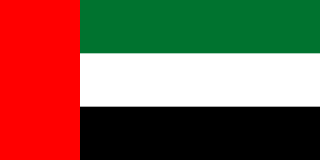
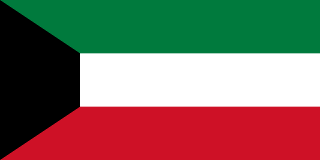
The United Arab Emirates and Kuwait both use green, white, red and black, but the UAE has a full-height red rectangle at the hoist and green-white-black horizontal bands. Kuwait has a black trapezoid at the hoist and green-white-red horizontal bands. Their standard flags are both twice as long as high. Identify the hoist shape and bottom band first: red rectangle and black bottom mean UAE; black trapezoid and red bottom mean Kuwait.
Comparison at a glance
| Feature | United Arab Emirates | Kuwait |
|---|---|---|
| Hoist device | Red rectangle | Black trapezoid |
| Top band | Green | Green |
| Middle band | White | White |
| Bottom band | Black | Red |
| Length:height | 2:1 | 2:1 |
| Device reach from hoist | One-quarter of length | One-quarter of length at narrow end |
The two visual tests that settle most identifications
The top green and middle white bands are shared by the two designs. Looking only at those bands is therefore not enough to distinguish them. Begin instead at the hoist, the edge attached to the flagpole. In the UAE flag, the entire left quarter is a solid red rectangular area. Its boundary with the fly is a straight vertical line from the top of the flag to the bottom.
Kuwait’s hoist is black. Its shape narrows from the full flag height at the pole to a shorter vertical edge at the center of the flag’s height. The upper and lower sides of that shape are diagonal. It is a trapezoid, not a triangle, because the inward edge has a measurable vertical length rather than ending in one point.
The second test is the lowest horizontal band. The UAE uses black at the bottom, while Kuwait uses red. This is especially helpful in a photograph where folds hide the hoist. If the bottom stripe is clear and the upper stripes are green and white, the choice between the two becomes straightforward.
Do not confuse the wide red vertical area of the UAE design with a red horizontal stripe. The color occupies a different position and shape in the flag. Equally, the black area of Kuwait is not simply the same rectangle recolored black: the angled boundaries are defining features.
A tiny screen icon can blur the trapezoid’s diagonal sides, making the black device appear nearly rectangular. In that case the bottom stripe is a useful independent clue. At larger sizes, inspect both the geometric shape and the color order.
If the flag is photographed from its reverse side, the pole may appear on the right. The full-height hoist device remains attached to that edge. Read the bands from top to bottom, and the device from the physical hoist rather than automatically assuming that it must appear on the viewer’s left.
The UAE flag: exact rectangular construction
The UAE’s federal flag description and government visual identity guidance establish a horizontal length equal to twice the vertical height. The red hoist rectangle occupies one-quarter of the total length. The remaining three-quarters are divided into three equal-height horizontal regions: green, white and black.
Take a flag with a length of sixty centimeters and a height of thirty centimeters. The red rectangle is fifteen centimeters wide and thirty centimeters high. The fly area measures forty-five centimeters across. Divide it into three horizontal bands of ten centimeters each.
The two stripe boundaries occur at ten and twenty centimeters from the top. Draw those boundaries only from the red rectangle’s right edge to the fly. The red field remains continuous, with no visible horizontal divisions crossing it.
All four colored regions have the same area in this geometry. The red region measures fifteen times thirty, or 450 square centimeters. Each of the other regions measures forty-five times ten, also 450 square centimeters. Thus each occupies one-quarter of the underlying flag area.
For a nine-hundred-by-four-hundred-fifty-pixel image, the red rectangle measures 225 pixels wide. The green, white and black stripes each have a height of 150 pixels and a horizontal length of 675 pixels. This produces exact boundaries without rounding.
A common drawing error is to divide the complete rectangle into four horizontal stripes. Another is to make the red bar one-quarter of the vertical height instead of one-quarter of the length. At this ratio those two measurements differ by a factor of two.
The simplest digital workflow is to create four filled rectangular shapes, with their edges meeting exactly. No emblem or outline is needed. Formal reproductions should follow the government’s current color references and official display rules rather than a color sampled from a random image.
Kuwait’s flag: construct the black trapezoid
The Kuwaiti flag law establishes the same overall one-to-two height-to-length ratio. It divides the background into green, white and red horizontal stripes of equal height. A black trapezoid lies at the hoist, its larger parallel side equal to the full flag height and its smaller parallel side equal to the height of the central white stripe.
The distance between those parallel sides is one-quarter of the flag length. Thus on a sixty-by-thirty centimeter rectangle, the black shape extends fifteen centimeters horizontally inward from the pole. Its full-height base measures thirty centimeters. Its narrow vertical end measures ten centimeters, matching the white stripe.
Use an origin at the top-left corner, with horizontal coordinates increasing toward the fly and vertical coordinates increasing downward. Mark the four trapezoid vertices at (0,0), (15,10), (15,20) and (0,30), in centimeters. Join them and fill the shape black.
This construction places the two short diagonal sides across the upper and lower colored regions. The trapezoid’s narrow vertical boundary aligns exactly with the left end of the exposed white stripe. There is no pointed apex at the central height.
For an image measuring nine hundred by four hundred fifty pixels, use vertices (0,0), (225,150), (225,300) and (0,450). Draw the three stripe rectangles first and overlay the black polygon. This gives clean joins along its diagonal edges.
The white band has only three-quarters of the complete length visible, because the trapezoid covers its first quarter. The upper green and lower red bands extend farther toward the hoist as they approach their outside edges. Their visible shapes are not simple rectangles.
Check the black device against the embassy’s description and the flag law translation. If the narrow end is reduced to a single point, the trapezoid becomes a triangle and the geometry no longer matches Kuwait’s design. If the narrow end is made full height, the device becomes a rectangle and the result resembles the UAE layout with different colors.
Compare color coverage at identical sizes
The two flags share four colors, but those colors occupy different proportions of their area. This is an informative mathematical distinction even if the designs are printed in monochrome with separate color labels.
On the sixty-by-thirty example, the total area is 1,800 square centimeters. The UAE gives every color an equal 450-square-centimeter area. The red area is the rectangular hoist band; green, white and black are the three equally sized fly rectangles.
Kuwait’s black trapezoid has parallel sides thirty and ten centimeters long, separated by fifteen centimeters. The area is the average of those sides multiplied by their separation: twenty times fifteen, or 300 square centimeters. That is one-sixth of the entire flag.
Before the trapezoid is applied, each horizontal stripe occupies six hundred square centimeters. In the central white stripe, the black shape covers a fifteen-by-ten centimeter rectangle, removing 150 square centimeters. The visible white area is therefore 450 square centimeters, the same total white area as the UAE’s example.
The black sections covering the top and bottom stripes are two right triangles, each with an area of seventy-five square centimeters. This leaves 525 square centimeters of green and the same amount of red. Each therefore occupies seven twenty-fourths of the whole area, approximately 29.17 percent.
The Kuwaiti color distribution is consequently black at about 16.67 percent, white at 25 percent, green and red at approximately 29.17 percent each. These values are calculations from the prescribed geometry, not a separate legal color-area table.
The comparison explains why the UAE can appear to contain more black when both flags are seen side by side. Its black horizontal band covers a full quarter of the flag, whereas Kuwait’s black hoist covers one-sixth.
For a classroom activity, ask students to derive these fractions without measuring a printed image. The result depends only on the overall ratio, stripe divisions and hoist-device dimensions. The calculation is also a way to detect a mistakenly drawn triangular or rectangular black region.
Independent adoption histories within a related flag tradition
Kuwait adopted its current flag in 1961, the year it became fully independent from Britain. The Kuwaiti embassy’s account describes a law issued in September 1961, followed by amendments in November. The design replaced earlier flags used in Kuwait and established the current four-color arrangement.
The four colors belong to a wider group of flag designs often described as Pan-Arab colors. Their use is associated with regional history, the Arab national movement and the symbolism of several earlier dynasties and political banners. A shared palette does not mean that all countries selected the same geometry or adopted their flags on the same date.
The United Arab Emirates was founded as a federation in 1971. Its flag belongs to the creation of that new state. The official UAE government account identifies its four colored areas, and the federal law gives the construction of the national flag.
The UAE’s straight red bar is a design feature of the federal national flag, rather than a representation of a separate country’s flag attached to a tricolor. Several emirates have their own historic red-and-white flags, but the national federal design has its own defined geometry.
Kuwait’s black trapezoid is likewise part of its national identity and cannot be detached from the remaining bands and treated as an independent national flag. It is a useful recognition feature precisely because of its distinctive integration with the stripes.
In a timeline, place Kuwait’s 1961 flag and the UAE’s 1971 federal flag on separate tracks. Although the color family connects the flags with broader regional traditions, their adoption dates and state histories are different.
Be cautious about claims that one design is directly copied from the other solely because of shared colors. The documented common regional palette is a stronger basis for comparison than an unsupported claim about a specific designer’s intentions.
Color meanings and the limits of a shared interpretation
The four colors are frequently explained through historical Arab symbols and poetry. Kuwaiti government accounts connect the colors with a traditional poetic association between white deeds, black battles, green fields and red swords. This is a cultural interpretation of the palette, not an instruction that the colors must appear in a particular geometric order on all Arab flags.
The UAE also connects its flag with national identity and the wider Pan-Arab tradition. Its official government guidance focuses on the design, dimensions, applications and appropriate display. The flag’s geometry remains clear even where different educational explanations emphasize different aspects of its symbolism.
It would be misleading to assign identical meanings to all four colors across every flag using the palette. Particular national sources, political history and official interpretations may differ. A comparative guide should attribute those interpretations to the relevant country rather than treating them as a universal legal definition.
The middle white and upper green areas are arranged similarly in the two flags. Yet the black and red areas occupy distinct locations. The historical relationship between the colors does not override those structural differences.
For a learner trying to identify flags, the correct order is to understand the physical design first and read the symbolism afterward. This avoids a circular argument such as assuming that a black hoist must mean the same thing wherever black is used.
If creating a teaching chart, include separate columns for design facts and historical interpretations. Use measurable dimensions and color positions in the first, and attributed explanations in the second. That organization keeps the national flags distinct without denying their shared cultural background.
Other Pan-Arab color flags to rule out
Palestine uses horizontal black, white and green stripes with a red triangle at the hoist. The black band appears at the top rather than the bottom. Its triangular hoist device is different from the UAE’s red rectangle and Kuwait’s black trapezoid.
Jordan has a similar black-white-green horizontal tricolor with a red triangle and a white seven-pointed star within that triangle. The star is a strong distinguishing feature where it is visible. Neither the ordinary UAE nor Kuwait flag contains a star.
Sudan uses red, white and black horizontal bands with a green triangle at the hoist. This places green in a different location from the upper stripe shared by the UAE and Kuwait. The triangle is pointed rather than ending in a vertical narrow edge.
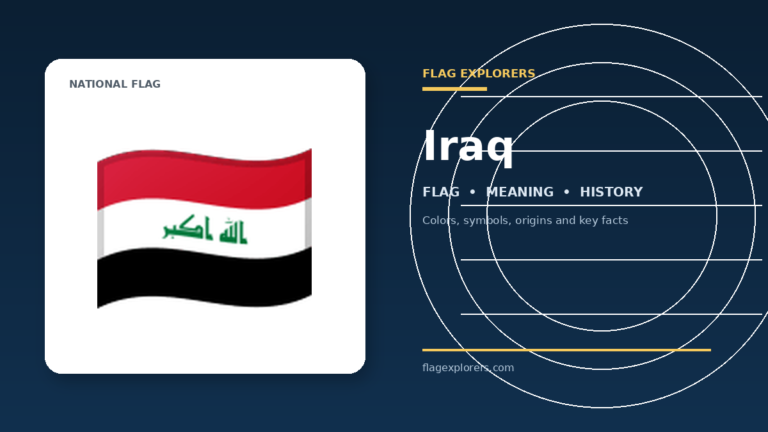
Iraq uses red, white and black horizontal bands with green Arabic writing across the white central stripe. Its graphic structure is different because it does not use a full-height hoist device of another color.
A useful identification chart therefore begins by asking whether a flag contains a rectangular bar, trapezoid, triangle or text. Follow that question with the position of the green band and the color of the lowest horizontal stripe.
In some images, a flag is wrapped around a person or hanging in folds. A crop that includes only a white and green band may not show the relevant device. Instead of assuming the flag is Emirati or Kuwaiti, locate another view or use the event’s reliable country label.
The shared four-color palette is helpful for narrowing the search, but it is not sufficient to assign one national identity. Structural comparisons make a flag finder more robust and avoid relying on exact digital shades.
Practical drawing and identification exercise
Give students two rectangles each thirty centimeters long and fifteen centimeters high. Divide both into three horizontal rows of five centimeters each and mark a point seven and a half centimeters from the hoist. These values follow both countries’ standard outer ratio and the one-quarter reach of their hoist devices.
On the first flag, reserve a rectangle seven and a half centimeters wide for red. Color the exposed upper row green, the center white and the lower row black. On the second, color the three base rows green, white and red before adding the black trapezoid.
Connect the upper hoist corner to the first band division at the seven-and-a-half-centimeter mark. Connect the lower hoist corner to the second band division at that same mark. Join the two interior points vertically and fill the resulting polygon black.
Ask students to measure the shapes and explain why the UAE has four equal-area regions but Kuwait does not. Let them calculate the trapezoid’s area and compare it with the area of the UAE’s red bar. This combines flag recognition with geometry rather than merely memorizing colors.
Then reduce the images to thumbnail size and identify them by the bottom stripe. Cover the bottom stripe and identify them using the hoist. This tests the two independent recognition features.
For official or ceremonial use, follow the current guidance of the respective government. An educational comparison does not establish that a particular display method, alteration or commercial application is permitted.
The dependable rule is red rectangle and black bottom for the UAE; black trapezoid and red bottom for Kuwait. Once these features are understood, both flags are easily distinguished even though they use exactly the same four broad color categories.
Frequently asked questions
Which flag has a black trapezoid?
Kuwait.
Which flag has a red vertical rectangle?
The United Arab Emirates.
Do both use the same four colors?
Yes, green, white, red and black, arranged differently.
Are the flag ratios the same?
Yes, both use twice the length relative to height.
Sources and artwork
UAE Government Media Office: UAE flag visual identity guidelines
Kuwait Embassy in Japan: history and flag description
Kuwait flag law, translated text and construction
Reference artwork: Flagpedia/FlagCDN, public-domain flag images. Educational comparison, not official endorsement. Reviewed November 2026.