Singapore vs Malaysia Flag: Crescents, Stars, Stripes and Shared History
Side-by-side identification, documented history and practical measured comparison.

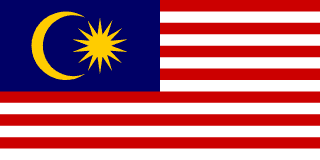
Singapore uses two broad horizontal fields, red above white, with a white crescent and five white stars in the upper hoist. Malaysia uses fourteen alternating red and white stripes and a blue canton containing a yellow crescent and a fourteen-pointed star. Both designs contain crescent imagery, but the stars, color placement and overall construction are unmistakably different. Their shared twentieth-century political history explains why the flags are often studied together.
Comparison at a glance
| Feature | Singapore | Malaysia |
|---|---|---|
| Horizontal bands | 2 equal fields | 14 equal stripes |
| Crescent | White | Yellow |
| Stars | Five separate five-pointed stars | One fourteen-pointed star |
| Canton background | Red upper field | Blue rectangle |
| Height:length | 2:3 | 1:2 |
| Modern adoption milestones | 1959; independence in 1965 | 1950 precursor; 1963 federation |
How to distinguish the two flags at a glance
The broadest visual difference is the number of red and white regions. Singapore has one uninterrupted red upper half and one white lower half. The Malaysian flag has seven red stripes and seven white stripes of equal height, beginning with red at the top and ending with white at the bottom.
Look at the upper hoist, the part of the flag closest to the top of the flagpole. Singapore’s white crescent and stars sit directly against the red upper field. There is no separate blue rectangle behind them. Malaysia’s yellow crescent and star are contained within a dark-blue rectangular canton.
The number of star shapes provides an especially useful distinction. Singapore has five separate stars, each with five points. Malaysia has a single star with fourteen points. Counting the number of stars is different from counting the points on one star; mixing those two questions is a common source of incorrect descriptions.
At thumbnail size, the smaller white stars on Singapore’s flag can merge visually into a light patch next to the crescent. The Malaysian crescent and star remain gold or yellow against blue. The stripe arrangement therefore provides a reliable second feature where small details are hard to see.
A flag viewed from behind will show the crescent and star arrangement mirrored, with the hoist on the opposite side of the picture. That does not create another national design. Identify the background behind the symbols and the number of bands before deciding which flag you are looking at.
The shared red and white colors are not sufficient to identify either flag. Several countries use them, and more than one uses a crescent. The combination of the two-field versus fourteen-stripe base, the crescent color and the separate star count resolves this pair.
Singapore’s flag: two fields and five separate stars
Singapore’s National Symbols Act defines a rectangular flag with two equal horizontal sections, red above white. The crescent and five stars are positioned in the upper hoist. They are all white. The familiar arrangement has the crescent opening toward the fly, with the five stars forming a compact circular group beside it.
The red field represents fellowship and equality among people. White is associated with enduring purity and virtue. The crescent is explained as a young nation progressing, while the five stars represent democracy, peace, progress, justice and equality. These interpretations are set out in Singapore’s official national-symbols materials.
The five stars do not stand for five states, ethnic groups or provinces. This distinction matters when comparing Singapore with Malaysia, whose fourteen-pointed star has a different federal meaning. The similarities of the crescent and star forms do not imply a common numerical symbolism.
To reproduce the layout, begin with a rectangle twice divided vertically into equal upper and lower halves. At a height of twenty centimeters, each colored field is ten centimeters high. Using the standard two-to-three height-to-length proportion, the rectangle is thirty centimeters long.
Reserve the upper hoist area for the white elements. The crescent and stars must remain in the red field, with sufficient red space around them. Use the official illustration for their exact scale and positioning; a group placed across the dividing line between red and white would not reproduce the national flag.
A crescent can be drawn by subtracting one offset circular shape from another, producing two pointed tips. This mathematical technique is useful for educational drawings, but the actual curves and proportions should be checked against the official flag artwork rather than treated as independently specified by the drawing method.
The five white stars are distinct shapes. Do not connect them with an additional white ring. The red spaces between them are part of the composition and help preserve the visual relationship between the crescent and the stars.
Malaysia’s flag: fourteen stripes and a fourteen-pointed star
Malaysia’s national flag is known as Jalur Gemilang. The official government portal identifies fourteen alternating horizontal stripes, beginning in red and ending in white. They represent the thirteen states and the federal component of the country.
The canton occupies the upper hoist and is blue. It contains a yellow crescent and a single yellow star with fourteen points. The yellow is associated with the royal color of the Malay rulers; the crescent is associated with Islam and the star expresses unity within the federation.
This star should not be drawn as fourteen small stars distributed around a ring. Its fourteen points belong to one continuous shape. Count them individually around its perimeter when checking an accurate reproduction.
A common standard reference for the flag has a length twice its height, with the canton extending across half its length and the upper eight stripes. The remaining six stripes beneath it run uninterrupted from the hoist to the fly. A full reference illustration makes this arrangement straightforward to verify.
For a flag twenty-eight centimeters high, each of the fourteen stripes measures two centimeters. The full length is fifty-six centimeters. The blue canton is twenty-eight centimeters wide and sixteen centimeters high, extending down to the eighth stripe boundary.
The canton covers the ends of the upper eight stripes near the flagpole, but those stripes remain visible toward the fly. Count the stripes on the right where they are uninterrupted, rather than counting only the six full-width stripes below the canton.
The crescent and fourteen-pointed star should remain entirely within the blue region. Use the Malaysian government’s reference to establish their dimensions and spacing. A generic yellow crescent and a five-pointed star would fail to reproduce the distinctive federal symbol.
The design’s numerical features work together: fourteen stripes and fourteen star points. That relationship is not present on Singapore’s flag, which uses two broad fields and five separate stars.
Compare the flag proportions and stripe geometry
Draw both designs on a common height of forty-two centimeters. The Singapore rectangle measures sixty-three centimeters across, while the Malaysian rectangle measures eighty-four centimeters across. The difference in length is visible even though the flags are the same height.
Singapore’s upper red and lower white fields each measure twenty-one centimeters in height. The background has a single horizontal division. Malaysia’s fourteen stripes each measure three centimeters, so the flag has thirteen horizontal boundaries before the canton is applied.
The Malaysian canton in the reference arrangement occupies the first forty-two centimeters of the length and the upper twenty-four centimeters of the height. The remaining eighteen centimeters consist of six uninterrupted stripes. This yields a useful checking method: the canton height should correspond to eight stripes.
On digital artboards, a Singapore flag six hundred pixels high would be nine hundred pixels long, with each main field three hundred pixels high. A Malaysia flag five hundred sixty pixels high would be eleven hundred twenty pixels long, with fourteen stripes forty pixels high.
On the Malaysian example, the canton extends five hundred sixty pixels horizontally and three hundred twenty pixels vertically. Use separate editable rectangle shapes for the stripes and canton. Avoid allowing a narrow gap between successive stripes when exporting the vector artwork.
The crescent and star details require their own reference-based placement. A numerical stripe grid does not supply the complete dimensions of every symbol. For formal reproductions, check the appropriate official artwork and color guidance.
If both flags must fit a standard display card, preserve their aspect ratios and leave additional space around the shorter image. Resizing them independently to the same width and height can distort the curves of the crescents and the proportions of the stars.
This construction exercise shows that the flags differ both in their basic geometry and the symbols placed on top of that geometry. Simply recoloring Singapore’s crescent yellow would not create the Malaysian flag.
How the two flags developed during the twentieth century
The Malaysian flag’s predecessor emerged from the formation of the Federation of Malaya. A national flag design selected around 1950 used red and white stripes and a blue canton with crescent and star. The design is associated with Mohamed Hamzah.
The original federal arrangement had eleven stripes and an eleven-pointed star. When Malaysia was formed in 1963, the design was adapted to the enlarged federation with fourteen stripes and a fourteen-pointed star. The continued use of fourteen after Singapore’s departure reflects the present national interpretation described by the government.
Singapore introduced its red-and-white flag in 1959, during the period of self-government. The National Heritage Board records the role of a committee headed by Toh Chin Chye in its development. Its crescent and five stars expressed the aspirations of the new self-governing state.
Singapore joined Malaysia in 1963 and became an independent republic in 1965. It retained its distinctive flag. The 1959 design therefore predates the country’s independent statehood, rather than first appearing as a response to separation in 1965.
The two flag histories intersect at the formation of Malaysia, but their designs and symbolism were developed for different political purposes. The fact that both use crescents does not establish that the Singapore design was created by modifying the Malaysian one.
For a timeline lesson, mark 1950 for the earlier Federation of Malaya flag, 1959 for Singapore’s flag, 1963 for the enlarged federation and 1965 for Singapore’s independence. Add separate images for the earlier eleven-stripe Malayan design and the current fourteen-stripe Malaysian design.
This approach distinguishes historical design versions from modern national flags. A photograph from 1957 should not be labeled with the current fourteen-stripe Malaysia flag without considering its date. Similarly, the presence of the Singapore flag before 1965 does not make the photograph historically impossible.
Do the two crescents mean the same thing?
A crescent is a geometric shape with many historical and cultural uses. On Malaysia’s flag, the official interpretation associates the crescent with Islam. The golden color of the crescent and star is also connected with the Malay royal tradition.
Singapore’s official symbolism assigns a different meaning to its crescent: a young nation on the rise. The five stars express five national ideals rather than an arrangement of federal units.
The distinction is particularly important for readers who see a crescent on an unfamiliar flag and assume that it has one universal religious meaning. A symbol’s meaning depends on the particular flag and its documented interpretation. Similar shapes can communicate different ideas in different political and cultural settings.
The colors also have separate documented meanings. Singapore’s red and white express ideals of fellowship, equality, purity and virtue. Malaysia’s red and white stripes belong to a federal design with its own explanations and structure. The blue canton and royal yellow add further elements that Singapore does not use.
When making a comparative worksheet, put the official interpretation next to the corresponding symbol rather than giving learners one generalized description of crescents and stars. For instance, ask which flag uses five separate stars to express national ideals and which uses one fourteen-pointed star to express federal unity.
This also helps distinguish the two flags from other national designs containing crescents, such as Türkiye, Pakistan or Tunisia. Their geometric resemblance is a useful visual category, but their colors, star arrangements and histories must be understood individually.
A flag’s public display does not reveal an individual’s personal religious beliefs or political opinions. The symbols represent national identities and should be interpreted through appropriate sources rather than assumptions about the person carrying them.
Rule out other red-and-white and crescent flags
Indonesia’s flag consists of red above white in two horizontal fields, with no crescent or stars. Singapore’s flag has the same broad color arrangement but adds the white devices near the upper hoist. A crop of the fly end of Singapore’s flag may therefore resemble Indonesia’s design.
Monaco also uses red over white without an emblem. Its usual proportions differ from Indonesia’s reference flag, but the shared bicolor arrangement makes it another possibility when Singapore’s crescent and stars are hidden.
The United States flag has thirteen alternating red and white stripes and a blue canton containing fifty white stars. Malaysia has fourteen stripes and a yellow crescent with one fourteen-pointed yellow star. Count the stripes and inspect the canton rather than identifying either striped flag from a quick color impression.
Liberia has eleven red and white stripes and a blue canton with one white star. That star is different in color and point count from Malaysia’s golden federal star, and there is no crescent on the Liberian flag.
Türkiye has a white crescent and single white star on an otherwise red field. Singapore has five stars and a separate lower white half. Tunisia has a red crescent and star inside a white disk on red. These designs demonstrate why crescent imagery alone cannot identify a country.
For a flag finder, the most useful filters are the number of horizontal bands, presence and color of a canton, number of stars, star points and presence of a crescent. Those features separate a large number of similar designs without relying on exact shades of red or blue.
A classroom activity for visual recognition and historical comparison
Give learners a red rectangle and a white rectangle representing Singapore’s equal halves. Ask them to place the white crescent and five stars in the correct upper-hoist location using a reference. Then ask them to name the five ideals from official Singaporean guidance.
For Malaysia, provide fourteen paper strips of equal height, alternating red and white. Assemble the rectangle and overlay the blue canton on the upper eight rows. Add a yellow crescent and a separate fourteen-pointed star.
Let learners count the Malaysian star’s points and compare that number with the stripe count. Then ask them to count the individual stars on Singapore’s flag. The exercise makes the difference between star count and point count explicit.
A second exercise can remove the country names and show the flags at small sizes. Students should identify Singapore from its two broad fields and Malaysia from its many stripes, even if the details of the stars are difficult to see.
For a historical extension, introduce separate reference images of the earlier eleven-stripe Malayan flag and present-day Malaysia. Ask students to explain how the federal design changed in 1963 while Singapore retained its own distinctive symbol.
The short recognition rule is sufficient for most everyday situations: two fields with a white crescent and five stars mean Singapore; fourteen stripes with a blue canton and yellow crescent and fourteen-pointed star mean Malaysia. The history and geometry explain why those clues remain meaningful.
Frequently asked questions
Which flag has five stars?
Singapore has five separate white stars.
Which flag has fourteen stripes?
Malaysia.
Are both crescents yellow?
No. Singapore’s is white and Malaysia’s is yellow.
Did Singapore change its flag when it became independent?
It retained the distinctive flag introduced in 1959.
Sources and artwork
Singapore National Symbols Act 2022, First Schedule
Singapore National Heritage Board: National Flag
Malaysia Government: Flag of Malaysia
Malaysia Information Department: national flag and history
Reference artwork: Flagpedia/FlagCDN, public-domain flag images. Educational comparison, not official endorsement. Reviewed November 2026.