Somalia vs Micronesia Flag: White Stars on Blue Compared
Distinguish two blue national flags by the number, arrangement and scale of their white stars.
Count the white stars, not their points
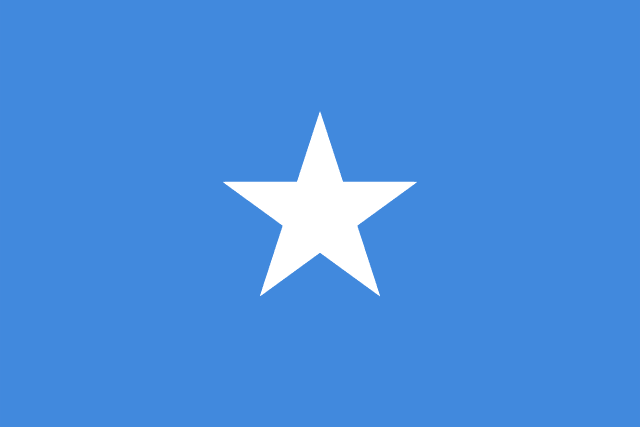
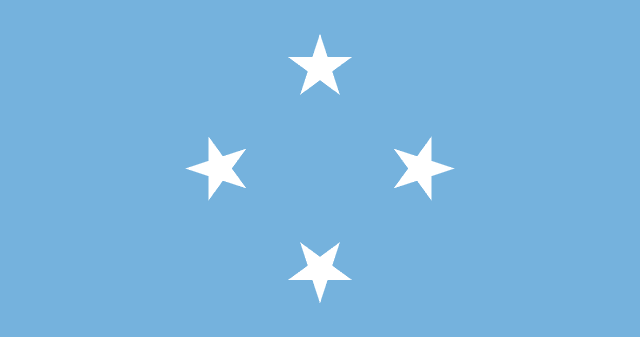
Somalia and the Federated States of Micronesia are easily confused when their flags are viewed in a small geography quiz. Both have a light-blue main field and white stars, without stripes or a multicolored coat of arms. The difference is the organization of the white shapes. Somalia places one large five-pointed star at the middle of its flag. Micronesia places four separate white stars in a circular arrangement that appears as a diamond when viewed from the front.
Look at the middle of the rectangle first. In the Somali design the center falls inside the white star. In the Micronesian design the center falls in the blue space between the stars. This is a useful secondary clue even before counting all the visible points. A learner who mistakes each point of a star for a separate star might otherwise give an incorrect count. Somalia has one star with five points, not five white stars.
A complete Micronesian reference shows a star above, below and on either side of the center. The device is a group rather than a single solid shape. Do not connect the stars with white lines when making a recognition diagram. The apparent diamond is the arrangement of the stars; no additional diamond outline is printed on the flag.
The name Micronesia can refer to a broad region of the Pacific or to the specific country called the Federated States of Micronesia. This comparison uses the latter meaning. Other countries and territories in the Micronesian region have their own flags. The four-star design is not a general flag representing every island in that region.
| Feature | Somalia | Micronesia |
|---|---|---|
| White stars | One | Four |
| Arrangement | One central star | Circle of four stars |
| Height:length | 2:3 common reference | 10:19 official; other dimensions allowed unofficially |
| Most useful clue | White device at center | Blue space at center |
Somalia’s single central star
The Somali presidency’s state-symbol reference describes a light-blue rectangular field with a single white star at its center. The 2012 provisional constitution also identifies this design in Article 6, with the flag shown in its first schedule. Those references establish the main structure of the current design. They should be distinguished from an exact industrial specification for every physical flag size.
The presidency associates the flag with national unity, peace and independence. Somalia’s foreign ministry credits Mohamed Awale Liban with its design. The historical interpretation of the five points has commonly been associated with Somali communities in different territories during the colonial period. This interpretation concerns the history of the national symbol; it should not be treated as a map showing present-day international boundaries.
The star has a single central body and five outward tips. In a clear ordinary front-view illustration, one point faces upward. The tips are surrounded by blue, and none should extend to the outer field boundaries. The generous uninterrupted background helps make the symbol recognizable even from a considerable distance.
A useful classroom observation is to cover the outer edges of a Somali flag picture while keeping its middle visible. The white star still appears in the remaining blue area, but you can no longer prove from that fragment that the star is actually centered in the original flag. The full outline is necessary for a precise description of placement.
Somalia also has a coat of arms containing a star on a shield. The coat of arms is not the same object as the national flag. The presence of a star on a government document does not mean that the whole coat of arms belongs on the blue rectangle. Use the separate official flag reference rather than substituting another national emblem.
Micronesia’s four stars and the federation
The FSM Code establishes a blue flag with four white stars organized around its center. Unlike many national-symbol descriptions, this law provides numerical relationships for both the outer rectangle and the individual stars. Title 1, section 501 gives a height-to-length ratio of one to 1.9 and a flag-height-to-star-width ratio of five to one. It expressly permits different dimensions for unofficial reproductions.
The stars represent the four member states: Yap, Chuuk, Pohnpei and Kosrae. This explains why the arrangement contains four separate devices rather than one star with four points. The locations of the stars in the diamond-shaped arrangement should not be mistaken for a map of the islands. The states lie across a wide area of the western Pacific, and the flag is a symbolic representation of the federation, not a geographical plotting system.
At first glance, the outer arrangement appears balanced around the center. Each star is a separate object with its own outline and surrounding blue space. The group is more useful for recognition than the precise rotation of any one star. If you are studying the rotation of the individual shapes, inspect a complete reliable reference rather than assuming that all four necessarily have the same orientation.
A school project may include a separate diagram identifying the four states in a list. Keep that explanatory information outside the flag itself. Adding the state names beside the stars inside the field would turn a national flag reference into an annotated graphic. Such a graphic should never be passed off as the unaltered flag.
The statute’s numerical star-width relationship is helpful for scaling an existing design. It does not provide a complete set of coordinates for every tip in the wording cited here. Consult a reliable model before claiming that a particular drawn constellation meets every official graphic requirement.
Compare the proportions at a common height
The commonly illustrated Somali flag uses a 2:3 height-to-length proportion. The Somali constitutional description cited here establishes a rectangular field and central star but does not state that numerical ratio in Article 6. Treat 2:3 as the ordinary reference proportion rather than attributing it directly to that provision. The Micronesian code is more specific: its official ratio is 10:19.
Choose a common height of twenty centimeters for a paper comparison. The Somali reference rectangle is thirty centimeters long. The official Micronesian rectangle is thirty-eight centimeters long. A correctly scaled Micronesian outline therefore extends eight centimeters farther horizontally than the Somali example. Both have a vertical centerline ten centimeters below the top edge, but their horizontal midpoints are fifteen and nineteen centimeters from the hoist respectively.
Under the FSM law the width of an individual star is one fifth of the field height. At twenty centimeters of flag height, that width is four centimeters. Keep the same convention for measuring the star width as the source reference; a circle’s diameter or another measurement across a rotated shape should not be substituted automatically. The law does not define a separate numerical center-to-center distance for all four stars in the cited text.
Now scale both rectangles by one half. The heights become ten centimeters, the Somali reference length becomes fifteen centimeters and the FSM official length becomes nineteen centimeters. The Micronesian star width becomes two centimeters. These values make a convenient worksheet for a notebook or a small sheet of graph paper.
This comparison illustrates why physical flag size and aspect ratio are different ideas. A large Somali flag can be longer than a small Micronesian flag. The distinction applies when comparing shapes at a common height. A uniform flag icon may crop, stretch or pad the artwork; moreover, the Micronesian statute permits alternative unofficial dimensions. Never rely solely on the outside rectangle to identify the country when the star arrangement remains visible.
Two separate histories involving international trusteeship
Somalia’s foreign ministry commemorates October 12, 1954 as the date of the creation of its flag. The presidency records its later status as the national flag of the independent republic on July 1, 1960, when the former British Somaliland and the former Italian-administered territory united. These dates distinguish the design’s earlier adoption from its role in the independent state.
The light-blue background is often discussed in connection with the United Nations and the trusteeship period. Readers should distinguish a historical explanation of the palette from the present design description. The presidency’s account identifies the color and the national significance of the flag without imposing an exact digital blue value.
The Micronesian flag developed in a separate Pacific trusteeship context. The earlier flag of the Trust Territory of the Pacific Islands had six stars. Historical flag specialists describe its transition to the four-star flag adopted by an interim congress on November 30, 1978, as the federation took shape. The four-star version reflects the political organization of the Federated States of Micronesia rather than the earlier wider trust territory.
This history makes older six-star images valuable for understanding the region. A museum exhibit may correctly display the former trust territory flag. It should not be labeled as the present four-star national flag, nor should it be dismissed as an erroneous reproduction simply because its star count is different.
The two histories show why blue and white can occur in national designs from places geographically far apart. Both histories involve periods of international administration, but the sources do not establish a direct design relationship between the two flags. Avoid claiming that Somalia copied Micronesia or vice versa merely on the basis of visual resemblance. A separate timeline for each country gives a more useful account than assuming that a shared color palette has a single cause.
How to identify the flags in photographs and small icons
A flag flying in the wind may show only two or three of Micronesia’s stars. If the fabric folds through the center, the original spacing of the group can become difficult to judge. A cropped photograph might even show only one star against blue. Do not conclude that the image is Somali solely because the other three stars are not visible.
When the central area is unobstructed, check whether there is a single star exactly at the rectangle’s midpoint or a blue gap between several white devices. Next inspect the visible upper and lower areas. On the Micronesian flag there should be white stars above and below the center, whereas Somalia has no separate upper or lower star. If the photograph lacks part of the field, look for a second angle or an event caption.
The rectangle’s shape can be helpful when displayed flat, but it is unreliable when photographed at an angle. Foreshortening can make a long flag look nearly square. An icon system may also show every flag within identical outer dimensions, independently of the original ratios. For recognition, prioritize the number and arrangement of white devices over the image container’s shape.
Do not use the apparent blue shade as the final test. Lighting, fabric and screen color management can make the flags appear closer or farther apart than their reference images suggest. A grayscale reproduction may still preserve the essential difference in the white shapes. Describing that structure makes the comparison accessible to people who have difficulty perceiving colors.
On a sporting scoreboard, country names and abbreviations are valuable supporting evidence. The two-letter identifiers SO and FM are commonly used for Somalia and the Federated States of Micronesia respectively. Other systems may use three-letter codes. Check the event’s legend rather than assume that every abbreviation belongs to the same standard.
Other blue flags that may enter a recognition quiz
Several other flags use a blue main field with bright geometric devices. The flag of Nauru, for example, has a horizontal yellow stripe and a white many-pointed star. Its extra stripe and the position of its star distinguish it from both designs in this article. A learner who identifies every white-star-on-blue flag as Somali or Micronesian will therefore make mistakes when the set of possible answers grows.
The Marshall Islands uses diagonal bands and a prominent white star toward the upper hoist. This arrangement is structurally different from a centrally placed star or a symmetrical four-star group. Palau’s flag has a large yellow disc on a blue field. These examples are useful in Pacific geography because a common main background does not necessarily imply a common emblem.
The United Nations flag contains a white map and olive branches rather than a single five-pointed star or a four-star arrangement. It identifies an international organization, not a country. A flag collection can include both kinds of symbols provided that the labels distinguish them correctly.
A practical sorting method begins with the field. Ask whether the background is plain blue or contains additional stripes or diagonal devices. Then inspect whether the main symbol is a star, a disc or a complex emblem. Finally count separate stars and identify their placement. This process narrows the set of possible answers without relying on slight color differences.
For historical collections, include a separate category for flags no longer used as current national designs. The six-star Trust Territory flag belongs there when the task concerns modern countries. A dated historic image should retain its own label. This teaches students to recognize current national flags while respecting the historical meaning of earlier designs.
A practical lesson and self-test
Set out two complete reference images at the same displayed height, with the names temporarily covered. Ask a learner to name the number of stars on each, the number of points on one star and the color at the field center. The correct explanation distinguishes the number of separate devices from the number of tips. This is a frequent source of confusion in verbal flag questions.
Next calculate the two rectangle lengths for a common height of twelve centimeters. The ordinary Somali reference is eighteen centimeters long, while the official FSM reference is 22.8 centimeters long. The latter’s legal star width is 2.4 centimeters. Mark the resulting outlines on separate pieces of paper. Do not force the Micronesian outline into the Somali proportions unless the exercise explicitly concerns an unofficial rendering.
Now cover the upper and right portions of the Micronesian image. Ask the learner to identify what is missing and whether the remaining shapes are enough for a confident answer. Repeat the procedure with the Somali flag. The aim is not to reward a lucky guess but to develop a habit of identifying reliable evidence.
For a history activity, put the dates 1954, 1960 and 1978 on separate cards. Match them to the Somali design’s adoption, its use by the independent republic and the Micronesian four-star design. Explain why those dates should not automatically be equated with the formation dates of every political institution associated with the flags.
When presenting the exercise, keep the original artwork complete and cite its source. Flagpedia identifies its provided flag images as public-domain artwork; the Micronesian code also regulates treatment and display of the national flag. Copyright status is not a substitute for national-symbol requirements. The aim of the images here is respectful identification, not endorsement or official certification.
Frequently asked questions
Which blue flag has a single white star? Somalia’s national flag has one five-pointed white star at the center.
Which has four white stars? The Federated States of Micronesia. The four stars are arranged around the center rather than merged into a single shape.
Are the official flag proportions identical? No. Somalia is commonly illustrated in 2:3 proportions. The Micronesian code defines 10:19 as the official ratio and allows other dimensions for unofficial reproductions.
What do the Micronesian stars represent? The four states of Yap, Chuuk, Pohnpei and Kosrae.
Is the six-star design Micronesia’s current national flag? No. It is associated with the former Trust Territory of the Pacific Islands. Check historical captions before using it in a contemporary flag quiz.
Can the flags be identified by the color blue alone? No. Count and locate the stars, then use the full outline and source caption to confirm the identification.
Sources and artwork
- Somali Presidency — national flag and adoption
- Somalia Provisional Constitution (2012), Article 6 and Schedule One
- Somalia Ministry of Foreign Affairs — Flag Day and designer
- FSM Code, Title 1, Chapter 5 — official design and display
- Flags of the World — Micronesian flag history
- Record Atlas — Somalia reference proportions
- Flagpedia — artwork terms
Complete national flag artwork supplied by Flagpedia / FlagCDN under its stated public-domain terms. Separate national-symbol and display regulations may apply.