Ghana vs Bolivia Flag: Red, Yellow and Green Tricolors Compared
Compare the same horizontal stripe sequence, Ghana’s Black Star, Bolivia’s flag variants and their separate histories.
The central stripe supplies the answer
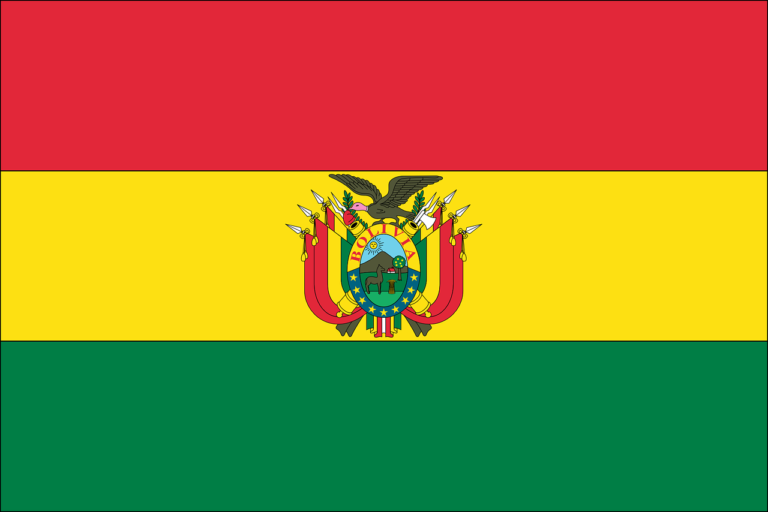
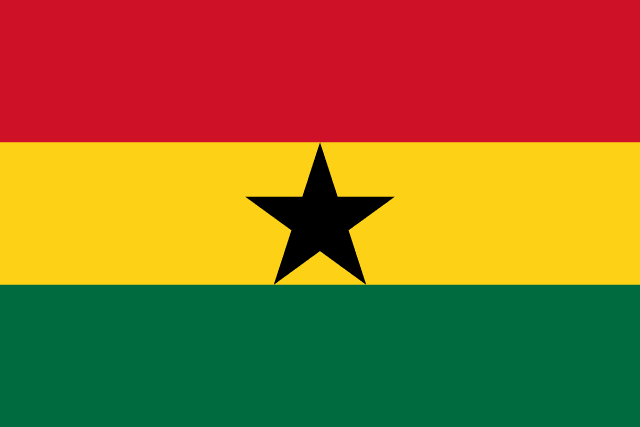
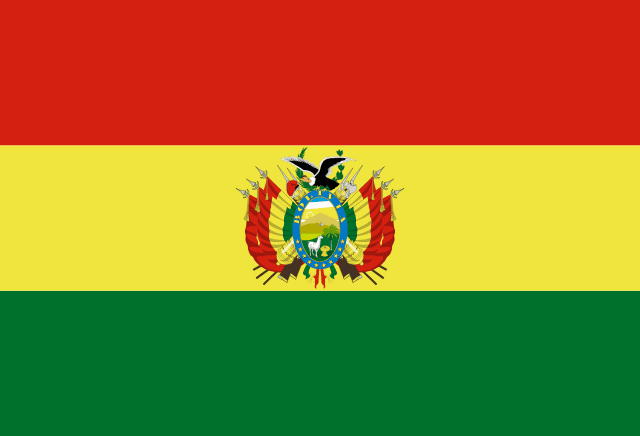
Ghana and Bolivia have a particularly similar background design. Both flags use three horizontal stripes of equal height, with red at the top, yellow or gold in the middle and green at the bottom. If only the far end of either flag is visible, the shared stripe arrangement can make identification difficult. The middle of the rectangle provides the most useful distinguishing feature.
Ghana’s ordinary national flag displays one black five-pointed star in the center of the gold stripe. The plain Bolivian tricolor has no star or other symbol in the yellow field. Bolivia also uses an institutional form carrying its coat of arms. A detailed national emblem on the central stripe is therefore another possibility when looking at a Bolivian flag.
The difference is not that Ghana uses horizontal stripes while Bolivia uses vertical ones. The direction and order of the three fields are the same. Neither is a simple green-yellow-red tricolor in the reverse order when viewed upright. The clearest initial test is to look for a black star, an uninterrupted yellow field or the more elaborate Bolivian arms.
This test works especially well when the possible answers are limited to these two countries. In a broader flag quiz, other national or historic designs may share some of the same colors and devices. The additional comparisons later in this guide explain how to distinguish those possibilities.
The Bolivian flag shown here is the plain tricolor. It is not intended as the only permissible Bolivian flag form. The distinction between plain and institutional versions is essential to understanding the country’s flag legislation.
| Feature | Ghana | Bolivia |
|---|---|---|
| Stripe order | Red, gold, green | Red, yellow, green |
| Middle device | Black five-pointed star | Plain tricolor or coat of arms, depending on use |
| Height:length | 2:3 conventional reference | 15:22 general construction; 2:3 listed institutional sizes |
| Key clue | Single black star | No star or detailed national arms |
Ghana’s Black Star and the three colored fields
The Ghana Permanent Mission to the United Nations credits Theodosia Okoh with designing the flag adopted in 1957. Its account identifies the gold stripe with mineral wealth, the green with forests and natural resources, and the red with the sacrifices associated with independence. It links the Black Star to African emancipation. The symbol is a defining component of the adopted design rather than a separate optional decoration.
Observe the star as a single silhouette. It contains five outward points and sits at the intersection of the flag’s horizontal and vertical midlines. An outline star with a transparent middle would not give the same appearance as the solid black device in the reference. Neither would a collection of five small stars scattered across the central stripe.
The Ghanaian mission also relates the symbol to the Black Star Line, associated with Marcus Garvey, and to the national football team’s familiar nickname. This cultural connection is useful when a learner encounters the name Black Stars on a scoreboard or in a sports article. It does not mean that the football association’s own badge is interchangeable with the national flag.
For visual recognition, distinguish the middle stripe from the star. The gold band extends across the full horizontal width of the flag, while the dark device occupies only its central region. If an icon makes the star difficult to see, seek a larger image before deciding whether the band is plain. The other two stripes are not sufficient to establish the country in this particular comparison.
For an art lesson, first draw the equal horizontal fields and mark their common midpoint. Then inspect a reliable reference of the star. The source consulted for the basic national description does not itself provide a complete numerical construction table for every star vertex. Do not invent a precise legal star diameter or claim that the width of a particular online graphic is a mandatory specification.
Bolivia’s plain and institutional tricolor designs
Bolivia’s Supreme Decree 241 of August 5, 2009 describes three equally sized horizontal stripes in red, yellow and green. The decree also identifies separate contexts for displaying the tricolor. Its provisions on public institutions call for the coat of arms to occupy the middle stripe on both sides of the relevant flag. The armed forces’ version includes further heraldic elements associated with the arms.
As a result, a learner may encounter more than one accurate national-symbol reference when searching for Bolivia’s flag. A plain version is familiar in country-flag charts, while photographs of government institutions may show the emblem-bearing design. The presence of the arms does not automatically indicate an inaccurate illustration. It can identify a different prescribed form of the tricolor.
Look at the scale and complexity of the central image. Ghana’s star is a single black geometric device with a distinct five-pointed outline. Bolivia’s arms contain multiple heraldic and landscape elements, making their overall shape much more detailed. At very small image sizes the arms may appear as a dark or multicolored patch. A larger view is useful before attempting to identify their individual components.
The Bolivian decree recognizes the Wiphala alongside the tricolor. This is another national symbol, with a square grid of colored blocks rather than three broad horizontal stripes. An image of the Wiphala should be identified by its own name and significance. It is not a fourth stripe or a central badge to add casually to the tricolor.
This page compares the tricolor with Ghana’s flag. It links the legal reference for the other Bolivian forms instead of supplying a newly drawn version of the coat of arms. The text and source references allow a reader to distinguish them without treating every national emblem as unrestricted decorative artwork.
Compare the stripe dimensions and outer proportions
The standard Ghanaian reference commonly uses a height-to-length ratio of two to three. The diplomatic description establishes the stripe colors and star, while the specialist flag reference supplies the usual numerical proportion. Bolivia’s 2009 decree requires additional care because it presents both a general construction relationship and specific physical sizes.
Article 8 of the Bolivian decree gives a height of 7.5 construction units and a length of eleven. Multiplying both by two produces a ratio of fifteen to twenty-two. Each stripe is 2.5 units high. Article 9 separately gives dimensions of 300 by 200 centimeters for flying flags and 30 by 20 centimeters for vehicles and desks in the institutional context. Those listed rectangles have a height-to-length ratio of two to three.
The difference between 15:22 and 2:3 is small but real. This guide does not silently replace the decree’s general ratio with its listed physical sizes. Choose the provision appropriate to the object under study. An online Bolivian thumbnail might also use a conventional graphic ratio rather than depict a precisely specified institutional textile.
For a useful comparison exercise, give both rectangles a height of fifteen centimeters. At 2:3, the Ghanaian reference length is 22.5 centimeters. Applying Bolivia’s general construction ratio gives a length of twenty-two centimeters. Each of the three horizontal stripes in both examples is five centimeters high. Their midlines are identical in the vertical direction, but the horizontal midpoint is slightly different.
The Ghanaian star is located at 11.25 centimeters across and 7.5 centimeters down in this example. The midpoint of the general Bolivian construction rectangle is eleven centimeters across and 7.5 centimeters down. A plain Bolivian example has no device at that point; an institutional design has the appropriate arms.
When comparing two online illustrations, preserve the original image proportions. The display containers may be the same size, but their contents should not be stretched to fit. This small difference in aspect ratio is not a practical identification rule at a distance. The central design is much more reliable than measuring a cropped flag icon.
Similar colors, distinct national histories
Ghana’s flag belongs to the country’s independence history. The British colony known as the Gold Coast became independent as Ghana in March 1957, and the new national flag expressed that change. The diplomatic account identifies the red, gold and green as Pan-African colors. The Black Star adds a distinctive expression of African liberation and unity.
The design also has a documented interruption in its use. The Ghanaian diplomatic and specialist sources agree that the familiar flag was restored in 1966, but their descriptions of the preceding period differ in detail. Flags of the World dates the white-centered replacement to 1964–1966. The mission’s short account gives an earlier end date for the first period of the red-gold-green design. For this reason, identify the source and date of a historical Ghanaian flag rather than derive an exact timeline from the short diplomatic summary alone.
Bolivia’s tricolor developed in a different South American setting. Its red, yellow and green flag tradition is associated with the nineteenth-century republic, rather than twentieth-century African independence movements. The 2009 decree gives current descriptions of the tricolor and other symbols of the Plurinational State. A modern codification should not be confused with the original adoption of the historic color arrangement.
The decree’s account of the colors includes historic sacrifice, mineral resources, nature and hope. Ghana’s official explanation also includes sacrifice, resources and natural wealth. These similar broad themes help explain why the two color palettes can be meaningful in different national settings. They do not establish that one country’s flag was copied from the other.
For a school report, make two separate timelines and place the documented Ghanaian adoption and restoration dates alongside the Bolivian legal reference. Record the specific event represented by each date. This prevents the date of a recent legal instrument from being incorrectly presented as the first appearance of the country’s flag.
Identify the flags when a photo is incomplete
When the two complete flags are displayed side by side, the central stripe usually resolves the comparison immediately. Real photographs are less straightforward. Wind can fold fabric so that a star disappears behind another part of the same flag. A picture of the fly end of a Ghanaian flag can resemble the plain Bolivian tricolor even when the original flag is perfectly accurate.
Before using the absence of a star as evidence, check whether the whole middle area is visible. If a photograph shows only the outer portion of the field, the missing central device may be concealed rather than absent. Ask for a fuller image or inspect a second photograph from another angle.
The coat of arms on an institutional Bolivian flag may likewise be partly hidden by folds. Do not identify a single dark fragment as Ghana’s Black Star without checking its actual outline. A star has a regular arrangement of pointed tips, whereas a detailed coat of arms has many irregular features. A good photograph should make it possible to distinguish the overall silhouette even if the small heraldic details remain unreadable.
The reverse view of an ordinary horizontal tricolor keeps the same stripe order when held upright. A vertically hung flag or a photograph rotated by an image editor can change the apparent direction of the bands. Identify the original orientation and boundaries before applying the stripe sequence rule.
Color reproduction also has limitations. Ghana’s official description uses the word gold and Bolivia’s describes the middle field as yellow. Those words are not reliable evidence of a visible difference between two particular textile samples. The same underlying hue can appear warmer or cooler in different light. A person with color-vision differences can instead use the presence and outline of the central device.
In sports coverage the country labels GHA and BOL are useful supporting clues where the icon is too small. Check the event’s own abbreviation convention. The label is independent information, not part of the flag design, and can settle a case where the visible artwork alone remains ambiguous.
Other red-yellow-green designs worth learning
The shared colors are not unique to Ghana and Bolivia. Guinea uses red, yellow and green in three vertical bands. Its flag is distinguishable from both horizontal tricolors before examining a central emblem. Mali also uses vertical bands, but in a different order. The direction of the stripes is therefore an effective first sorting question.
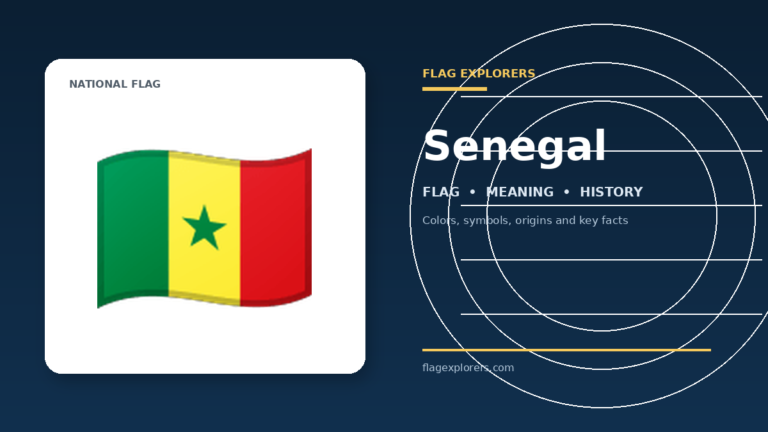
Senegal combines a vertical green-yellow-red tricolor with a green star in its middle yellow field. It provides a useful contrast to Ghana: both flags contain a star in a yellow or gold central area, but their stripe directions and star colors differ. Do not identify either flag solely because a star appears against yellow.
Cameroon’s flag also uses vertical green-red-yellow bands and a yellow star in the middle red field. A comparison exercise should identify the order of the background colors and which field contains the device. Merely counting the three colors and one star is insufficient to distinguish several African designs.
Ethiopia uses a horizontal green-yellow-red arrangement, with a central emblem in the ordinary modern national flag. Its top and bottom colors are in the opposite order from the Ghanaian and Bolivian examples. Historic Ethiopian flag forms may lack the modern emblem, so use a correctly dated reference when studying their history.
A useful way to sort the expanded set is to ask four questions: are the bands horizontal or vertical, which color is at the top or hoist, does a device appear in the central field, and what shape and color does that device have? This method remains useful when the reference set grows beyond the original pair. It also provides a structured explanation of why two flags may seem similar without being identical.
Practice with a comparison worksheet
Prepare two blank rectangles of equal height, using the source proportions selected for your exercise. Divide each height by three and mark the horizontal band boundaries. Color the fields in the shared red, yellow and green sequence. At this stage the basic study resembles Bolivia’s plain tricolor, but it does not yet contain Ghana’s defining star.
Next consult the complete Ghanaian reference and identify its central star. If you are making a private educational sketch, compare the position and outline against the source. Keep the label and construction notes outside the field. For a study of the Bolivian institutional design, examine the legal reference instead of creating an invented substitute coat of arms.
A second task uses a twenty-two-centimeter length and the Bolivian general construction ratio. The height is fifteen centimeters and each stripe is five centimeters. Compare it with a Ghanaian rectangle of the same length under the usual 2:3 ratio, whose height is approximately 14.67 centimeters. Each band in the latter example measures about 4.89 centimeters. This exercise demonstrates that equal length does not always imply equal height.
Finally make three verbal clues: a plain red-yellow-green horizontal tricolor, the same stripe sequence with a black central star, and a tricolor carrying the Bolivian national arms. Match each clue to its correct reference and explain the difference between a national design and a variant used in particular official circumstances.
Flagpedia identifies its supplied flag artwork as public domain. That statement concerns the graphic files and should not be interpreted as authorization to use government insignia as trademarks or to imply official sponsorship. Respect national-symbol rules and keep educational references accurate and clearly identified.
Frequently asked questions
Which flag has the black star? Ghana’s national flag has a single black five-pointed star in the middle of its gold stripe.
Does Bolivia have a flag without a coat of arms? Yes. The plain tricolor is a familiar national flag form; the decree also provides for arms-bearing versions in specified institutional contexts.
Are the stripe colors in the same order? Yes. Both run red, yellow or gold, and green from top to bottom.
Are their proportions exactly the same? Not in every specified form. Ghana’s ordinary reference is 2:3. Bolivia’s decree gives 15:22 as a general construction ratio and separately lists 2:3 physical sizes.
What is the Wiphala? It is a separate square, multicolored symbol recognized by Bolivia, not a variation of Ghana’s three-stripe design.
Can the two flags be identified from their far ends alone? Not always. If the center is concealed, both can show the same visible stripe arrangement. Seek a full view or a reliable label.
Does the shared palette establish a common design origin? No. The flags belong to separate historical traditions, and their similarities do not establish a direct relationship.
Sources and artwork
- Ghana Permanent Mission to the United Nations — flag design, designer and symbolism
- Ghana Embassy to the Holy See — national flag
- Flags of the World — Ghana flag history and proportions
- Bolivia Supreme Decree 241 of August 5, 2009 — reproduced text, Articles 5–12
- Infoleyes — parallel legal reference for Decree 241
- Flagpedia — artwork terms
Complete flag artwork supplied by Flagpedia / FlagCDN under its stated public-domain terms. Bolivia’s official arms-bearing forms are described in the linked decree. Separate national-symbol and display regulations may apply.