Turkey vs Tunisia Flag: Crescent, Star and White Circle
Compare the white crescent and star of Turkey with the red crescent and star inside Tunisia’s white disc.
White crescent and star directly on red.
Official flag reference →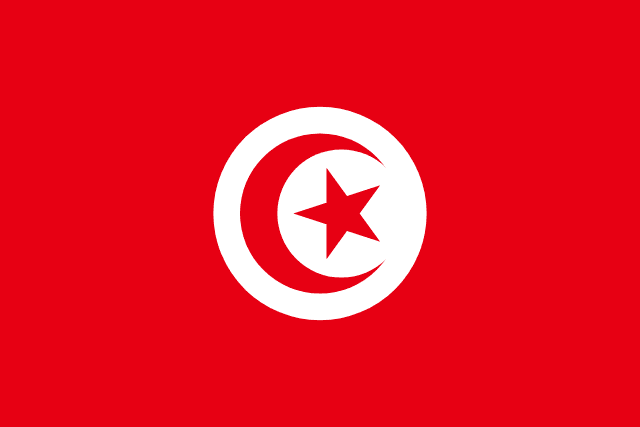
Look for the white disc first
Turkey and Tunisia use red national flags featuring a crescent and a five-pointed star. In a geography quiz, the easiest way to distinguish them is to inspect the field surrounding the crescent. Turkey, officially also known as Türkiye, places a white crescent and star directly on its red background. Tunisia places both a red crescent and a red star inside a centered white disc. The white circle is a defining element of the Tunisian flag, not an optional background for a crescent illustration.
The positions of the devices also differ. In the Turkish design, the crescent sits toward the hoist, the side attached to the pole, and the star is located toward the open side of that crescent. In the Tunisian design, the entire white disc occupies the middle of the rectangle, and the smaller red components are organized within it. Inspecting the full outline makes this relationship especially clear.
The ordinary national flag proportions are two to three in both examples. Consequently, a correctly sized rectangle does not settle the identification on its own. The existence of the disc and the reversal of the crescent and star colors are the strongest first clues. A viewer who has learned those structural features does not need to memorize the particular red shade of every flag illustration.
The comparison concerns the standard national designs. Presidential standards, historic banners and other symbols can include additional details. When identifying an unfamiliar photograph, determine which form of the flag is actually being shown rather than assuming that every red crescent-and-star banner must be one of these two national flags.
| Feature | Turkey | Tunisia |
|---|---|---|
| White disc | No | Centered |
| Crescent and star | White | Red |
| Height:length | 2:3 | 2:3 |
| Star reference diameter at 20 cm hoist | 5 cm | 4.5 cm |
Understand Turkey’s white crescent and star
Article 3 of the Turkish Constitution and the Presidency’s flag reference identify the national design as a red field carrying a white crescent and star. Law No. 2893, adopted on September 22, 1983, provides the legal basis for its construction and use. The appended construction diagram is important because a verbal description alone cannot establish every measurement of the crescent.
A crescent can be understood geometrically as a region between two curved boundaries. In the Turkish construction reference, the outer circle has a diameter equal to half the flag height, and the inner circle has a diameter equal to two fifths of the height. The inner circle is displaced toward the fly. The overlap of the circles produces the familiar open shape, with two tips facing toward the right in an ordinary front-view reference.
For a classroom example using a field height of twenty centimeters, the outer construction circle measures ten centimeters across, while the inner one measures eight. Their centers are not the same. If they were concentric, the shape would be a ring rather than the specified crescent. The outer center is ten centimeters from the hoist and at mid-height, and the offset of the inner center follows the construction reference.
The white star is a separate five-pointed device on the open side of the crescent. Its circumscribed reference circle measures one quarter of the field height, or five centimeters in the example. It is not placed in a surrounding white disc. The blank red space between the two white shapes is an important feature to observe.
To construct an exact official illustration, use the authoritative diagram and applicable production standards. The geometric relationships in this section help compare the two flags, but they do not replace the complete technical sheet or establish a particular fabric specification. A learner can calculate the construction circles and inspect their positions without claiming that a rough pencil sketch is an authorized production model.
Read Tunisia’s disc, crescent and star
Tunisia’s 2022 constitution describes the red flag with its white center and two red devices. The detailed proportions appear in Organic Law 99-56 of June 30, 1999, published in the official gazette on July 6. This earlier design law supplies the measurements that make the flag particularly interesting for a geometry lesson.
The white disc has a diameter equal to one third of the flag length. Its center lies at the intersection of the diagonals. For a thirty-centimeter-long flag, the disc measures ten centimeters across. On a twenty-centimeter-high rectangle, that is exactly half the height. The red shapes within the disc are smaller than its outer boundary.
The center of the star lies on the same horizontal midline but is displaced toward the fly by one thirtieth of the flag length. At the thirty-centimeter scale, the displacement is one centimeter. The circle passing through the outer tips of the star has a diameter equal to fifteen percent of the length, or 4.5 centimeters in this example. One point faces toward the hoist along the horizontal midline.
The red crescent is formed using two arcs. Their reference diameters are one quarter and one fifth of the flag length. The outer arc is centered at the center of the white disc; the inner arc is centered at the star’s location. At the selected scale, their diameters are 7.5 and six centimeters. The arrangement is a precise relationship between the disc, the offset star and the curved shape.
The whole circle should remain clearly visible in an educational reference. Do not treat it as a crop mask around a Turkish crescent or use the Turkish flag’s construction parameters to draw the Tunisian shapes. Both the colors and the geometric references differ. The original law’s technical annex and authoritative artwork should be consulted for any details required beyond these measurements.
Compare the geometry at a common height
Draw two blank rectangles twenty centimeters high and thirty centimeters long. Both have the same outer midpoint at fifteen centimeters from the left and ten centimeters from the top. This gives an equal-size basis for comparing the design features. It also removes the distraction caused by viewing one national flag at a larger size than the other.
On the Tunisian reference, the white disc is ten centimeters across and centered on the entire flag. Its horizontal extent is from ten to twenty centimeters across the field. Its upper and lower edges are five and fifteen centimeters down. These calculated positions describe the outer disc, rather than the exact limits of the red crescent or star. The red star center is at sixteen centimeters across and ten down.
The Turkish reference does not have an outer disc at the field center. Its ten-centimeter outer crescent construction circle has its center ten centimeters from the hoist. Although the diameter is equal to the Tunisian white disc in this worked example, the two circles represent different things. In Turkey, the construction circle contributes to the crescent geometry. In Tunisia, the full disc appears visibly on the flag. This distinction prevents an apparent numerical similarity from becoming a misleading visual explanation.
A second comparison concerns the stars. The Turkish reference circle has a diameter of five centimeters, while the Tunisian reference circle measures 4.5 centimeters. These dimensions are close, but the Turkish star is white on red, and the Tunisian star is red on white. The Tunisian star is also contained within a larger circular area. The geometric context matters more than the small difference in nominal star size.
For a half-scale study, divide each linear measurement by two. The rectangles become ten by fifteen centimeters, the Tunisian disc measures five centimeters, and the star offset becomes half a centimeter. The Turkish reference circles and star scale by the same factor. If the images are stretched into squares, these relationships will no longer be preserved.
How the two designs developed
The red crescent-and-star motif has a long history in the region. Historical flag specialists associate the modern Turkish form with Ottoman-era banners, including the five-pointed star design used in the nineteenth century. The republic retained the familiar motif, with later legislation establishing detailed specifications. The 1936 flag law preceded the 1983 law. These dates are different stages in the regulation of the design rather than the first appearance of every symbol.
Tunisian flag history likewise predates the modern republic. Tunis Afrique Presse’s historical reporting connects the national flag with earlier Tunisian maritime and political traditions and the period of Ottoman influence. The red field and crescent-and-star vocabulary reflect that wider setting, while the distinctive white circular field establishes a separate national arrangement.
The Tunisian flag was described in the constitution adopted in 1959, and the 1999 organic law gave the more detailed measurements. The 2022 constitutional text retains the broad description. This sequence is useful because it distinguishes the existence of a recognized flag from the later adoption of a precise written technical specification.
Historical accounts of crescents and stars sometimes contain legends about their origin. A legend can be important to a community’s cultural memory, but it should not be presented as proof of a particular construction decision unless documentary evidence supports it. The flag laws establish the present geometry more directly than a popular story about the first use of a crescent.
For an educational timeline, identify the dates of the national designs, earlier historical references and later flag legislation separately. The fact that the flags share visual elements does not mean that either is an interchangeable representation of the other country. Their separate national histories are as significant as their resemblance.
Recognize both flags in photographs and sports icons
When the complete flags are visible, the white disc makes the distinction straightforward. In photographs of flags flying outdoors, the fabric may fold through the middle. Part of Tunisia’s white circle may disappear behind another part of the flag. The Turkish crescent may appear as an irregular white patch, particularly at a distance.
Look for a curved white area enclosing red details. If the visible part of the Tunisian design contains a clear red star against white, this provides a useful clue even if the complete disc boundary is hidden. For the Turkish design, look for a white star against the uninterrupted red field. If neither relationship can be established from the photograph, seek a fuller view.
A reverse view changes the apparent direction of the crescent opening and star placement. The normal hoist side may appear on the right of the picture rather than the left. Do not reject a genuine flag simply because its crescent appears to open in the opposite direction when viewed from behind. The distinction between the white disc and the direct red background remains useful.
Sports websites frequently crop national flags into circles or other uniform icon shapes. An interface’s outer circular frame must not be confused with Tunisia’s internal white disc. Look at the colors and symbols inside the actual flag, and read the country label when the image is too small to inspect accurately. The common sports abbreviations TUR and TUN are useful additional evidence when used by the relevant organization.
A written description should include the color of the crescent and the presence or absence of the white disc. Describing both designs simply as red flags with stars and crescents does not give enough information for reliable identification. The more precise description also helps readers who cannot rely on subtle color differences.
Other crescent-and-star flags and protected emblems
The crescent-and-star motif appears in several other national flags. Algeria has a green-and-white divided field with a red crescent and star. Pakistan has a white crescent and star on a green field with a white vertical band. Singapore combines a white crescent with a group of stars in a red upper band over a white lower band. These examples illustrate why the presence of a crescent alone cannot identify a country.
When building a study set, classify the flags by their overall backgrounds first. A plain red rectangle, a red rectangle with a white disc, and a vertically divided field are different structures. Then identify the color of the crescent and the number or placement of the stars. This order reduces confusion when more possible answers are introduced.
Do not confuse the national designs with the protected Red Crescent emblem used in humanitarian contexts. An isolated red crescent on white can have a specific legally protected function. The complete Tunisian flag is a national symbol with additional features. Retain the full flag and country caption when studying it, rather than extracting an isolated symbol to serve as a medical or humanitarian logo.
Flagpedia describes its supplied national flag images as public-domain artwork. Separate national-symbol use rules and protections for humanitarian emblems may still apply. The educational purpose of a comparison does not establish permission to use national insignia for branding, advertising or official authentication.
The source section links to Turkey’s flag law and the Tunisian design legislation. These are more reliable starting points for formal reproduction than a generic stock illustration. This article’s diagrams and numerical examples explain identification and proportional relationships, not a comprehensive legal determination of every possible use.
A practical comparison activity
Prepare two reference cards using the complete flags and conceal their captions. Ask a learner to describe the colors of the two crescents, the positions of the stars and the presence of a disc before naming each country. If the learner answers only that both flags are red, ask for the specific internal structure.
Next, draw two identical blank rectangles and mark their center points. On the Tunisian worksheet, calculate and mark the outline of the central disc. On the Turkish worksheet, record the location of the outer crescent construction circle. Explain why these two circles serve different purposes even though their diameters are the same in the chosen example. Use the official diagrams to confirm the actual arrangement.
For a numerical challenge, set both flags to a length of forty-five centimeters. Their height is thirty centimeters. The Tunisian disc is fifteen centimeters across and the star center is offset by 1.5 centimeters. Its star reference circle measures 6.75 centimeters. The Turkish outer crescent circle measures fifteen centimeters, and its star reference circle measures 7.5 centimeters. Students should be able to explain which measurements use field length and which use field height.
Finally, introduce Algeria and Pakistan into the recognition exercise. Ask the learner to distinguish the background arrangement, crescent color and star placement in each example. This turns the two-choice task into a reusable identification method. Record any uncertain answers and explain what additional evidence would resolve them, rather than guessing when part of an image is concealed.
Frequently asked questions
Which flag has the white circle? Tunisia. The circle contains a red crescent and a red five-pointed star.
Which flag has a white crescent and star directly on red? Turkey. There is no separate white disc around the two devices.
Are their flags the same proportion? Yes, both ordinary national designs have a two-to-three height-to-length relationship.
Is the Tunisian star at the exact center of the entire flag? No. The white disc is centered, but the star center is displaced toward the fly by one thirtieth of the flag length.
Can I tell the flags apart if the crescent is hidden? If the star and its surrounding field are clearly visible, the white-on-red versus red-on-white relationship is useful. Otherwise a complete view or country label may be needed.
Do the shared symbols mean that the flags are interchangeable? No. They identify different nations with distinct histories and legal specifications.
Where can I check the exact proportions? Use Turkey’s flag law and construction reference and Tunisia’s Organic Law 99-56, linked below. Consult the complete technical references for reproduction requirements.
Sources and artwork
- Presidency of Türkiye — national flag
- Turkish Historical Society — Flag Law 2893
- Flags of the World — Turkish construction reference and historical context
- Tunisian Official Gazette, July 6, 1999, p. 1088 — Organic Law 99-56 (French translation)
- Tunisia Constitution 2022, Article 8
- Tunis Afrique Presse — flag anniversary and history
- Flagpedia artwork terms
The Turkish Presidency’s reference is linked rather than newly reproducing the Turkish flag pending further use clarification. Tunisian reference artwork supplied by Flagpedia / FlagCDN under its stated public-domain terms. National-symbol and humanitarian-emblem rules remain separate from copyright.