How to Draw the Wyoming Flag: Exact Borders, Bison and Seal Measurements
Measured construction steps, practical examples and accuracy checks.
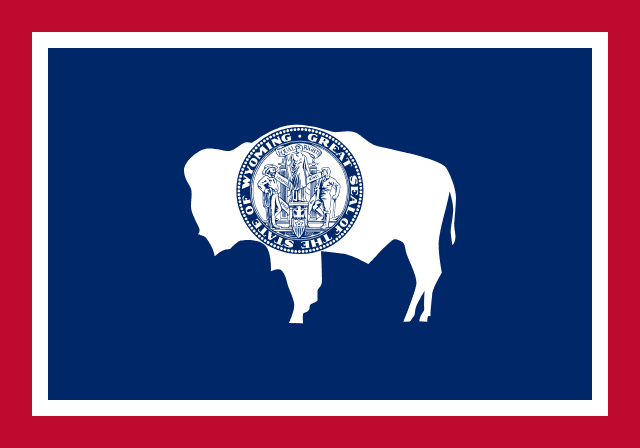
Wyoming’s flag uses a 10:7 length-to-height ratio, a red outer border, a narrower white inner border and a blue field carrying a white bison. Wyoming Statutes §8-3-102 sets the border widths as fractions of the overall length, the bison length as half the blue field’s length and the seal diameter as one-fifth of the flag length. This guide turns those relationships into exact drawing coordinates while referring to the state’s reference for the detailed silhouette and seal.
For the history and symbolism, read our Wyoming flag guide.
Construction measurements
| Length:height | 10:7 |
|---|---|
| Red border thickness | Length ÷ 20 |
| White border thickness | Length ÷ 40 |
| Blue field length | 17/20 of total length |
| Bison silhouette length | Half the blue field length |
| Seal diameter | Length ÷ 5 |
Step 1: Set the outer 10:7 rectangle
Wyoming’s flag is slightly less elongated than the common three-to-two rectangular format. The statute expresses the vertical dimension as seven-tenths of the horizontal length. A length of forty centimeters consequently requires a height of twenty-eight centimeters.
Start with those dimensions for a substantial classroom drawing. Mark the four corners, then measure the diagonals to check that the rectangle is not skewed. Its center lies twenty centimeters from the hoist and fourteen centimeters from the top.
The entire construction is easiest to calculate from the horizontal length. In this tutorial L represents that length, while H represents the height. Wyoming’s law uses width for the shorter dimension, so this distinction avoids a common misunderstanding in digital design applications.
A smaller flag can measure twenty centimeters long by fourteen high. A larger poster can measure eighty centimeters long by fifty-six high. All subsequent border and device measurements follow from the chosen length.
For digital work, use an artboard measuring eight hundred pixels by five hundred sixty pixels. This gives integer coordinates for the major borders and the bison length. A copy at twice that scale measures sixteen hundred by eleven hundred twenty pixels.
Do not force the finished illustration into a three-to-two image frame by stretching it. The border thicknesses are based on length, and stretching would change their apparent relationship along the horizontal and vertical edges. Add neutral surrounding space if a display card needs a different ratio.
Label the pole edge as the hoist in the initial drawing. The standard reference shows the bison facing the hoist. Its detailed outline should be copied from the state reference rather than inferred from the outer rectangle.
Step 2: Measure the red outer border on all four edges
The red border measures one-twentieth of the total horizontal length. For the forty-centimeter drawing, divide forty by twenty to obtain two centimeters. This is the same physical thickness along the top, bottom, hoist and fly.
Mark lines two centimeters inside each edge of the complete rectangle. The upper red area extends from y equals zero to two centimeters; the lower one from twenty-six to twenty-eight. The left and right portions use the same two-centimeter inset.
The area inside this first border measures thirty-six centimeters horizontally and twenty-four centimeters vertically. Calculate those dimensions by subtracting the border thickness twice from each outer dimension.
Do not calculate the top border as one-twentieth of the height. The statute bases the thickness on the flag’s length. If you used the twenty-eight-centimeter height instead, the border would be only 1.4 centimeters thick in the example.
In vector artwork, create a red rectangle covering the entire artboard, then overlay the next white rectangle with its edges inset by the calculated thickness. This produces a uniform border without needing four separately aligned strips.
At eight hundred by five hundred sixty pixels, the red thickness is forty pixels. The white rectangle begins at x equals 40 and y equals 40, and measures seven hundred twenty pixels long and four hundred eighty pixels high.
A paper drawing can use a red base with a white sheet placed above it. Cut the white rectangle carefully and center it so the visible red border has equal thickness on every side. Measure both top and side margins before proceeding.
The four red corner regions are part of the continuous outer border. They should not be removed or replaced by white corner squares. A simple nested-rectangle construction is particularly effective for this flag because all the required margins remain visible.
Step 3: Add the white inner stripe and calculate the blue field
The white stripe immediately inside the red border is one-fortieth of the total flag length. In the forty-centimeter example, it is one centimeter thick. It is exactly half the thickness of the red border.
Measure another one centimeter inward from the inner edge of the red border on all four sides. The blue field begins three centimeters from each outer edge. Its horizontal dimension is forty minus six, or thirty-four centimeters. Its vertical dimension is twenty-eight minus six, or twenty-two centimeters.
The combined inset is therefore three-fortieths of the total length. Subtracting it twice from the horizontal length leaves seventeen-twentieths of the original length. Subtracting it twice from the height leaves eleven-twentieths of the original length.
These fractions make it possible to calculate the complete field directly without drawing the intermediate border first. At a total length of eighty centimeters, the blue region is sixty-eight centimeters long and forty-four centimeters high. The red and white borders are four and two centimeters thick respectively.
On the eight-hundred-pixel artboard, the white border thickness is twenty pixels. The blue rectangle begins at (60,60), extends to (740,500) and measures 680 by 440 pixels.
The red and white borders must surround the entire blue field, including all four corners. A white stripe on only the hoist and fly would not follow the statute. A gap between the borders would introduce an extra color region.
If using a stroke tool rather than nested rectangles, check whether strokes are aligned inside, outside or centered on their paths. A centered stroke may extend into a neighboring region and produce a different final width. Filled rectangles make the required insets easier to control.
Once the blue field is complete, measure the red and white thicknesses along both a horizontal and a vertical edge. The red border should always be twice the white one. This provides an independent check on the construction before adding the bison.
Step 4: Size and transfer the white bison silhouette
The statute gives the bison’s overall length as half of the horizontal length of the blue field. For the forty-centimeter drawing, the blue rectangle is thirty-four centimeters wide, so the silhouette must measure seventeen centimeters from its leftmost to rightmost points.
The field itself shares the center of the full flag because the borders are symmetrical. Position the bison’s silhouette in the center according to the state reference. If its horizontal bounding rectangle is centered, the seventeen-centimeter example extends from 11.5 to 28.5 centimeters from the hoist.
The animal’s height and detailed proportions follow its established silhouette. The law does not give a separate numeric height in the cited text. Use the official reference image to establish the relationship between the hump, head, legs and hindquarters.
A bison is not interchangeable with a generic domestic cow or a water buffalo. Study the prominent shoulder hump and the heavy head and forequarters in the state artwork. Reproducing a photographic animal in full color would also be different from the prescribed white silhouette.
Begin with a light bounding rectangle at the measured length. Transfer the outline using a grid or by scaling a verified vector reference uniformly. Avoid altering only the legs or head to make the figure fit. All the silhouette details must remain proportional.
At eight hundred pixels of total flag length, the blue field is 680 pixels long and the bison is 340 pixels long. A horizontally centered bounding rectangle extends from x equals 230 to x equals 570. Use the reference to determine its vertical extent.
For a classroom drawing, transfer a simplified outline that preserves the animal’s recognizable posture. If the outline is approximate, call it a classroom sketch rather than a production-ready reproduction.
Leave the animal white, with the blue seal to be added on its body. The bison should not receive a separate black border or colored details beyond the established reference design.
Step 5: Understand the circular seal dimension and its placement
The Wyoming state seal appears in blue on the ribs of the white bison. The statute specifies its diameter as one-fifth of the entire flag length. At forty centimeters across, the seal’s diameter is eight centimeters.
This measurement is independent of the blue field length. If the artist takes one-fifth of the thirty-four-centimeter field instead, the diameter would be only 6.8 centimeters. That would not match the stated relationship.
The seal is placed on the animal’s body, not at the geometric center of the entire flag regardless of the silhouette. Examine the state reference to locate its center on the ribs. The law names the anatomical location but does not supply a separate coordinate pair for the center in its text.
For a digital flag eight hundred pixels long, the specified diameter is 160 pixels. Compare that dimension with the 340-pixel bison length. The seal occupies a substantial portion of the animal’s body, so it is important to preserve its placement and scale.
The detailed seal contains figures, lettering and other historical devices described separately by state law. Use the state government reference for those elements rather than inventing a generic circular state emblem. Do not substitute the state name alone or draw a blank blue circle as if it were the finished seal.
The Wyoming government’s explanation relates the seal’s placement to the historical practice of branding livestock. It is part of the state’s flag design rather than a decoration added to an otherwise complete bison flag.
For a drawing practice worksheet, a temporary circle can mark the specified diameter while the detailed artwork is studied separately. A worksheet with that circle left blank should be labeled incomplete, not displayed as the official flag.
Wyoming’s law describes citizens’ use of its flag. The standalone great seal represents official state authority and should not be used to suggest endorsement, authentication or government affiliation. Use the complete flag reference in its educational context and consult appropriate rules for formal or commercial reproduction.
Worked measurements for three flag sizes
For a twenty-centimeter-long classroom drawing, the height is fourteen centimeters. The red border is one centimeter thick and the white border half a centimeter. The blue rectangle is seventeen centimeters long by eleven centimeters high. The bison length is 8.5 centimeters and the seal diameter four centimeters.
For a forty-centimeter-long drawing, the height is twenty-eight centimeters. The borders are two centimeters and one centimeter respectively. The blue field measures thirty-four by twenty-two centimeters. The bison length is seventeen centimeters and the seal diameter eight.
For an eighty-centimeter-long poster, the height is fifty-six centimeters. The red and white margins are four and two centimeters. The blue field measures sixty-eight by forty-four centimeters. The bison is thirty-four centimeters long and the seal diameter is sixteen centimeters.
At eight hundred pixels long, the outer height is 560 pixels. The red margin is forty pixels, the white margin twenty and the blue rectangle 680 by 440. The bison length is 340 pixels, and the seal diameter is 160 pixels.
These examples use a single scale factor from the total length. They can be checked by comparing the ratios of corresponding measurements: the blue field should always be 85 percent of the total length, the bison 42.5 percent of that total length and the seal 20 percent.
A useful area exercise focuses on the underlying rectangular fields before the bison and seal are added. In the forty-by-twenty-eight centimeter example, the full area is 1,120 square centimeters. The red area is 1,120 minus 864, or 256 square centimeters. The white border is 864 minus 748, or 116 square centimeters.
The initial blue field occupies 748 square centimeters. Adding the white bison and blue seal changes the final visible color areas, so these calculated areas refer only to the nested rectangular base. This distinction prevents confusing the geometry of the border with the visual color proportions of the complete flag.
Colors, layers and ceremonial accessories
The law connects Wyoming’s red, white and blue with the colors used for the United States flag. For a school drawing, a strong red, clear white and dark blue provide the appropriate visual contrast. Formal color matching requires the relevant current production references.
In an editable file, the natural layer order is a red outer rectangle, a white inset rectangle, a blue inner rectangle, the white bison silhouette and its blue seal. The nested base should remain separate from the detailed artwork while checking measurements.
Keep the bison and seal grouped when moving or resizing the animal. Their relative dimensions and placement are a defining feature of the flag. Scaling the seal by itself to make small lettering readable would change the statutory diameter.
The law also describes a gold cord and tassels attached to the flag. These are physical presentation accessories rather than colors added to the flat rectangular field. They should not be counted as part of the ten-to-seven fabric proportions in an ordinary digital flag image.
A classroom picture of a ceremonial flag can show a pole, gold cord and tassels separately. Label these accessories so learners can distinguish the measured cloth design from the complete mounted object.
Use a clean export for the flag artwork and a separate annotated version for teaching. The latter can include measurement arrows around the rectangle and a guide to the seal diameter. The clean flag should not contain those labels or temporary outlines.
Final checks and a measurement challenge
First verify the outer ratio. The height must be seven-tenths of the length. Then measure the red and white border thicknesses: one-twentieth and one-fortieth of that same length. The red band should be twice as wide as the white.
Check the blue field’s size independently. It should measure seventeen-twentieths of the total horizontal length and eleven-twentieths of that length vertically. All four sides must be framed by the white stripe and red border.
Inspect the white bison and compare its outline with the state reference. Its length should equal half the blue field length. The blue seal belongs on its body and has a diameter of one-fifth of the full flag length.
For a classroom challenge, give learners a flag length of sixty centimeters. Ask them to derive a height of forty-two centimeters, red border of three centimeters, white border of one and a half centimeters, blue field of fifty-one by thirty-three centimeters, bison length of 25.5 centimeters and seal diameter of twelve centimeters.
Have them explain why using the shorter dimension as the base for each fraction would produce an incorrect result. This is one of the most important distinctions in the Wyoming construction.
The existing Wyoming history guide discusses the designer, the bison and the state’s symbols. The measured drawing above adds a practical construction method without replacing that historical reference.
Frequently asked questions
What is the Wyoming flag ratio?
Ten units long by seven high.
How wide is the red border?
One-twentieth of the flag length.
How wide is the white border?
One-fortieth of the flag length.
How large is the seal?
Its diameter is one-fifth of the complete horizontal flag length.
Sources and artwork
Wyoming Statutes §8-3-102, flag construction
Wyoming Secretary of State: state symbols and flag reference
State of Wyoming: flag symbolism
Flagpedia/FlagCDN reference artwork, attachment 2142; use of the flag is addressed in W.S. §8-3-102. Original educational calculations; reviewed November 2026.