Mali vs Senegal Flag: The Green Star and the Mali Federation Connection
Side-by-side identification, documented history and practical measured comparison.
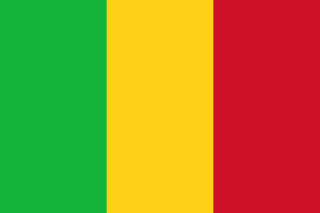
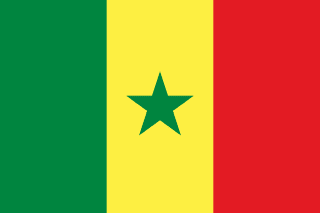
Mali and Senegal both use equal vertical green, gold and red bands, in that order from the hoist. Senegal adds a green five-pointed star in the middle of the gold band; Mali has no central emblem. Their resemblance reflects a shared history in the short-lived Mali Federation of 1959–1960. The current flags are distinct national symbols, and the green star is the most dependable way to identify them.
Comparison at a glance
| Feature | Mali | Senegal |
|---|---|---|
| Hoist band | Green | Green |
| Middle band | Gold | Gold |
| Fly band | Red | Red |
| Stripe width | Equal thirds | Equal thirds |
| Central emblem | None | Green five-pointed star |
| Reference ratio, height:length | 2:3 | 2:3 |
Look for the green star first
Put the two flags side by side in their standard front-facing orientation. The color next to the pole is green in both. The central stripe is gold, often rendered as yellow in digital illustrations. The remaining outer stripe is red. The two vertical boundaries occur at the same relative positions in each design.
The difference sits exactly in the area between those boundaries. Senegal has a single green five-pointed star in the center of the gold stripe. Mali has a completely plain gold stripe. Unlike a subtle difference in color shade, the presence or absence of that shape is a structural feature defined in the respective constitutional descriptions.
Look at the entire middle stripe before deciding that the star is absent. A piece of folded fabric can hide the center while leaving both outer colors visible. An image cropped to the upper or lower part of the gold stripe will not necessarily include Senegal’s star.
In a very small icon, the green star may appear as a tiny spot. Zoom in and check whether the mark is centered, green and star-shaped. A manufacturer’s watermark, dirt on a fabric flag or a nearby object in a photograph should not be confused with an official emblem.
If the central region is clear and completely plain, the standard green-gold-red vertical flag corresponds to Mali. If it contains the green star, the Senegalese identification is supported. If the middle is obscured, report the identification as unresolved rather than treating missing visual information as proof of absence.
The flags are not made more distinct by changing their stripe order. In both, green is the hoist color. A flag with red beside the pole and green at the fly belongs to a different arrangement that is also used in West Africa.
Measure the common tricolor base
The constitutional descriptions of both flags establish three equal vertical bands. For the following educational comparison, use the common two-to-three height-to-length reference ratio. This is a chosen drawing format; the constitutional descriptions of the bands are not by themselves a complete manufacturing specification.
Draw two rectangles thirty centimeters wide and twenty centimeters high. Mark the first vertical division ten centimeters from the hoist, and the second twenty centimeters from it. Each stripe is ten centimeters wide and twenty centimeters high. The underlying area of each stripe is two hundred square centimeters.
Color the left stripe green, the middle stripe gold and the right stripe red on both rectangles. At this stage they are identical in layout. The Malian reference is complete, whereas the Senegalese reference still requires its central star.
On the Senegal drawing, the center of the gold band lies fifteen centimeters from the hoist and ten centimeters below the upper edge. It is also the center of the whole rectangle because the three bands have equal width and span the entire height.
A digital version can begin at nine hundred by six hundred pixels. The vertical boundaries are at x equals 300 and x equals 600. The central star belongs around x equals 450 and y equals 300. The geometry of the flag base is straightforward to reproduce with filled rectangular shapes.
The Senegalese constitutional definition does not give a complete numerical vertex table for the star. Use the verified reference to determine its exact size and orientation. A made-up diameter described as a constitutional requirement would be misleading.
If a teaching exercise requires a simplified star, draw it in the central stripe and label the result an educational sketch. For a formal reproduction, consult the relevant official artwork and any applicable technical standards. The distinction between a calculated stripe boundary and a reference-transferred star contour matters.
How to reproduce and recognize Senegal’s star
The star is green, the same broad color category as the hoist band, and has five outer points. It is centered in the gold stripe. The design does not contain a black figure, a coat of arms or an extra circular border.
Begin by locating the center of the central band. A regular five-pointed star may be constructed using a temporary circle and five equally spaced outer vertices. Mark the vertices at seventy-two-degree intervals, connect every second vertex and trace the resulting silhouette. Compare its orientation and dimensions with the Senegalese flag reference.
For a paper activity, reserve the star shape before coloring the gold band if you are using markers. The green star should remain a clean shape on a solid gold background. Avoid adding a white outline or making it appear inside a separate green rectangle.
In vector software, use a closed green star path above the three background bands. Keep it on its own layer so that it can be scaled and checked without affecting the stripe widths. The reference image, rather than an arbitrary default icon, should determine its final placement and size.
The star can also be used as an independent identifier in photographs. If the outer bands are hidden but a green star on gold is visible, Senegal is a strong candidate. Nevertheless, other flags or emblems may contain a green star, so the wider stripe arrangement should be confirmed where possible.
Do not add a star to Mali simply to make its flag more distinctive. The absence of an emblem is an intended feature of the modern Malian flag. The related historical flag of the Mali Federation had a different central figure, which should not be transferred to the current design.
When comparing the images on a map or in a small flag picker, retain the star in the source asset. A label can help users identify it when the detail is too small, but removing it would make the two designs appear identical.
Why the two flags share a documented history
The relationship between the flags goes beyond the widespread use of Pan-African colors. In 1959, Senegal and the Sudanese Republic, the latter developing from the former French Sudan, formed the Mali Federation. Its flag used the same general green-gold-red vertical base with a black central design known as the kanaga.
The federation became independent from France in June 1960. It was short-lived, and Senegal left it in August that year. The two successor states subsequently established their separate national identities and retained related flag colors.
The shared federation is important because it offers a documented reason for the unusually close resemblance of the modern flags. They did not emerge in entirely unrelated parts of the world with an accidental match of all three color positions.
The name Mali Federation refers to a particular twentieth-century political entity. It should not be confused with the medieval Mali Empire, whose historical extent, symbols and political organization were different. A modern reconstruction claimed to represent the medieval empire is not equivalent to the federation’s documented flag.
For a timeline exercise, create three records rather than two: the historical federation, present-day Senegal and present-day Mali. Give each a separately labeled flag description. The federation’s black central figure separates its historical design from both modern flags.
This is also useful when identifying historical photographs. A green-gold-red flag with a black figure in its center might refer to the federation or an early period of independent Mali, depending on the context. Its colors alone do not establish that the photograph shows the current Republic of Mali.
The political history explains why both countries retained the same underlying tricolor after their separation. Their subsequent decisions about the central emblem created the difference that remains visible today.
Mali: the transition to a plain tricolor
After the dissolution of the federation, Mali continued using a design with the central kanaga figure for a period. Specialist flag histories record the removal of that figure in 1961, resulting in the current plain green-gold-red arrangement.
It is important to describe that change accurately without suggesting that the modern flag has lost a star. The historical central device was a black stylized figure. Senegal’s green star developed in the successor design used by Senegal, while Mali adopted the plain tricolor.
The 2023 Malian Constitution describes the national emblem as three equal vertical bands in green, gold and red. This confirms the current design without relying solely on a commercially sold flag or a historical illustration.
The flag’s colors also belong to the wider Pan-African palette. Historical accounts often associate this palette with African independence movements and the influence of Ethiopia’s flag tradition. The individual meanings of each color may be described differently in educational sources, and the legal description itself primarily establishes the arrangement.
A plain tricolor can be especially difficult to identify from a partial view because there are no other symbols to provide a second clue. For Mali, the hoist color and the complete sequence are essential. A reverse view can make the red and green appear exchanged.
In a historical collection, separate pre-independence material, the Mali Federation flag, the early Malian emblem-bearing version and the present plain tricolor. Keep dates attached to the specific objects rather than assuming that all use of green, gold and red identifies the modern state.
The individual Mali flag guide provides additional background. The comparative point here is that the current plain center is deliberate and historically documented, not a missing detail introduced by an illustrator.
Senegal: the green star as a national emblem
Senegal adopted its own green-gold-red design with a green star when it separated from the Mali Federation. Specialist historical references identify the transition from the federation’s black figure to the Senegalese star in 1960.
The Presidency of Senegal describes the flag as three equal vertical bands and a green five-pointed star centered in the gold band. The same essential description appears in Article 1 of the Constitution. Those sources are stronger evidence for the design than a generalized color illustration.
Senegal’s official explanations give cultural and national significance to the colors and star. Their interpretation belongs to Senegal’s history and should not automatically be assigned to Mali’s corresponding color bands.
The green star makes the Senegalese flag distinctive within a family of African tricolors. Its color repeats the first band, rather than introducing a new color to the palette. This visual economy allows the underlying tricolor relationship to remain apparent.
Do not confuse the green star with the gold star used on Cameroon or Ghana’s black star. Those countries have their own flag designs and symbolism. The color, position and surrounding stripe arrangement all matter for recognition.
For a classroom comparison, use the flag’s central star as a starting point for understanding the change from the historical federation to separate national flags. Ask learners to explain what stayed the same and what changed, then connect those visual observations to the chronology.
The star also provides a useful lesson about national identity: a single additional emblem can distinguish flags that otherwise share the same colors and stripe geometry. That is why the Senegalese flag should never be simplified by omitting the star in a modern country collection.
Guinea, Cameroon, Ghana and other related palettes
Guinea uses equal vertical bands of red, yellow and green, with no central emblem. When all flags are shown in the standard front view, Guinea reverses the outer colors of Mali. This makes the hoist orientation particularly important for photographs of the plain tricolors.
If a Malian flag is photographed from its reverse side and the pole is not visible, its apparent left-to-right order may look like Guinea. Check the physical attachment edge, a reliable caption or other evidence before identifying the country.
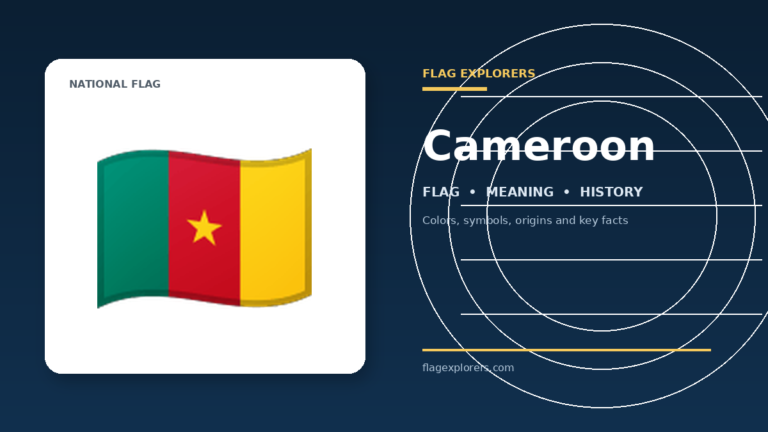
Cameroon has vertical green, red and yellow bands with a gold star in the red center. The middle stripe differs from Senegal’s gold, and its star differs in color. It is not a Senegal flag merely because it has a star within a Pan-African tricolor.
Ghana uses three horizontal bands in red, gold and green, with a black star in the middle. Band orientation distinguishes it from the vertical designs before the star color is considered. Benin also uses these colors, but its green hoist region and two horizontal fly fields form a different geometry.
The Ethiopian flag tradition is historically influential in the broader color family, but Ethiopia’s contemporary flag has horizontal green, yellow and red bands with a blue central emblem. It should not be confused with a plain vertical tricolor.
These examples show why a flag finder needs multiple fields: stripe direction, order, emblem presence, emblem color and shape. A search containing only the words red, yellow and green may produce several plausible results. Each additional structural clue helps narrow the possibilities.
For the specific Mali–Senegal comparison, however, the easiest decisive feature is still the green star in the center of the gold band. If the center is clearly visible, there is no need to compare subtle differences in the exact colors.
A geography and historical evidence activity
Prepare two identical green-gold-red vertical drawings at a common height. Give students a separate green star cutout and ask them to place it on the Senegalese flag. The remaining plain tricolor represents Mali in the standard front view.
Next cover the central portion of both drawings with a small strip of paper. Ask the students whether there is enough evidence to distinguish them now. The answer should be no if their visible parts are identical. This demonstrates the difference between a missing symbol and a symbol known to be absent.
For a history extension, introduce a third labeled illustration of the Mali Federation flag using a documented historical source. Discuss the independence-era transition and identify the different central device. Do not reconstruct it from a generic human silhouette without consulting the historical artwork.
A map exercise can locate Senegal on the Atlantic coast and neighboring Mali inland. The geographic relationship provides useful context for the historical federation but is not a substitute for visual identification.
Finally, compare the flags with Guinea and Cameroon in a wider regional chart. Have learners identify each using direction, stripe order and the central emblem rather than memorizing a list of names. The original national flags should remain labeled and accurately reproduced.
For everyday identification, remember the concise distinction: Mali is plain green-gold-red, while Senegal adds the green star. The historical link explains why the base designs are shared, and the constitutional descriptions explain why the modern emblems must remain distinct.
Frequently asked questions
Which flag has a green star?
Senegal.
Do Mali and Senegal use the same color order?
Yes, green, gold and red from the hoist.
Why are they similar?
Both developed from the flag tradition of the Mali Federation, which existed in 1959–1960.
Can a cropped photo be ambiguous?
Yes. If the middle of the gold stripe is hidden, the two flags may be indistinguishable.
Sources and artwork
Mali Constitution of 2023, national emblem definition (Comparative Constitutions Project)
Presidency of Senegal: flag and motto
Senegal Constitution, Article 1
Flags of the World: Mali flag history
Flags of the World: Senegal flag history
Reference artwork: Flagpedia/FlagCDN, public-domain flag images. Educational comparison, not official endorsement. Reviewed November 2026.