How to Draw the Colorado Flag: Step-by-Step Construction Guide
A dedicated drawing tutorial with proportional measurements, reference artwork, step-by-step instructions and error checks.
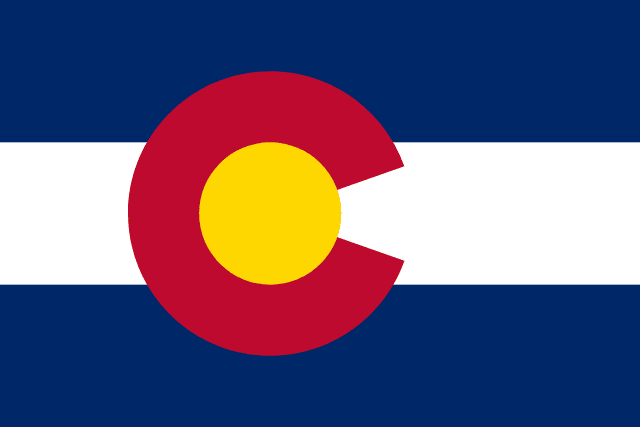
To draw Colorado’s flag, make a three-by-two rectangle, divide it into three equal horizontal bands, color the top and bottom blue and leave the middle white. Add the circular red C toward the hoist and place a golden disk in its center. This tutorial converts the Colorado flag statute into scalable drawing measurements and explains how to reproduce the circular emblem without substituting a printed letter or inventing an official construction detail.
For historical background and symbolism, read our Colorado state flag guide.
Step 1: Draw three equal horizontal stripes
Use a rectangular sheet with a horizontal length of thirty centimeters and a vertical height of twenty centimeters. Colorado’s flag has a height equal to two-thirds of its length, so these dimensions maintain the prescribed relationship. A digital artboard of nine hundred by six hundred pixels also works well.
Mark the top and bottom boundaries of the rectangle. On the left and right edges, divide the height into three equal parts. For the paper example, each band is six and two-thirds centimeters tall. Draw two horizontal guides through corresponding marks.
The upper and lower stripes are blue and the middle stripe is white. Both blue stripes have exactly the same height as the white stripe. Do not make the central white area thinner simply because the red C will overlap it later.
For an accurate rectangle, calculate both division coordinates from the same overall height. If measuring successive rounded values of six and seven-tenths centimeters, small errors may accumulate near the lower edge. A better approach is to mark one-third and two-thirds of the original height separately.
The blue and white bands span the entire horizontal length. The large C is applied above them as a separate emblem, so the stripe guides remain useful even where they will eventually be hidden by the red and gold shapes.
When working digitally, create the white background as the base layer, then add two equal blue rectangles. Their boundaries meet the white central stripe without any gaps. Use exact fractional coordinates in an editable vector file if the chosen artboard height is not divisible by three.
Scaled measurements and worked examples
These examples use the statutory flag height equal to two-thirds of its length. Values in each row use the same units as the canvas.
| Canvas | Each stripe height | C distance from staff end stated in law | Outer C diameter | Vertical centerline |
|---|---|---|---|---|
| 18 × 12 cm | 4 | 3.6 | 8 | 6 |
| 30 × 20 cm | 6.667 | 6 | 13.333 | 10 |
| 45 × 30 cm | 10 | 9 | 20 | 15 |
| 900 × 600 px | 200 | 180 | 400 | 300 |
| 1200 × 800 px | 266.667 | 240 | 533.333 | 400 |
For a 18 × 12 cm canvas, the calculated dimensions are: each stripe height 4 cm; c distance from staff end stated in law 3.6 cm; outer c diameter 8 cm; vertical centerline 6 cm. Use consistent rounding when transferring the measurements to paper.
For a 30 × 20 cm canvas, the calculated dimensions are: each stripe height 6.667 cm; c distance from staff end stated in law 6 cm; outer c diameter 13.333 cm; vertical centerline 10 cm. Use consistent rounding when transferring the measurements to paper.
For a 45 × 30 cm canvas, the calculated dimensions are: each stripe height 10 cm; c distance from staff end stated in law 9 cm; outer c diameter 20 cm; vertical centerline 15 cm. Use consistent rounding when transferring the measurements to paper.
For a 900 × 600 px canvas, the calculated dimensions are: each stripe height 200 px; c distance from staff end stated in law 180 px; outer c diameter 400 px; vertical centerline 300 px. Keep fractional measurements in the vector construction and round only at raster export.
For a 1200 × 800 px canvas, the calculated dimensions are: each stripe height 266.667 px; c distance from staff end stated in law 240 px; outer c diameter 533.333 px; vertical centerline 400 px. Keep fractional measurements in the vector construction and round only at raster export.
Step 2: Locate the circular red C
Colorado’s flag statute gives a distance of one-fifth of the total horizontal length from the staff end for the circular C. For a thirty-centimeter-wide drawing, that distance is six centimeters. The reference artwork helps determine the placement of the C’s outer edge rather than mistakenly treating this distance as the center of the letter.
The letter’s outside diameter is two-thirds of the flag height. For a twenty-centimeter-high drawing this is thirteen and one-third centimeters, with a radius of six and two-thirds centimeters. The C is centered vertically in the standard reference arrangement.
Draw a light vertical guide for the emblem position. In the usual construction interpretation, the leftmost edge of the circular C begins at the one-fifth-length mark. Adding its outer radius gives a circle center about twelve and two-thirds centimeters from the hoist in the thirty-centimeter example. Compare this calculated position with the reference before completing the outline.
The vertical center is ten centimeters from the top. With an outer radius of six and two-thirds centimeters, the circle extends upward to roughly three and one-third centimeters from the top and downward to sixteen and two-thirds centimeters. This means the emblem crosses both stripe divisions while leaving visible blue above and below it.
This position is a central feature of the flag’s design. If you place the C at the exact horizontal center of the rectangle, the distance between the emblem and the fly edge becomes too small relative to the reference. Conversely, a C pushed against the left edge leaves too little blue and white space on the hoist side.
Use a compass to draw the outer circle on paper, or create a perfect circle in a digital drawing. Keep the guide editable. The finished emblem is not a complete red disk: part of it forms the opening of the C, and the golden center must still be added.
Step 3: Build the C rather than typing a letter
The red C is a geometric emblem. Typing a capital C in an ordinary font does not guarantee the correct circular shape, thickness or opening. Fonts can have curved terminals, uneven stroke widths and differently proportioned openings. Use the established flag artwork as the design reference.
Begin with the outer circle and its center. Draw a second concentric circle for the golden disk. The statute describes the opening of the C by reference to the width of its red bar, specifying a relationship between the inner and outer opening lines. Match the reference drawing for the exact terminal geometry.
In the familiar standard illustration, the gold disk fills the center of the C and has a diameter matching approximately the height of the central white stripe. That produces an annular red band of approximately the same radial thickness as half the central stripe height. Treat this as a reference-based construction aid rather than presenting an extra numerical legal requirement absent from the cited description.
For the twenty-centimeter example, a gold disk matching the central stripe height would have a diameter near six and two-thirds centimeters. Its radius would be three and one-third centimeters. Drawing the outer and inner circles with the same center makes the red band consistent around the curved portions.
The C opens toward the right. Use the official reference to mark the two terminal boundaries and remove the appropriate sector of the red annulus. Do not remove the golden disk or cut a large white hole through it. The opening reveals the underlying flag background beside the gold center.
On paper, use the compass outlines to sketch the opening before coloring any part of the ring. Compare the upper and lower terminal shapes so that they appear balanced around the horizontal centerline. A misplaced terminal can make the C look tilted.
For a vector construction, place the red outer circle above the stripes, subtract the inner disk and the opening as separate shapes, and add the gold circle in the center. This approach gives an editable geometric emblem. Use a verified reference rather than assuming that an arbitrary wedge angle exactly reproduces the statutory design.
Step 4: Add the golden disk
The center of the Colorado C is a golden disk. The statute calls for the space inside the circular letter to be filled with gold. This means the center should not be left white and should not contain a star, seal or other emblem.
Keep the disk concentric with the outer circular portion of the C. On the standard illustration, its upper and lower extrema align approximately with the borders of the central white stripe. This provides a useful visual check when working from the full reference.
Draw the disk lightly with a compass before filling it. Check that the surrounding red band has consistent thickness in the upper, lower and left portions. If the disk is shifted to one side, the red band will become noticeably narrower on that side.
Use a strong golden yellow that is distinct from the white stripe. In a school drawing the exact physical shade may differ from a commercial flag textile, but the shape must be visible against the red surrounding it.
A common mistake in digital drawing is to make the center transparent, allowing the white stripe to show through. Instead add a filled gold circle as part of the emblem. The gold is not simply the empty inner area of a typographic letter.
Where the C opening meets the gold disk, inspect the official picture to reproduce the junction. A thick decorative outline or an additional stroke around the gold disk is not needed. Keep the final shape clean so that the disk and red C read clearly at a small size.
When creating a printable coloring activity, leave separate regions for the red annulus and golden center. A child should be able to identify which part to color without drawing an extra boundary that changes the design. The reference image provides a completed example for checking the result.
Step 5: Color the bands and emblem
Colorado uses four principal colors: blue, white, red and gold. The statute links the red and blue to the corresponding colors of the United States flag. For official production, consult the current applicable color and artwork guidance rather than relying on a sampled web hexadecimal code.
Fill the top and bottom stripes with the same dark blue. Leave the middle stripe white. If using colored paper, the two blue strips can be cut from the same sheet to ensure they match.
The red C should be a solid, uninterrupted red in its curved body. Apply the gold disk separately, keeping the boundary between the two colors clear. A red letter outlined in another color is not the standard design.
If using pencil, color the gold region before the darker red. On the surrounding blue areas, work toward the outer circle guide so that the curvature stays smooth. The original flag has clean color boundaries rather than visible sketch lines.
A collage is another effective classroom method. Cut the three base bands to size, assemble them into a rectangle, then cut the circular C and center disk from red and gold paper. Use the measured positioning guides before gluing the pieces in place.
If preparing a white-background webpage or worksheet, the middle white stripe may appear to merge into the page at the sides. A subtle frame outside the reference image can show its full width. Do not extend the red C into that presentation frame or add an official-looking border to the flag itself.
Digital construction with measured layers
A twelve-hundred-by-eight-hundred-pixel canvas follows the three-to-two ratio. Each horizontal stripe is eight hundred divided by three, or approximately 266.667 pixels high. The upper stripe ends at that first boundary and the lower stripe starts at approximately 533.333 pixels.
The statutory one-fifth distance from the hoist is two hundred forty pixels. The outer C diameter is approximately 533.333 pixels. Using the conventional outer-edge placement, the circle center is approximately 506.667 pixels from the hoist and four hundred pixels from the top. Review that placement against the reference artwork.
If using the reference-based disk size matching the center stripe height, its diameter is approximately 266.667 pixels. Create both circles with an identical center. Then construct the opening in the red body according to the visible reference and the legal description rather than picking an arbitrary font.
Keep the stripe boundaries and circles in fractional coordinates where possible. A vector editor can retain these values. Exporting to a raster format will introduce antialiasing at some edges; that is expected and is different from changing the underlying proportions.
An alternative artboard is nine hundred by six hundred pixels. Each stripe is exactly two hundred pixels tall, the outer C diameter is four hundred pixels, and the statutory distance from the hoist is one hundred eighty pixels. This canvas is convenient for calculations with fewer fractional values.
Place the background stripes and emblem in separate editable groups. Export the entire flag at a locked aspect ratio. If you want to make a small icon, scale the group as a whole instead of reducing the size of the C independently to make room for an external margin.
Check common Colorado flag drawing mistakes
If the red C is centered horizontally on the canvas, measure its position from the hoist. The standard design places it toward the left, leaving a larger open area on the right. Compare the C’s outer edge with the one-fifth-distance construction reference.
If the C is entirely contained inside the white stripe, it is too small. The outer diameter is two-thirds of the flag’s height, which is twice the height of a single stripe. The emblem crosses into the upper and lower blue areas.
If the gold circle is missing or replaced by a star, restore the solid disk. The state flag does not contain a lone white star as Texas does, nor does it display a circular state seal on the central stripe.
If the opening faces left, rotate or rebuild only the red emblem to match the standard front view. The C’s opening faces the fly side. Check that the gold disk remains centered as you correct the opening.
If the upper and lower blue bands have different heights, remeasure the entire rectangle and divide it into thirds. The emblem can conceal a portion of the central boundaries, so use the visible ends of the stripes as measurement points.
For an identification exercise, compare Colorado with the flag of Arizona. Both contain a conspicuous warm-colored central feature and blue, but Colorado has three horizontal bands and a C with a gold disk. Arizona has a sunburst and copper star. A correct drawing should remain distinct even if the two designs are viewed at a small size.
Classroom projects and proportion challenges
For younger learners, prepare three equal rectangles of colored paper. Assemble the blue, white and blue stripes first. Provide an outline of the red C and gold disk, then let students position the emblem using the reference. This separates the stripe construction from the more difficult circular geometry.
For a measurement challenge, ask students to begin with a flag length of twenty-seven centimeters. The height is eighteen centimeters, each stripe is six centimeters high, the outer C diameter is twelve centimeters and the distance from the hoist stated in the law is 5.4 centimeters. They can calculate each value before touching the ruler.
A second challenge can start with a twenty-four-centimeter height instead of a given length. The flag should then be thirty-six centimeters wide. Ask students how the stripe and emblem dimensions change if both sides are doubled. This demonstrates the relationship between scale and proportion.
For a compass activity, have learners draw the outer circle and then a concentric circle using a smaller radius. Compare that result with a hand-drawn capital C. Discuss why the flag’s circular emblem is not interchangeable with letters from different typefaces.
Finally, ask learners to cover the flag caption and identify the state from the three stripes and emblem. The existing Colorado flag history guide can then explain the origin and symbolism of the design. The construction tutorial gives the learner a way to reproduce it rather than repeating that historical material.
Frequently asked questions
How many stripes are on Colorado’s flag?
Three equal horizontal stripes: blue, white, blue.
How large is the outer C?
Its diameter is two-thirds of the flag’s height.
Which way does the C open?
Toward the fly, or right in the normal front view.
What fills the C?
A solid golden disk.
Sources and artwork
Colorado Revised Statutes §24-80-904, State flag
Public-domain reference artwork
Image: existing public-domain-credited FlagExplorers attachment 2014, via Flagpedia/FlagCDN. Classroom examples are original scale calculations. Reviewed November 2026.