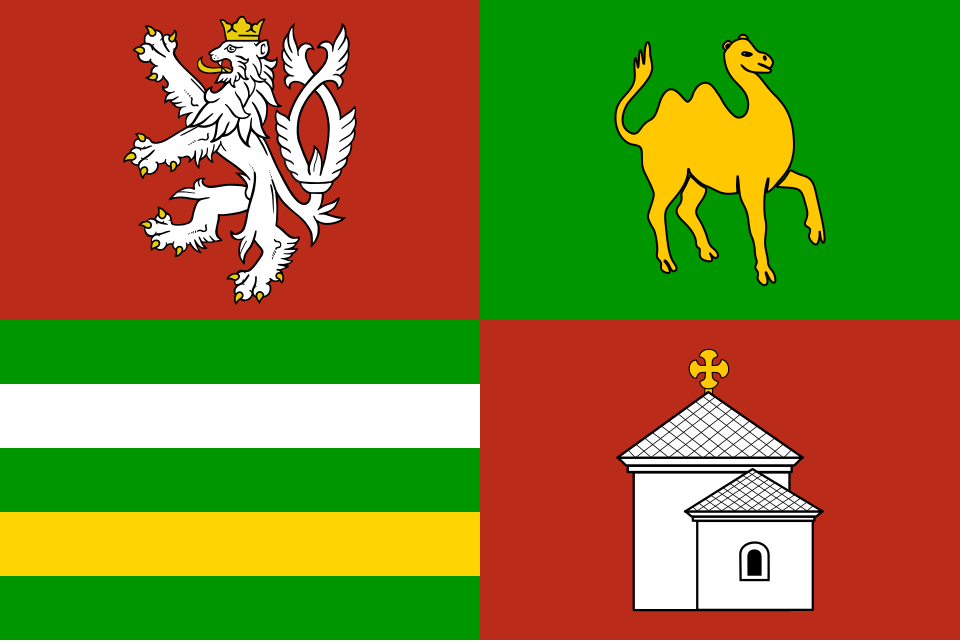
Plzeň Region Flag: Golden Camel, Czech Lion & Romanesque Church
A guide to the official Plzeň Region flag: the distinctive quartered design, historical symbols, origins and how it differs from similar Czech regional flags.
Plzeňský kraj lies in western Czechia against Germany. Its regional capital is Plzeň (Pilsen), known for industrial heritage and brewing; the Šumava foothills and river valleys extend through the region. The featured flag represents this particular region and should not be mistaken for the national flag or a municipal flag of a city with a similar name.
Plzeň Region flag at a glance
| Region | Plzeň Region (Plzeňský kraj) |
|---|---|
| Country | Czechia / Czech Republic |
| Administrative centre | Plzeň / Pilsen |
| Flag adoption | 31 January 2002 |
| Defining design | The Plzeň Region’s flag is quartered. The upper hoist is red with a white Czech double-tailed lion. The upper fly shows a golden camel on green; the lower hoist shows horizontal white and yellow bars over green; the lower fly depicts a white Romanesque church on red. |
What does the regional flag look like?
The Plzeň Region’s flag is quartered. The upper hoist is red with a white Czech double-tailed lion. The upper fly shows a golden camel on green; the lower hoist shows horizontal white and yellow bars over green; the lower fly depicts a white Romanesque church on red.
Unlike the national Czech flag, regional banners often quarter several older civic and royal heraldic devices. The layout and individual symbols are important for correct identification.
Meaning of the regional symbols
The camel comes from the coat of arms of Plzeň city. The lower stripes evoke important rivers and routes through western Bohemia, while the church represents a historic building tradition associated with Starý Plzenec. The white lion identifies the region as Bohemian.
The white double-tailed lion recurs in Bohemian heraldry. Other charges such as a camel, flower or river are the particular region’s own additions, not a new state flag for the whole country.
Historical background and adoption
The regional flag was adopted on 31 January 2002, following heraldic work after Czech self-governing regions were established in 2000. Its unusual camel separates it instantly from the more conventional eagle, lion and cross devices used elsewhere.
The present Czech self-governing regions date to the administrative reform around 2000; their flags were subsequently approved during 2001–2003. Their incorporated heraldic devices can be centuries older.
Where is this region?
Plzeňský kraj lies in western Czechia against Germany. Its regional capital is Plzeň (Pilsen), known for industrial heritage and brewing; the Šumava foothills and river valleys extend through the region.
The Czech name is Plzeňský kraj, and the regional centre is Plzeň / Pilsen. A regional flag is different from the municipal flag of the capital city.
Colours and detailed heraldry
The Plzeň Region’s flag is quartered. The upper hoist is red with a white Czech double-tailed lion. The upper fly shows a golden camel on green; the lower hoist shows horizontal white and yellow bars over green; the lower fly depicts a white Romanesque church on red.
Red and white identify the Bohemian lion quarters; other fields use blue, green, gold and various local charges. Use the exact original drawing when reproducing detailed arms.
Similar Czech regional flags compared
South Bohemia displays a heraldic rose and city towers, rather than Plzeň’s golden camel and church. Karlovy Vary Region also contains a fountain and mining tools, reflecting different western Bohemian traditions.
Because the white Bohemian lion appears in many Czech regional flags, compare the remaining quarters before naming a region. This prevents confusion between the district, the city and the administrative region.
How to draw or identify it
The camel is a heraldic feature of the city of Plzeň and should not be interpreted as a claim that camels historically lived in the region. Heraldic animal charges often originated in grants and historical narratives.
Start with a rectangle divided into the proper quarters, then trace the distinct charges from the original image rather than making a generic heraldic icon.
Regional flag versus Czech national flag
The Plzeň Region’s flag is quartered. The upper hoist is red with a white Czech double-tailed lion. The upper fly shows a golden camel on green; the lower hoist shows horizontal white and yellow bars over green; the lower fly depicts a white Romanesque church on red.
The national Czech Republic flag has a white stripe, a red stripe and a blue triangle from the hoist. Regional flags are separately authorised symbols of local self-government.
Frequently asked questions
Why is there a camel on the Plzeň regional flag?
It comes from the historic coat of arms of the city of Plzeň, whose golden camel is part of the region’s quartered design.
What is the regional name in Czech?
Plzeňský kraj.
When was the flag officially adopted?
31 January 2002.
Which city is the regional centre?
Plzeň / Pilsen.
Is the region a separate country?
No. It is a self-governing region of Czechia.
How does this regional flag differ from other Czech flags?
South Bohemia displays a heraldic rose and city towers, rather than Plzeň’s golden camel and church. Karlovy Vary Region also contains a fountain and mining tools, reflecting different western Bohemian traditions.
Can I reproduce the artwork?
Use the linked Wikimedia Commons original to check the official drawing, author and copyright status, and any rules concerning official heraldic use.
Sources and illustration credit
List of official Czech regional flags and adoption dates
Flags of the World: Czech regional symbols, historic explanations and variants
Wikimedia Commons: Flag of Plzen Region.svg. The PNG was proportionally scaled from this vector illustration. The source page provides artwork attribution and the applicable copyright status for Czech official symbols.
Czech Republic national flag for the official white-red-blue design.
Independent educational guide, reviewed 20 November 2026; not an official regional-government publication.