Tuscany Flag: Silver Pegasus, Red Stripes & Symbol History
What does the flag of Tuscany represent? Discover its design, symbols, regional history and how to distinguish it from Italy’s national flag and local civic banners.
Tuscany is central Italy’s region of Florence, Siena, Pisa, Arezzo and much of the Tuscan countryside. The flag emphasizes a cultural image rather than a literal scene of vineyards or hills. This guide covers the region’s flag, rather than confusing it with the flag of its capital or the national Italian tricolour.
Tuscany flag at a glance
| Place | Tuscany, Italy |
|---|---|
| Capital | Florence |
| Type | Italian regional flag |
| Modern adoption | 3 February 1995 |
| Key feature | Pegasus is a winged horse from classical mythology, not a unicorn. |
What does the Tuscany flag look like?
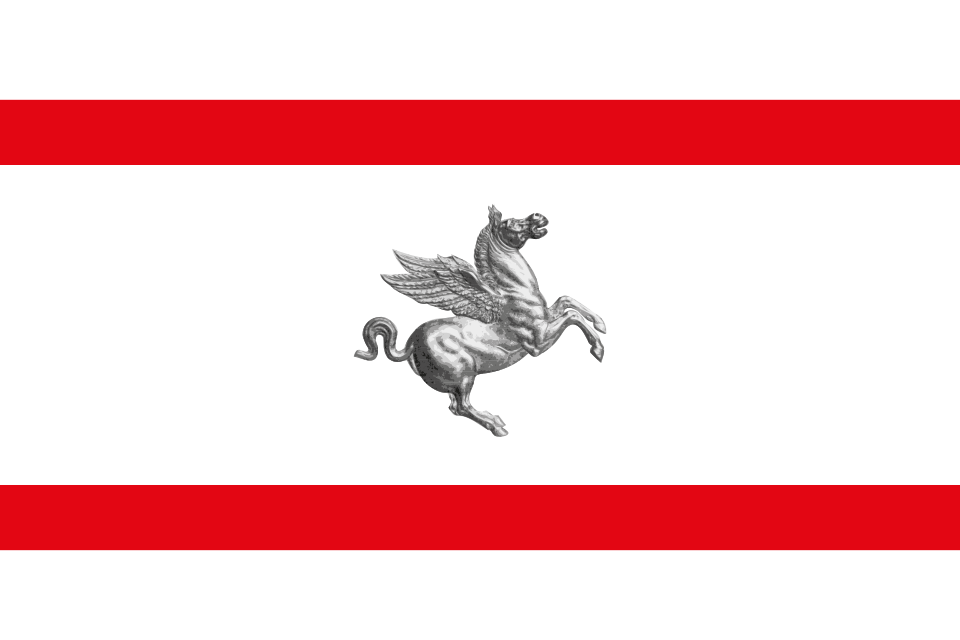
Tuscany’s regional flag has a white field between two red horizontal bars and places a silver winged horse, Pegasus, in the centre. It is a regional emblem, not the medieval flag of Florence.
The main visual clue is Pegasus represents creative and cultural ideals in Tuscan symbolism. The winged horse has an artistic pedigree connected to a sixteenth-century coin made by Benvenuto Cellini, which helped inspire its modern use.
Meaning of the central emblem
Pegasus represents creative and cultural ideals in Tuscan symbolism. The winged horse has an artistic pedigree connected to a sixteenth-century coin made by Benvenuto Cellini, which helped inspire its modern use.
Pegasus is a winged horse from classical mythology, not a unicorn.
What do the colours represent?
The strong red-and-white arrangement gives Tuscany a clear graphic identity, while the silver Pegasus is the distinctive feature. It should not be replaced by Florence’s red fleur-de-lis, the city’s separate civic symbol.
Read the colours together with the emblem rather than assigning invented meanings to every line or decorative detail.
When was the flag adopted?
The regional flag was adopted in 1995. Its Pegasus image draws on a 1537 coin associated with the Florentine artist Benvenuto Cellini and Cardinal Pietro Bembo, connecting the design to Italian Renaissance culture.
Recorded adoption dates refer to the modern regional banner. Older symbols can appear inside a much newer official flag.
Where is Tuscany in Italy?
Tuscany is central Italy’s region of Florence, Siena, Pisa, Arezzo and much of the Tuscan countryside. The flag emphasizes a cultural image rather than a literal scene of vineyards or hills.
Capital: Florence. The regional flag identifies the wider administrative region, not just its capital city.
How is it different from nearby flags?
Florence uses a red fleur-de-lis on white. Tuscany as a region uses Pegasus. The difference matters when identifying flags at sports events, exhibitions and public buildings.
The easiest way to distinguish the banner is to identify its central device and overall colour arrangement before looking at fine heraldic detail.
How to identify and draw the design
Tuscany’s regional flag has a white field between two red horizontal bars and places a silver winged horse, Pegasus, in the centre. It is a regional emblem, not the medieval flag of Florence.
For an exact reproduction, use the linked source image or the regional design specification; hand drawings should preserve the relative position of the main device rather than guessing complex line work.
Frequently asked questions
Is Tuscany a country?
No. Tuscany is an administrative region of Italy.
What is the main symbol?
Pegasus represents creative and cultural ideals in Tuscan symbolism. The winged horse has an artistic pedigree connected to a sixteenth-century coin made by Benvenuto Cellini, which helped inspire its modern use.
When was the modern flag adopted?
3 February 1995.
Is it the same as the Italian national flag?
No. Italy’s national flag is a vertical green-white-red tricolour; the regional banner is different.
How can I identify it quickly?
Tuscany’s regional flag has a white field between two red horizontal bars and places a silver winged horse, Pegasus, in the centre. It is a regional emblem, not the medieval flag of Florence.
Sources and image credit
Flags of Italy’s regions — reference index with regional histories
Wikimedia Commons — Flag of Tuscany.svg (original file, creator and reuse-license details). Displayed PNG is a scaled rendering; no editorial alteration of the emblem.
Educational explanation, not official government guidance. Checked 20 November 2026.