Maine (France) Flag: Royal Lilies, Le Mans and Provincial Arms
Understand Maine (France)’s historical flag: colours, heraldic meaning, regional origins and similar flags commonly confused with it.
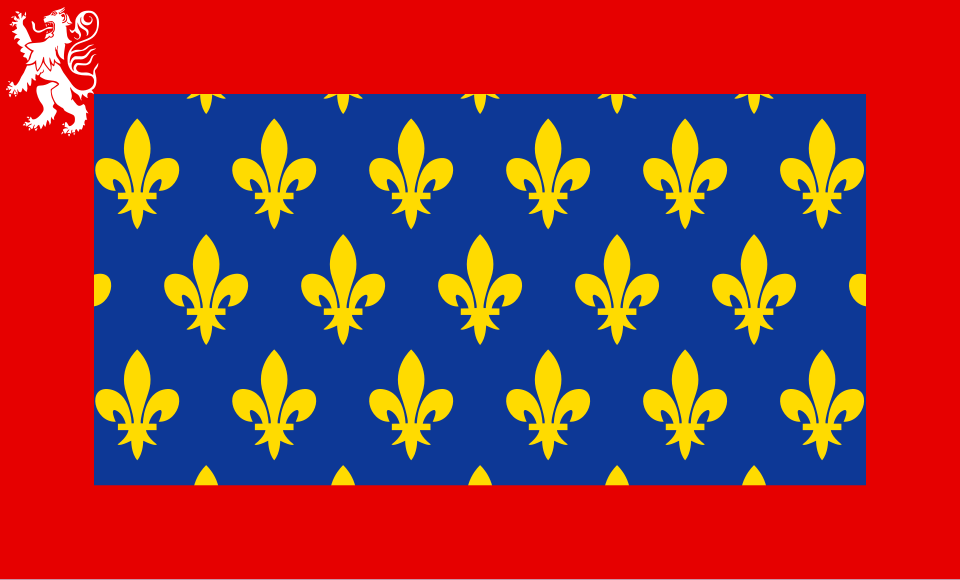
The old County of Maine centred on Le Mans and became entwined with the wider Angevin and Plantagenet dynastic story. Modern Sarthe and Mayenne are its principal successor areas; neither is identical to the present American state called Maine. The guide below identifies the historical design in the featured artwork and distinguishes it from today’s French national and regional flags.
Maine (France) flag at a glance
| Historic territory | Maine (France), France |
|---|---|
| Traditional centre | Le Mans |
| Modern region | Pays de la Loire (primarily Sarthe and Mayenne) |
| Flag type | Historical / cultural banner of arms |
| Distinctive design | The historical Maine banner is built around blue-and-gold royal heraldry, with golden fleurs-de-lis across the blue field. This is a French provincial arms banner, not the modern pine-tree flag designs associated with the US state of Maine. |
Design: how to recognise the banner
The historical Maine banner is built around blue-and-gold royal heraldry, with golden fleurs-de-lis across the blue field. This is a French provincial arms banner, not the modern pine-tree flag designs associated with the US state of Maine.
The exact artwork shown is a heraldic or historical provincial design. In France, this need not be identical to a present-day regional council’s logo or flag.
Why does it show these symbols?
The golden fleurs-de-lis reflect the heraldic links of medieval French territories and rulers. Maine was a contested county in the medieval politics of Anjou, Normandy and the French and English crowns.
The heraldic devices express older dynastic, civic or territorial relationships rather than a guaranteed literal explanation for every detail.
Flag history and historical status
The old County of Maine centred on Le Mans and became entwined with the wider Angevin and Plantagenet dynastic story. Modern Sarthe and Mayenne are its principal successor areas; neither is identical to the present American state called Maine.
Today’s French departments and regions were reorganised centuries after many of these symbols developed. A historical coat of arms is not a present-day independence claim.
Colours, field and heraldic identification
The historical Maine banner is built around blue-and-gold royal heraldry, with golden fleurs-de-lis across the blue field. This is a French provincial arms banner, not the modern pine-tree flag designs associated with the US state of Maine.
Use the recognised heraldic colour names: gold or yellow, silver or white, red and blue. Artistic shades vary, but the pattern and order of colours matter.
Where was this province?
Maine (France) centres on Le Mans. Its successor territory is principally associated with Pays de la Loire (primarily Sarthe and Mayenne).
A historical province and a modern elected region do not necessarily cover identical territory; the old name should be used with that distinction in mind.
How does it compare with similar flags?
Anjou’s traditional banner carries three gold lilies on blue with a red border, while Bourbonnais has a large diagonal red band. Some images of Maine show a dense field of lilies; check the original illustration rather than assuming all blue-lily flags name the same region.
A practical way to distinguish provincial arms is to check whether the red element is a label, diagonal bend or border, and count the animal or lily motifs if visible.
How to identify or draw the exact flag
The useful identification question is whether the image refers to Maine in France or Maine in the United States. On historical flag charts the French design uses heraldic lilies, not a pine tree or North Star.
Use the image shown above as a reference, and consult the linked original SVG for accurate curves, proportions and any fine detail.
What is the flag used for today?
The featured banner may be displayed in heritage, local history, education and regional-cultural contexts. Its role is not necessarily equivalent to an official governmental flag in modern France.
For a present French administrative council, use that council’s current approved insignia; do not replace it with a historical province’s banner without explanation.
Frequently asked questions
What does the Maine (France) flag look like?
The historical Maine banner is built around blue-and-gold royal heraldry, with golden fleurs-de-lis across the blue field. This is a French provincial arms banner, not the modern pine-tree flag designs associated with the US state of Maine.
What is the origin of the symbol?
The golden fleurs-de-lis reflect the heraldic links of medieval French territories and rulers. Maine was a contested county in the medieval politics of Anjou, Normandy and the French and English crowns.
Is this a flag of a current French administrative region?
No automatic equivalence should be assumed. The article covers a traditional provincial heraldic banner; the modern administrative relationship is Pays de la Loire (primarily Sarthe and Mayenne).
What is the main place associated with Maine (France)?
Le Mans.
Is this the French national flag?
No. France’s national flag is the blue-white-red vertical tricolour.
Can I download and reuse the illustration?
The source artwork is credited below with its declared licence. Follow the linked terms and check whether a specific official insignia has separate use restrictions.
Research and image credit
Flags of the World: historical provinces of France, heraldic background and sources
Wikimedia Commons: historical provinces versus official regional flags
Source image: Flag of Maine (France).svg. Artwork: Saebhiar, with later SVG refinements by Fry1989; released into the public domain by the source creator. Licence and reuse terms. The visible PNG was converted from the SVG and scaled; no flag-design elements were changed.
Read about the national flag of France for the blue-white-red tricolour.
Independent educational information; not a publication of the French government. Reviewed 20 November 2026.