East Riding of Yorkshire Flag: White Rose, Blue & Green Meaning
Why does East Riding’s flag have an upside-down Yorkshire white rose between blue and green panels? Explore the 2013 public vote, farming and maritime symbolism.
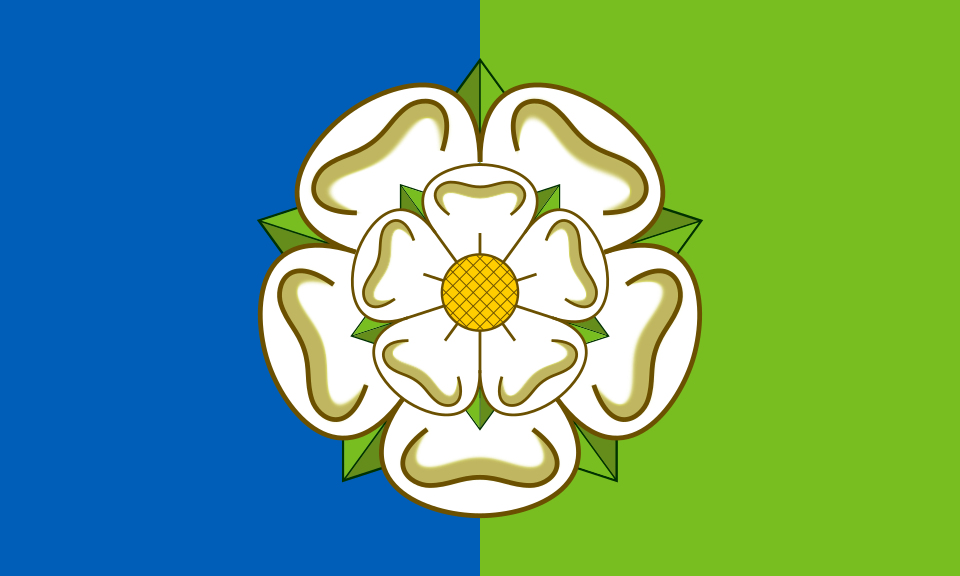
East Riding of Yorkshire has a distinctive flag whose details are often lost in small icons or confused with neighbouring county designs. The flag is split vertically into a blue hoist half and a green fly half, with a large white Yorkshire rose placed centrally over the boundary. This guide explains the main motifs, supported historical milestones and its place in the UK Flag Registry.
East Riding of Yorkshire flag at a glance
| Feature | Details |
|---|---|
| Region | East Riding of Yorkshire, historic riding of England |
| Registry type | Regional community flag |
| Flag date | 18 April 2013 |
| Designers | Trevor and Thomas Appleton |
| Field | Blue hoist half; green fly half |
| Central badge | White Yorkshire rose in East Riding orientation |
| Green meaning | Agriculture and eastern position |
| Blue meaning | Maritime links and Yorkshire connection |
| Ratio | 3:5 |
Historic county identities, modern geographic regions and local-government authorities are different things. The dated flag reference below distinguishes inherited heraldic designs from modern public flag registrations.
What does the East Riding flag look like?
The flag is split vertically into a blue hoist half and a green fly half, with a large white Yorkshire rose placed centrally over the boundary.
The rose has distinctive leaf and gold-centre details and is shown in an inverted East Riding orientation compared with the better-known all-Yorkshire white rose.
Why is the white rose inverted?
The white rose connects the riding with Yorkshire, while its orientation distinguishes the East Riding from the county-wide flag and other riding variations.
In the registered flag, the rose is not simply an arbitrary flower pasted over a bicolour. Its turning and placement are part of the regional design.
Why is the left half blue?
Blue evokes the maritime and coastal links of the East Riding and its connection with the wider Yorkshire identity, whose county flag is white rose on blue.
The Flag Institute specifies that blue appears at the hoist, or flagpole side, rather than treating the two halves as interchangeable.
What does the green half represent?
Green evokes the riding’s agricultural landscape and its position to the east within the historic Yorkshire structure.
The two fields therefore combine coastline and farming, two recurring regional themes. The rose bridges them to show an East Riding identity within Yorkshire.
When was the East Riding flag adopted?
The flag was selected on 18 April 2013 after a public competition launched by BBC Radio Humberside in January 2013.
A judging panel shortlisted six designs from numerous entries, and members of the public voted for the winning flag. The Flag Institute credits Trevor and Thomas Appleton.
What is an East Riding?
A riding is a historic subdivision of Yorkshire, formerly divided into East, North and West Ridings. The East Riding has its own continuing geographic and cultural identity.
The registered East Riding flag is not the same as a flag of the whole Yorkshire historic county, nor does it make the riding a separate nation.
East Riding vs Yorkshire county flag
The all-Yorkshire flag is a white rose on a solid blue field. East Riding keeps the rose but puts it across blue and green vertical panels.
Checking for a green right half is the fastest way to distinguish the East Riding design from the county-wide banner in a flag chart.
East Riding compared with the other Yorkshire ridings
The North and West Ridings also have registered regional flags using Yorkshire rose elements and different cross or field arrangements.
These are regional subdivisions, and their flags do not replace the all-Yorkshire design. The East Riding uses the white rose centrally on blue-and-green, rather than a red Scandinavian cross or another riding’s geometry.
How to draw the East Riding flag
Divide a 3:5 rectangle vertically with blue on the left and green on the right. Place a large white Yorkshire rose across the centre in the registered East Riding orientation.
Use the licensed vector to preserve the flower details. A quick recognition clue is ‘white rose over blue and green vertical halves’.
Frequently asked questions
When did East Riding adopt its flag?
18 April 2013.
Who designed it?
Trevor and Thomas Appleton.
What is the central emblem?
The white Yorkshire rose in a distinctive East Riding orientation.
Which side is blue?
The hoist or flagpole side.
What does green represent?
Agricultural land and its location in the east of Yorkshire.
How was it chosen?
A public vote after a BBC Radio Humberside design competition.
Is it the same as the Yorkshire flag?
No; the Yorkshire flag has a wholly blue background.
Is East Riding a separate country?
No; it is a historic riding within Yorkshire, England.
Official references and illustration credits
Flag Institute — East Riding of Yorkshire county flag
Image rights and attributionFlag illustration: Wikimedia Commons — East Riding of Yorkshire flag. The displayed PNG is a raster conversion of the Commons SVG. See the linked source for artist, copyright licence and applicable attribution/share-alike terms; official insignia may be subject to additional restrictions.
Independent educational guide. Research checked November 2026; no endorsement by the Flag Institute or local authorities is implied.