Tristan da Cunha Flag: Rock Lobsters, Albatrosses & Longboat
An oceanic coat of arms with two rock lobsters, four yellow-nosed albatrosses and a longboat makes Tristan da Cunha’s blue ensign distinctive.
Tristan da Cunha is an exceptionally remote inhabited island group in the South Atlantic, administered as part of the British Overseas Territory of Saint Helena, Ascension and Tristan da Cunha. Its flag depicts marine wildlife and the islanders’ seafaring tradition rather than a map or a group of stars.
The Tristan da Cunha’s official stamp issue about its flags describes the longboat, naval crown, albatrosses, lobsters and the motto. The historical flag register records the royal grant dated October 2002.
Tristan da Cunha flag at a glance
| Feature | Details |
|---|---|
| Territory | Tristan da Cunha, South Atlantic Ocean |
| Status | Part of Saint Helena, Ascension and Tristan da Cunha (UK Overseas Territory) |
| Main settlement | Edinburgh of the Seven Seas |
| Main flag type | British Blue Ensign |
| Coat of arms granted | 20 October 2002 |
| Shield animals | Four yellow-nosed albatrosses |
| Supporters | Two Tristan rock lobsters |
| Motto | Our Faith Is Our Strength |
These facts distinguish the flag’s official design from its heraldic origins, regional traditions or separate constitutional status. Use the references below if reproducing the flag for institutional purposes.
What does Tristan da Cunha’s flag look like?
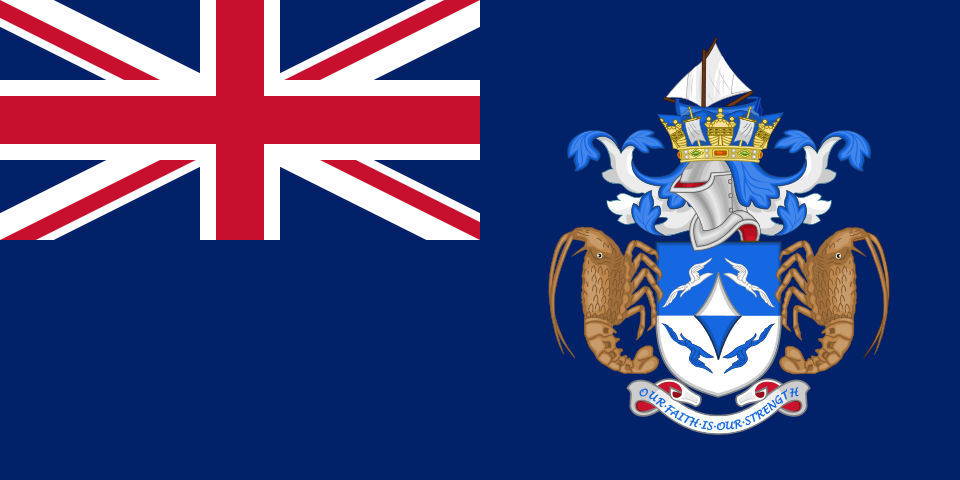
The field is a dark-blue British ensign, with the Union Jack in the upper quarter by the flagpole. At the fly is a coat of arms with a shield divided into blue and white shapes and featuring four albatrosses. Two large rock lobsters flank the shield.
Above the shield is a knight’s helmet, naval crown and a single white Tristan longboat. At the bottom sits a ribbon with the motto. In thumbnail images, the lobsters and small boat are more recognizable than the precise heraldic shapes within the shield.
Why are two lobsters on the flag?
Two Tristan da Cunha rock lobsters support the shield. This marine species is important in the islanders’ economy and is associated with the local lobster fishery. Its inclusion gives the flag a uniquely Tristan reference rather than using a generic British lion.
Tristan’s lobster is a marine crustacean; it should not be represented as a crab with a pair of broad pincers. The two supporters are displayed symmetrically, with their long antennae forming a striking outline around the shield.
What do the four albatrosses mean?
The shield includes four yellow-nosed albatrosses, reflecting important seabirds of the Tristan archipelago. The birds are depicted in flight with wings spread and arranged around contrasting blue-and-white central shapes.
The official heraldic description specifies the species group rather than simply calling them gulls or doves. They are distinct from Ascension Island’s wideawake seabirds, and the number four is part of the design rather than a claim that only four birds live on the island.
What is the small boat above the shield?
The crest depicts a Tristan longboat, a traditional craft associated with transport and life at sea in this isolated community. It sits above a naval crown, a symbol linked with maritime heritage.
The boat is not HMS Bounty, the historic ship associated with the Pitcairn Islands flag. On Tristan’s flag the local longboat celebrates island skills and mobility in a place where the ocean has long shaped daily life.
What does Our Faith Is Our Strength mean?
The ribbon reads OUR FAITH IS OUR STRENGTH. It is an English-language motto associated with the island community, reflecting a tradition of resilience, shared beliefs and mutual support in a remote setting.
The wording should be kept intact when describing the flag. It is not the Latin motto of South Georgia and it does not appear as large lettering across the plain blue field; it is written below the coat of arms.
When was Tristan da Cunha’s flag adopted?
The royal grant of arms and flag dates from 20 October 2002. The design gave Tristan da Cunha an official island-specific ensign instead of relying only on flags shared with the other parts of its overseas territory.
This modern adoption date should not be confused with the island’s early settlement history. The flag deliberately uses symbols drawn from much older local traditions, but the combination in its present official format belongs to the twenty-first century.
Is Tristan da Cunha an independent country?
Tristan da Cunha is not a sovereign state. It is a constituent part of the British Overseas Territory of Saint Helena, Ascension and Tristan da Cunha and maintains its own local institutions and distinctive flag.
The island group’s flag contains the Union Jack in the canton, but that does not mean it is identical to the flags of Saint Helena or Ascension Island. Each island part has separately developed symbols.
Tristan da Cunha vs Saint Helena and Ascension flags
Saint Helena uses a shield with a wirebird and ship by cliffs. Ascension Island features two green turtles, Green Mountain and seabirds. Tristan da Cunha has large lobsters, albatrosses and a longboat.
All three belong to one British Overseas Territory, but their flag badges emphasize different natural and historical identities. For identification, look for the lobster supporters and the English motto below the shield.
How to draw or recognize the Tristan da Cunha flag
Start with a navy-blue field and Union Jack at upper left. Put the arms on the right: four albatrosses and blue-and-white shapes on the shield, two rock lobsters flanking it, and a local boat above a naval crown.
Use the credited vector for an accurate image, because the species silhouettes, heraldic shape and motto lettering are complex. An uncomplicated flag quiz clue is ‘two lobsters and an island longboat‘: Tristan da Cunha.
Frequently asked questions
Why are lobsters on the Tristan da Cunha flag?
They represent Tristan rock lobsters, an important part of the island’s marine life and economy.
How many albatrosses are on the flag?
Four yellow-nosed albatrosses.
What is the boat on the crest?
A traditional Tristan da Cunha longboat.
What does the motto say?
Our Faith Is Our Strength.
When was the flag granted?
20 October 2002.
Is Tristan da Cunha in Africa?
It is a remote South Atlantic island group often grouped with African Atlantic territories for regional indexing; it is not part of an African sovereign state.
Is the flag the same as Saint Helena’s?
No. Saint Helena has a wirebird and ship, not lobsters and albatrosses.
Does Tristan da Cunha have its own government?
It has local administration within a British Overseas Territory and is not an independent state.
Official sources and illustration credits
Tristan da Cunha — official stamps telling the story of the flags
Tristan da Cunha — Flags of Tristan da Cunha
Flags of the World — Tristan da Cunha flag grant and heraldic description
The displayed PNG was rendered from the Wikimedia Commons vector: Tristan da Cunha flag. Vector flag illustration from the xrmap public-domain release on Wikimedia Commons; official insignia may be subject to separate restrictions.
The drawing is supplied for educational flag identification. It does not imply official endorsement. Content reviewed November 2026.