Melilla Flag: Blue Field, Medina Sidonia Arms & Hercules Pillars
Melilla’s flag is a sky-blue field carrying a complex ducal coat of arms. Learn about the pillars, motto, dragons and heraldic history behind this design.
Melilla is a Spanish autonomous city on the Mediterranean coast of North Africa. Its flag does not follow Spain’s national red-yellow-red format, nor does it copy the black-and-white triangular flag of Ceuta.
The legal definition is concise—sky blue with Melilla’s coat of arms—but the city’s official protocol rules explain the individual heraldic parts in detail. These sources allow a more accurate guide than guessing at the symbols from a small image.
Melilla flag at a glance
| Feature | Details |
|---|---|
| Place | Melilla, North African Mediterranean coast |
| Constitutional status | Spanish autonomous city |
| Background | Sky blue (azul celeste) |
| Central emblem | Historic municipal / Medina Sidonia arms |
| Shield features | Cauldrons, serpent heads, castles and lions |
| Supporters | Pillars of Hercules |
| Motto on pillars | Non Plus Ultra |
| Statutory basis | Organic Law 2/1995, Article 3 |
The quick facts distinguish the flag’s design from separate heraldic history and constitutional status. Official sources and artwork credits are included below for readers who need to check a legal description or specific emblem detail.
What does the flag of Melilla look like?
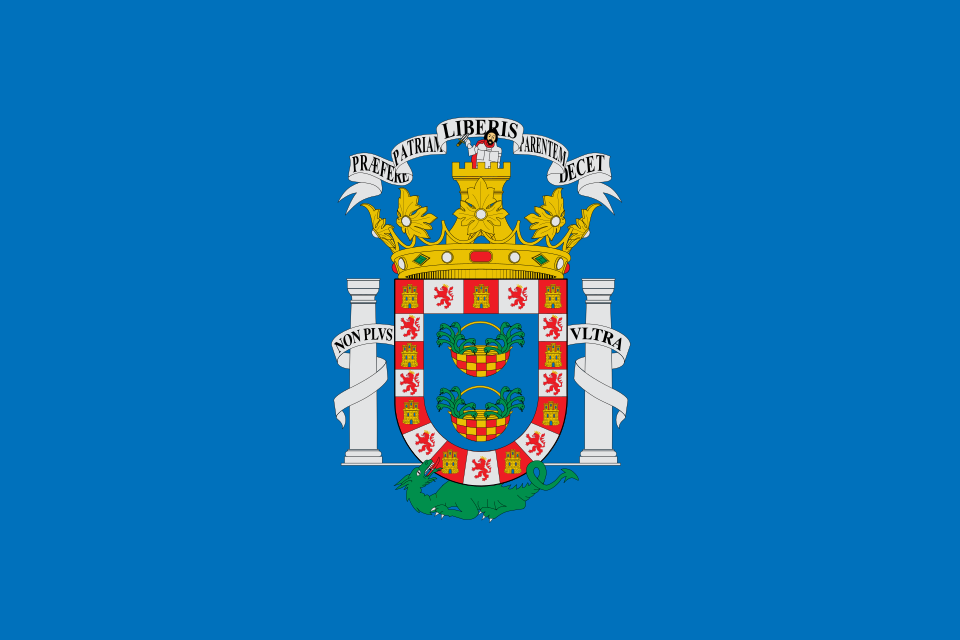
The background is a uniform light sky blue. Centred on the field is an elaborate coat of arms, much more detailed than the simple geometric symbols on many national flags. From a distance the flag appears as blue surrounding a large multi-colour emblem.
The official flag has no horizontal bands and no repeated stars. Its complexity comes from the municipal heraldic shield, crown, supporters and surrounding devices. For identification, sky-blue background plus a central historical coat of arms is the quickest clue.
How is the Melilla flag defined by law?
Article 3 of Organic Law 2/1995, Melilla’s Statute of Autonomy, defines the flag as the traditional sky-blue flag with the city’s coat of arms in its centre. This provides the current constitutional wording for the official symbol.
The city developed additional protocol regulations describing display on public buildings, especially alongside Spain’s national flag. These rules do not mean the flag was first invented in 1995; rather, the statute codified Melilla’s traditional symbols within its modern autonomous-city status.
Why does the flag use the arms of Medina Sidonia?
Melilla’s coat of arms is linked with the ducal House of Medina Sidonia, whose history is connected with the Spanish conquest of Melilla in 1497. The city’s official protocol regulation explicitly identifies the arms with that house.
That heraldic background explains why the emblem is complex: it is not an abstract logo designed solely for tourism. Its dynastic devices were inherited through the city’s history and are distinct from the present-day royal coat of arms on Spain’s national flag.
What are the two decorated pots inside the shield?
The central heraldic shield includes two chequered cauldrons in gold and red, with stylised green serpent heads. The city regulation describes the devices formally using heraldic terms and colours.
Small digital reproductions can make these details look like patterned circles or flowers. They are not decorative plates, and the snakes do not indicate a local zoological emblem. Their placement is part of the historic coat of arms rather than a modern map of the city.
Why are castles and lions around the shield?
The border incorporates alternating castles and lions associated with the historic royal arms of Castile and León. This imagery connects the duke’s arms with the heraldic tradition of the Iberian kingdoms.
The city’s legal text gives the border’s heraldic composition. It should not be described as nine individual forts in Melilla or as nine modern neighbourhoods; the castles and lions are inherited heraldic symbols.
What are the Pillars of Hercules and Non Plus Ultra?
Two large columns support the Melilla shield. They represent the Pillars of Hercules, a classical name associated with the two sides of the Strait of Gibraltar. The official protocol text says the pillars bear the motto Non Plus Ultra (‘Nothing further beyond’).
The phrase is historically linked with the ancient idea of the western limits of the known world. It should not be confused with Spain’s better-known modern Plus Ultra (‘Further beyond’) motto. The exact wording matters when explaining the Melilla emblem.
What is above and below the Melilla coat of arms?
Above the shield is a ducal crown associated with Medina Sidonia, and an unusual figure of Guzmán el Bueno shown in a heraldic story. The complete arms also include a banner bearing a Latin phrase and a green dragon beneath.
These details can be difficult to see at ordinary website thumbnail size. A high-resolution reference is preferable for readers studying heraldry. The emblem is not simply ‘a crown and two pillars’—the arms contain several historically distinct motifs.
Melilla vs Ceuta vs Spain: identifying the flags
Ceuta uses alternating black-and-white triangles around Portuguese-derived arms. Melilla uses a sky-blue field with the House of Medina Sidonia arms. Spain uses red-yellow-red stripes.
Both Ceuta and Melilla are Spanish autonomous cities on the African coast. They share constitutional status but their designs and earlier histories differ. Do not use one city’s flag as a generic banner for both.
How to draw or identify the Melilla flag
Start with a plain sky-blue rectangle. Add the official municipal coat of arms centred. For a reliable educational illustration, trace from a licensed, high-resolution heraldic file rather than improvising the very detailed cauldrons, serpent heads, castles, lions, pillars and ducal crown.
The basic quiz clue is ‘light-blue flag with an ornate ducal coat of arms’: Melilla. If you see black-and-white wedges, it is Ceuta instead.
Frequently asked questions
What colour is the Melilla flag?
Sky blue, officially described as azul celeste.
What is the symbol in the centre?
The historic coat of arms of Melilla, associated with the House of Medina Sidonia.
What do the Pillars of Hercules mean?
They are classical columns associated with the Strait of Gibraltar and appear as supporters of Melilla’s shield.
What does Non Plus Ultra mean?
‘Nothing further beyond,’ a traditional Latin phrase; it differs from the better-known Spanish motto Plus Ultra.
What are the two objects inside the shield?
Heraldic red-and-gold chequered cauldrons with green serpent heads.
Does Melilla’s flag have a dragon?
The full heraldic emblem includes a green dragon beneath the main shield.
When did Melilla define its flag in its autonomy statute?
Organic Law 2/1995 established the present statutory wording.
Is Melilla a country?
No. It is a Spanish autonomous city geographically on the North African coast.
Official references and illustration credits
Spain BOE — Melilla Statute of Autonomy, Organic Law 2/1995
City of Melilla — Official protocol and heraldry regulation
Spanish Society of Vexillology — Flag and coat of arms of Melilla
Flag drawing derived from Wikimedia Commons — Melilla flag vector. Flag vector credited to SanchoPanzaXXI, Wikimedia Commons, CC BY-SA 3.0. PNG rasterization for this guide, shared under CC BY-SA 3.0: https://creativecommons.org/licenses/by-sa/3.0/. Official symbols have separate usage provisions.
All flags are shown for educational identification. This article is independent of the government or institution represented. Information and source descriptions reviewed November 2026.