Yukon Flag: Green, White & Blue Stripes, Fireweed and History
What do the Yukon’s green-white-blue stripes, coat of arms and fireweed flowers mean? Learn Lynn Lambert’s winning 1967 design and its March 1968 effective date.
Yukon is one of Canada’s three northern territories. Its flag is especially useful for learning how northern landscapes can be represented through simple colors: forests, snow, rivers and lakes sit alongside an intricate coat of arms. It is also a documented example of a public flag-design competition leading to an official government symbol.
The Government of Yukon explains the three panels and symbols, and the Canadian Heraldic Authority gives the precise historical adoption dates. Official sources distinguish the contest in 1967 from the flag coming into force in March 1968.
The flag is not a Canadian provincial flag in legal terminology: Yukon is a territory, with distinct governmental arrangements. Its civic banner is part of Canada’s wider system of provincial and territorial symbols.
Yukon flag at a glance: colors, arms and adoption
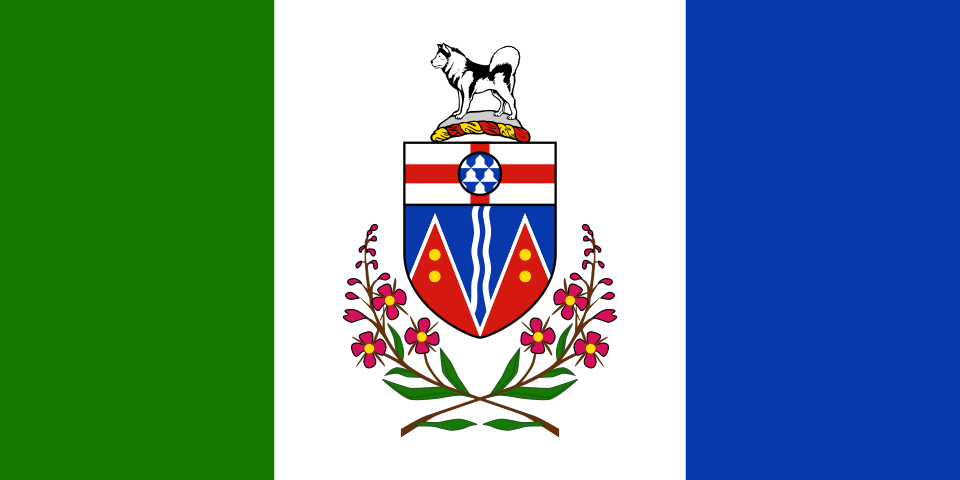
The banner uses vertical green, white and blue panels, with a wider white center section containing the territorial shield and crest above two crossed stems of fireweed. The government-approved imagery connects natural features and territorial history with the Yukon’s familiar floral emblem.
| Feature | What to know |
|---|---|
| Territory | Yukon, Canada (capital Whitehorse) |
| Field | Three vertical panels: green, white, blue |
| Green | Forests |
| White | Snow |
| Blue | Rivers and lakes |
| Centre | Territorial coat of arms and crest |
| Flowers | Two fireweed branches |
| Designer | Lynn Lambert |
| Ordinance assent | December 1, 1967 |
| Effective date | March 1, 1968 |
What do Yukon’s green, white and blue colors mean?
The Government of Yukon explicitly defines the three colors: green symbolizes forests, white represents snow, and blue stands for rivers and lakes. Those are broad features of the landscape rather than separate political parties or administrative districts.
Yukon contains extensive forested valleys, alpine and subarctic environments, and waterways including the Yukon River. The simple color arrangement is therefore grounded in recognizable geography. White is the center panel, not a decorative stripe added only behind the shield.
When identifying the flag, read the colors from the pole side: green first, white in the middle and blue at the fly. The central white band is wider than the two outside bands in the official design; it provides room for the coat of arms and fireweed.
Do the colors symbolize different towns?
No. The official interpretation concerns forests, snow and water. It does not assign Whitehorse, Dawson City and Haines Junction one stripe each. A flag chart that labels the bands as three municipalities would confuse geography with symbolism.
What is the coat of arms in the center?
The center contains Yukon’s coat of arms and crest. The shield features a red St George cross and a heraldic pattern associated with northern mountains, gold resources and the rivers of the Klondike. A malamute stands above the shield on a snowy crest.
The territorial government explains these details in its coat-of-arms section. The wavy blue-and-white lines evoke the Yukon River and gold-bearing creeks; the red mountain-like shapes with gold circles refer to natural terrain and mineral resources.
These small features are distinct from the flag’s three large vertical colors. A tiny online image may make the crest look like a generic animal, but the official emblem depicts a malamute rather than a polar bear or a moose.
The arms were approved in 1956, before the territorial flag contest. The flag later incorporated these established symbols, rather than creating every heraldic element from scratch in 1967.
Why are there two fireweed plants on the flag?
Fireweed, now usually called Chamerion angustifolium (historically Epilobium angustifolium), is the floral emblem of Yukon. It was selected in 1957, and the plant’s bright magenta flowers are familiar along roadsides and disturbed ground during the northern summer.
The flag has two stems of fireweed arranged below the coat of arms. They are not wheat stalks or green pine branches. Their appearance connects the institutional coat of arms with a readily recognizable wildflower.
The Yukon Government notes that fireweed is among the first plants to appear after a forest fire. That ecological characteristic provides useful context, but the official flower emblem is not meant to declare a separate historic wildfire date.
In an educational drawing, use the green stem and pink-purple flower spikes so the plants do not become generic red roses. A comparison with Saskatchewan’s red lily also helps readers distinguish two different Canadian floral emblems.
Who designed the Yukon flag?
The original design came from Lynn Lambert, a young Yukoner whose entry won a flag competition organized in connection with Canada’s 1967 Centennial celebrations. The Whitehorse branch of the Royal Canadian Legion sponsored the competition, and the Yukon Government reports that the design was selected from 137 submissions.
The concept united the three landscape colors with the existing Yukon coat of arms and fireweed, creating a regional emblem grounded in local geography. This process was different from flags that were simply extended from old British colonial ensigns.
The official heraldic register credits Lambert as the original concept creator. Although some sources associate the design with Haines Junction and others identify Lambert as being from Destruction Bay, these local descriptions do not change the documented attribution of the flag design.
For a classroom research activity, compare the Yukon flag design competition with the contests that produced Canadian flags in other regions and ask why a community might choose existing local emblems for a new banner.
Why do sources give both 1967 and 1968?
The Flag Ordinance was assented to on December 1, 1967, following the Centennial-year design competition. It took legal effect on March 1, 1968. The Canadian Heraldic Authority confirms both dates.
As a result, one source may say “adopted in 1967” while another says “officially accepted in 1968.” The complete chronology shows why those statements appear: the legal measure was passed in late 1967 and became effective in early 1968.
This distinction is worth preserving in an educational reference. The flag’s basic green-white-blue design did not need to change between those dates for the administrative milestones to differ.
Yukon’s coat of arms dates to 1956 and fireweed became its floral emblem in 1957. Those dates relate to elements placed on the flag, not to the flag’s final legal adoption.
Is Yukon a province or territory?
Yukon is a Canadian territory, not one of the country’s ten provinces. Canada has three territories: Yukon, Northwest Territories and Nunavut. Each has an official flag distinct from the Canadian national maple-leaf banner.
Yukon was established as a separate territory in 1898, after previously being part of the Northwest Territories. Its government and population have changed substantially since then, and its history includes the continuing cultures and governments of Yukon First Nations.
The green-white-blue flag is the territorial civic symbol of Yukon as a whole. Displaying it does not imply that the territory is a sovereign independent country, nor that one stripe is assigned to a particular Indigenous nation.
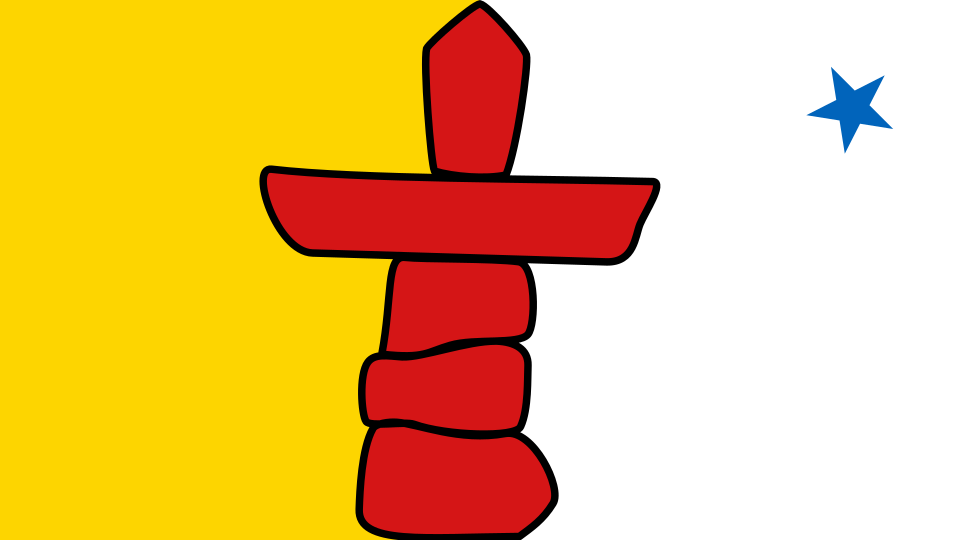
Another northern territorial symbol is the Nunavut flag, whose red inuksuk and blue North Star reflect a different Inuit-centered design history.
Yukon vs. Nunavut and Canadian provincial flags
Yukon: three vertical green, white and blue panels, with heraldic arms and fireweed. Nunavut: yellow and white fields separated visually by a red inuksuk, plus a blue North Star. The distinct center devices are the quickest identification clues.
Saskatchewan also uses green and yellow and has a flower on its flag, but its bands are horizontal and the flower is a western red lily. Alberta uses a solid blue field with a landscape shield, not Yukon’s three-panel layout.
Canada’s national flag has the red maple leaf in a white panel between red side bars. It should not be confused with Yukon’s separate regional emblem. For a quiz, ask which flag contains fireweed and a small shield in its central white panel; that answer is Yukon.
How to draw and recognize the Yukon flag
Begin with a wide rectangle and divide it into three vertical sections, making the white middle panel wider than either outer panel. Color the pole-side band green and the far-side band blue. Keep the center white and place the Yukon coat of arms there.
Under the coat of arms add two stems of magenta-flowering fireweed. If creating only a simple educational sketch, preserve the color order and floral arrangement even if the tiny shield details are simplified. For a precise reproduction, use official government artwork.
A common error is to draw a white-blue-green horizontal tricolour or to replace the fireweed with a maple leaf. Those are not the same design. Yukon is most easily identified by the green-white-blue vertical sequence plus its central arms and flowers.
Frequently asked questions
What colors are on the Yukon flag?
Green at the hoist, white in the middle, and blue at the fly.
What do the colors mean?
Green forests, white snow, and blue rivers and lakes.
What flowers are on the flag?
Two stems of fireweed, Yukon’s floral emblem.
Who designed the flag?
Lynn Lambert, whose design won a 1967 territory-wide competition.
Why is there a shield in the middle?
It is Yukon’s coat of arms, approved in 1956, expressing historic northern geography and resources.
When was Yukon’s flag adopted?
The ordinance was assented to on December 1, 1967 and took effect March 1, 1968.
Is Yukon a Canadian province?
No. Yukon is one of Canada’s three territories.
Is Yukon’s flag the same as Nunavut’s?
No. Nunavut’s flag has a red inuksuk and blue star against yellow and white fields.
Does the center shield show a polar bear?
No. The crest of Yukon’s coat of arms shows a malamute on snow.
Official references and illustration credits
Government of Yukon — official symbols and flag
Canadian Heraldic Authority — Flag of Yukon
Canadian Heritage — Yukon Territorial Symbols
Yukon Legislature — 1967 Flag Ordinance historical account
Flag drawing imported from Wikimedia Commons and rendered from SVG as a PNG. Please check the original file’s creator and reuse license before redistributing. Comparison illustrations are from the credited Wikimedia Commons flags already used in linked FlagExplorers guides.
Official symbols may have specific institutional use requirements independent of copyright. Factual references reviewed November 2026.