Balearic Islands Flag: Purple Castle & Red-Yellow Stripes
Why does the Balearic Islands flag have a white castle in a purple corner? Explore its four red stripes, medieval heraldic roots and official autonomy statute.
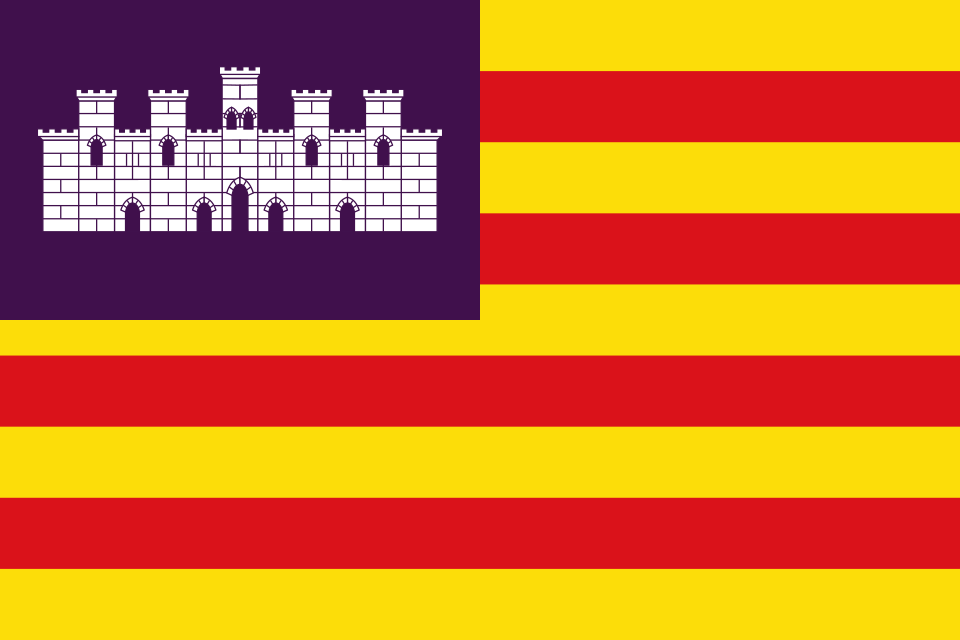
The Balearic Islands of Spain include Mallorca, Menorca, Ibiza and Formentera. Their regional flag is closely related to the red-and-yellow banners of other former Crown of Aragon territories, yet its purple castle makes it distinct at a glance.
The regional flag is not simply Catalonia’s Senyera with the colors changed. It retains four red bars on yellow but adds an unusual white castle in a purple hoist canton. The Balearic Islands Statute of Autonomy spells out the castle and stripe design in Article 6.
This guide explains the flag’s modern legal definition, the inherited heraldic bars and how it differs from the separate flags of individual islands and towns.
Flag of the Balearic Islands at a glance
The regional banner has four red horizontal bars across a yellow field, creating an alternating red-and-yellow pattern. Its upper corner nearest the pole is purple and features a white five-towered castle, a separate heraldic symbol within the design.
| Flag feature | Description |
|---|---|
| Region | Illes Balears / Islas Baleares, Spain |
| Background | Yellow with four red horizontal bars |
| Hoist canton | Purple rectangle in upper hoist |
| Canton emblem | White five-towered castle |
| Legal definition | Article 6, 2007 Statute of Autonomy |
| Historic roots | Crown of Aragon red-and-gold heraldry |
| Main islands | Mallorca, Menorca, Ibiza, Formentera |
What does the castle on the Balearic flag mean?
The white castle is a historic heraldic feature set inside a purple upper-hoist rectangle. The 2007 Statute identifies it as a five-towered castle, which is the most useful factual detail for recognizing an accurate image.
Heraldic castles are often used to recall political authority, fortified towns and historical territorial emblems. For the Balearic flag, the castle belongs to a design whose roots are connected to medieval royal and island symbolism. It should not automatically be identified as a precise picture of one surviving building without evidence.
In common illustrations the castle looks like a row of white towers with battlements. At small sizes its five towers can be difficult to count. A high-quality educational image should preserve the castle’s broad structure rather than replace it with a generic palace, fortress wall or crown.
Why does the flag have a purple upper corner?
Balearic regional legislation describes a purple canton in the upper corner next to the pole. It is visually distinct from the red and yellow bars, allowing the white castle to stand out from the rest of the banner.
The purple section is not the same as Valencia’s royal blue band. Valencia uses a vertically extended blue hoist section with a golden crown. The Balearic flag uses a shorter purple rectangle confined to the upper hoist, with a white castle. The placement is one of the easiest distinctions between the designs.
The exact shades of purple and red can vary in photographs due to lighting and digital display. For official use, follow government symbol specifications rather than a souvenir rendering, but the purple-white-castle and red/yellow bars are the essential recognition features.
Why are there four red bars on yellow?
The four red bars on a yellow background derive from the medieval heraldic tradition of the Crown of Aragon. Mallorca and other parts of the Balearic archipelago were historically linked to that political system, so the related red-and-gold design appears across several flags of the western Mediterranean.
The number four does not refer to a modern count of exactly four inhabited islands. The archipelago contains several other islands and islets, and the historic heraldic bars have a different origin. It would be inaccurate to claim that each red bar is an official symbol for Mallorca, Menorca, Ibiza or Formentera.
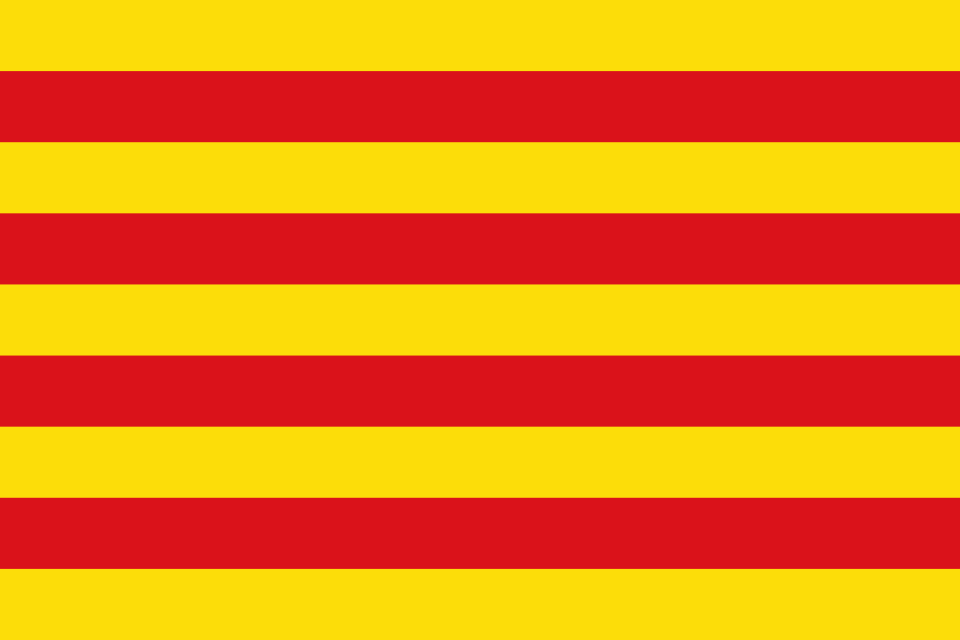
One quick comparison is with the Catalan Senyera, which uses the red and yellow bars alone. The Valencian flag adds a crowned blue hoist band, while Balearic Islands add the purple castle canton. Their common bars reflect history, not identical current legal flags.
When was the Balearic Islands flag officially adopted?
The design’s modern official status comes from the autonomous community’s legal framework. The 1983 Statute of Autonomy established the autonomous community and recognized regional symbols, while the revised 2007 Statute specifies the flag in Article 6.
The statute describes the four red horizontal bars on yellow and the purple upper hoist quarter with a five-towered white castle. These statements provide a reliable modern reference even though the heraldic elements themselves are much older.
Flag images reproduced for institutions should follow the law and relevant regional rules. The presence of alternative political flags or municipal banners on the islands does not replace the symbol of the autonomous community as defined in its statute.
Does the flag belong to Mallorca, Menorca, Ibiza or all the islands?
The flag represents the autonomous community as a whole, not just Mallorca or Palma. Its legal use covers the shared regional institutions responsible for the Balearic Islands.
Individual islands and municipalities can have other traditional flags and coats of arms. A photo of a banner at a local festival in Menorca, for example, may depict a municipal or island flag rather than the regional banner. When identifying an image, check for the purple castle canton and four red bars before assuming it is the regional flag.
The distinction is especially useful for travelers and students. The archipelago includes Mallorca, Menorca, Ibiza and Formentera, but not every local symbol is the same as the autonomous community’s official design.
Balearic vs Catalonia vs Valencia flags
The three flags share red-and-gold heraldry, but each has a different element next to the pole. Catalonia has no special corner or vertical band; Valencia adds a royal golden crown over a blue vertical band; the Balearic Islands use a white castle inside a purple upper corner.
These distinctions are more dependable than guessing from shades of red or yellow. In a photograph a flag may be folded and hide some of the stripes, but the hoist-side symbol often gives the correct identification.
For a broader Spanish comparison, Andalusia uses green-white-green and the Canary Islands use white-blue-yellow vertical stripes. Regional flags within one country can therefore be completely different even though they share the same national flag.
How to draw the Balearic Islands flag
Begin with a horizontal yellow rectangle. Add four red horizontal stripes across the field. Then reserve the upper-left corner next to the pole for a purple rectangular area.
Inside the purple canton draw a white five-towered castle, keeping the broad crenellated wall and tower structure recognizable. The castle should not be placed at the centre of the entire flag or in a blue vertical strip; either change would make the design resemble a different emblem.
A classroom identification test can compare the castle canton with Valencia’s royal crown and Catalonia’s plain stripes. The result demonstrates how a small added heraldic symbol can distinguish three historically related regional banners.
Frequently asked questions
What are the colors of the Balearic Islands flag?
Red and yellow horizontal bars with a purple upper hoist corner and a white castle.
What does the white castle represent?
It is a historical heraldic emblem; the official statute specifies a castle with five towers.
How many red stripes does the flag have?
Four horizontal red bars on a yellow background.
What color is the castle canton?
Purple, in the upper corner next to the flagpole.
Is the Balearic flag the same as the Catalan flag?
No. The Balearic flag adds a purple canton with white castle; Catalonia’s Senyera has only the red/yellow bars.
Is the castle the same as Valencia’s crown?
No. Valencia has a golden royal crown over a blue hoist band, while the Balearics have a white castle in a purple canton.
When was the flag legally defined?
The region’s modern statute, revised in 2007, describes the flag in Article 6.
Does the flag represent only Mallorca?
No. It is the flag of the Balearic Islands autonomous community as a whole.
Why does the flag have four bars?
The four red bars derive from Crown of Aragon heraldry, not from a modern list of four named islands.
Official sources and image credits
Spain Official Gazette — Balearic Statute of Autonomy, Article 6
Sociedad Española de Vexilología — Illes Balears flag
Wikimedia Commons — Balearic Islands flag, CC0
Wikimedia Commons — Catalan flag for comparison
The Balearic flag is by Xavier Conde Rueda, distributed as CC0 via Wikimedia Commons. Rasterized to PNG; comparison image of Catalonia from Commons.
Illustrations were imported into the FlagExplorers media library as PNG renditions of Wikimedia Commons source files. Graphic reproduction should observe any separate institutional use of protected official emblems. Sources checked November 2026.